
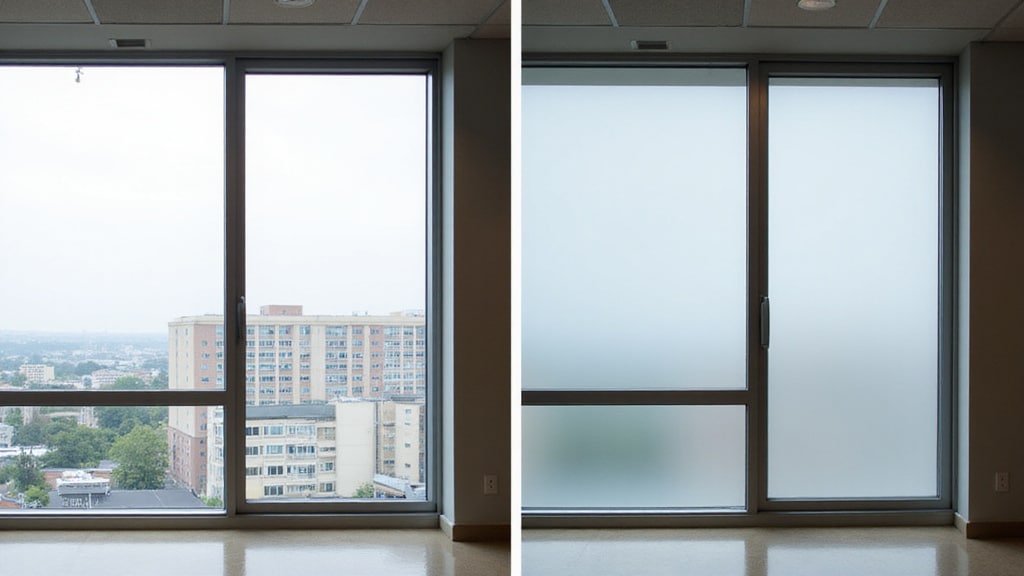
You can dramatically bolster your door’s strength and insulation by upgrading to modern door glass inserts featuring tempered glass, multi-pane technology, and factory-applied fastening systems. Tempered glass improves strength 4-5 times compared to standard glass, while dual or triple-pane configurations with low-E coatings reduce heat loss by up to 71%. Impact-rated frames with reinforced materials and mechanical fasteners distribute loading forces across multiple anchor points, providing superior durability. These integrated systems deliver both security and energy efficiency that’ll transform your home’s performance.
Understanding Door Glass Inserts: Definition and Components
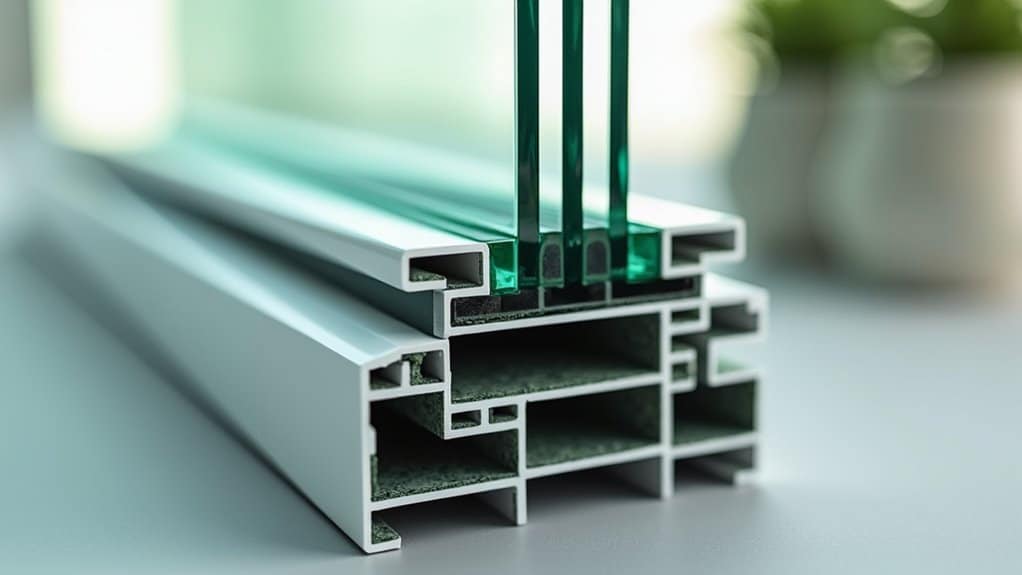
Because they’re fundamental to both residential and commercial doors, door glass inserts, commonly called lites or glazing, deserve closer examination. You’ll find that these glass panels integrate into door frames composed of vertical stiles and horizontal rails that provide structural support. The stop moulding attached to the door frame aligns the glass insert within the frame and prevents it from shifting during operation.
Understanding insert glazing configurations is essential, as you can select single, double, or triple-pane options based on your performance requirements. Each configuration requires specific spacer material selection, typically aluminum or foam, to maintain sealed airspaces between panes. The choice between clear, textured, or tempered glass significantly impacts both the visual appeal and safety characteristics of your door insert.
Core components you should recognize include the glass panes themselves, which form the primary functional element. Seals and gaskets prevent air and moisture infiltration at the edges. Optional Low-E coatings bolster thermal performance. Muntins or frames hold everything securely in place, creating a complete assembly that balances visibility with structural integrity and energy efficiency. Grilles-Between-the-Glass options provide decorative divided lite designs while maintaining easy glass cleaning access.
Compatible Door Types and Materials
When you’re selecting a door with glass inserts, you’ll find that fiberglass, steel, and wood options each offer distinct advantages based on your specific needs. Fiberglass doors provide exceptional durability and weather resistance with narrower glass panels, while steel doors deliver straightforward installation and impact-rated glass compatibility for bolstered security. Wood doors, particularly primed options, give you the widest selection of decorative glass designs and larger insert sizes to improve your entryway’s aesthetic appeal. Plexiglass inserts are impact-resistant and shatter-resistant, making them a safer alternative to traditional glass for all door material types. For enhanced insulation and energy efficiency, consider choosing glass inserts with double-glazing with argon gas to reduce heat transfer and lower utility costs. Pairing durable glass units with multi-point locking systems ensures a safe and secure entrance that complements any door material choice.
Fiberglass Door Compatibility
Fiberglass doors offer exceptional versatility across residential, commercial, and institutional applications, delivering superior durability and thermal performance that you won’t achieve with traditional materials. You’ll benefit from laminated or pultruded fiberglass skins paired with polyurethane foam cores, which provide excellent insulation and weatherability. Aluminum or composite-reinforced edges strengthen your door’s structural integrity while minimizing maintenance concerns. You can select polystyrene cores in heavy-duty applications for amplified flame spread control, and multi-layer fiberglass reinforcement with vertically and horizontally oriented fibers optimizes load distribution. These doors meet ENERGY STAR standards, comply with FDA and USDA guidelines for institutional use, and deliver up to five times better insulation than solid wood. Fiberglass doors are highly resistant to forced entry and can meet fire safety standards in demanding environments. Unlike wood doors that require regular painting and staining, fiberglass doors need only regular cleaning with a damp cloth] to maintain their appearance. You’ll appreciate their compatibility with tempered, laminated, and low-E glass panels, maintaining thermal performance while boosting security. The closed cell foam core construction creates a monolithic design that provides an extreme strength-to-weight ratio, making fiberglass doors ideal for environments that destroy traditional materials like stainless steel.
Steel and Wood Options
While fiberglass doors dominate the market for thermal performance, steel and wood remain viable alternatives that you’ll want to ponder based on your specific security, aesthetic, and maintenance requirements.
Steel doors deliver superior security benefits and exceptional steel door longevity when paired with tempered or impact-resistant glass inserts. You’ll appreciate their foam cores and thermal breaks, which provide strong heat transfer barriers comparable to fiberglass options. Steel frames accommodate double or triple-glazed Low-E panels effectively. Tight seals around the door glass panel prevent drafts and water infiltration, enhancing the overall energy efficiency of steel door installations. Steel doors can withstand extreme force without warping, making them an excellent choice for homeowners prioritizing security.
However, wood door suitability depends heavily on your commitment to maintenance. Wood doors offer traditional aesthetics but present challenges: they’re susceptible to warping, cracking, and moisture damage around glass openings. You’ll need high-quality weatherstripping and Low-E coatings to compensate for wood’s inferior insulating properties. Double or triple glazing provides additional insulation layers that wood doors benefit from significantly. While viable, wood requires ongoing care to maintain integrity around glass installations.
Design Options: From Clear to Textured Glass
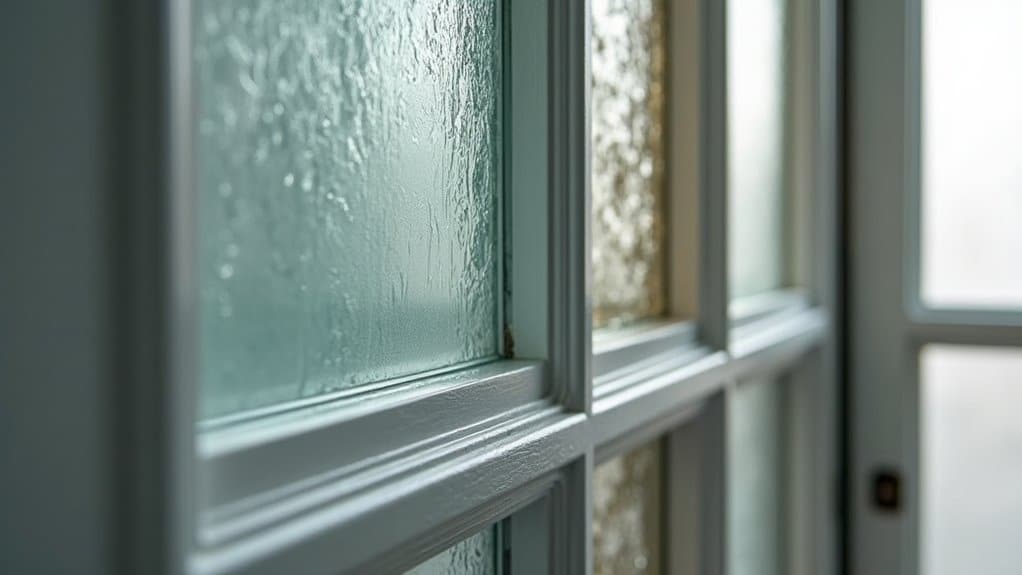
Because door glass inserts meaningfully impact both your home’s aesthetic and functional performance, selecting the right design is essential to balancing visibility, privacy, and energy efficiency.
| Glass Type | Primary Benefit |
|---|---|
| Clear | Maximum light transmission |
| Textured | Glare reduction and privacy |
| Frosted | Uniform obscurity with brightness |
| Decorative | Custom artistic expression |
| Privacy | Obscurity with integrated blinds |
You’ll find that clear glass amplifies natural light and suits modern aesthetics, while textured varieties diffuse brightness and augment privacy through reeded or fluted patterns. Frosted inserts offer versatility across contemporary and classic designs, incorporating edge detailing and decorative patterns for customization. Specialty options feature stained, etched, or painted motifs with ornamental caming. Privacy glass inserts balance security with aesthetics, often featuring integrated blinds between panes. Low-E coatings in triple-pane construction filter harmful UV rays while improving thermal insulation and sound reduction, ensuring your choice fortifies both form and function. Available caming colors such as Nickel, Black Chrome, and Brass provide additional customization to match your door’s aesthetic. The vast selection of designs available allows you to customize your existing door frames without committing to an entirely new installation.
How Tempered Glass Strengthens Door Inserts
Beyond selecting your preferred glass design, you’ll want to understand how material treatment directly impacts your door insert’s performance and safety. Tempered glass undergoes heating and rapid cooling, creating surface compression and internal tension that delivers improved structural integrity. You’ll gain four to five times greater strength compared to standard annealed glass.
This treatment provides three critical advantages:
- Impact resistance: The compression layer absorbs force from accidental impacts and attempted break-ins, shattering into harmless fragments rather than dangerous shards
- Thermal capacity augmentation: Your door withstands temperature fluctuations up to 250°C without cracking, maintaining stability in direct sunlight or extreme climates
- Durability: Amplified resistance to scratches and mechanical wear guarantees long-term clarity and function
You’re also fulfilling safety code requirements for entryways, substantially reducing injury risk while bolstering overall door performance.
Impact-Rated Frames and Reinforced Materials
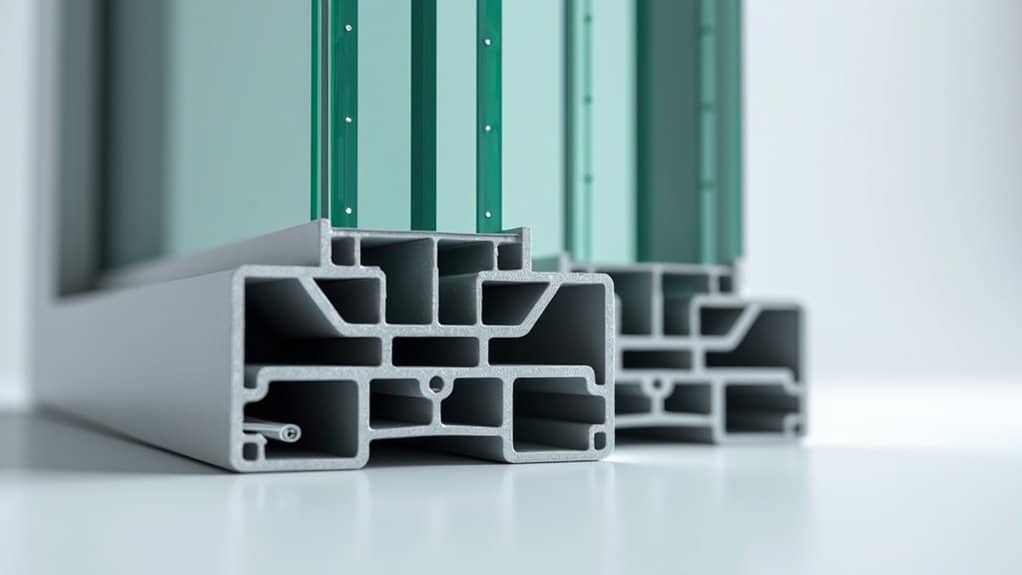
You’ll find that impact-rated frames employ reinforced construction methods, including ME and SE Series frames supporting openings up to 8’0″ x 8’0″, that work in tandem with aggressive adhesive technology to create a unified, structurally sound assembly. These frames integrate beveled edges and tighter tolerances that minimize gaps between door and frame, reducing water infiltration while maintaining the frame’s ability to withstand design pressures up to ±150 PSF. Your door’s resistance to hurricane-force winds and missile impact depends on this frame-and-material synergy meeting rigorous testing standards such as IBC, FBC, and ASCE 7-10 protocols.
Reinforced Frame Construction
The structural foundation of any impact-rated door hinges on its frame’s ability to withstand extreme environmental forces. You’ll find that reinforced frame integrity directly determines your door’s comprehensive structural performance metrics during high-wind events.
Modern impact-rated frames incorporate advanced construction techniques:
- Multi-chambered profiles that improve both structural rigidity and thermal insulation properties
- Welded construction methods that provide superior strength and durability, especially in demanding environments
- Specialized anchoring systems with galvanized fasteners that secure frames to your home’s structural elements
You benefit from these engineered designs because they distribute wind pressures evenly across the frame’s profile. Proper installation proves critical, even premium materials fail without correct anchoring. Miami-Dade County’s certification standards guarantee your frame withstands hurricane-force winds exceeding 140 mph while maintaining water-tight integrity throughout severe weather events.
Aggressive Adhesive Technology
Pressure-sensitive aggressive adhesive, factory-applied to door glass insert frames, creates a critical structural bond that works in tandem with mechanical fasteners to lock glass and frame components into your door slab. This dual-redundancy system distributes stresses during impact events, maintaining frame integrity against wind pressure and debris collision. Advanced adhesive application techniques guarantee optimal perimeter coverage, while rigorous adhesive testing procedures validate sustained attachment under extreme conditions. The aggressive adhesive accommodates thermal expansion between composite, fiberglass, or metal frames and insulated glass units, preventing bond failure despite environmental fluctuations. You’ll benefit from heightened airtight sealing that improves thermal insulation and reduces air leakage. Factory-application guarantees consistent quality across your door products, minimizing long-term maintenance issues from shifting or warping while supporting hurricane impact-resistance requirements.
Impact Resistance Standards
While aggressive adhesive technology secures glass within door frames, the frame itself must withstand violent impact forces that adhesive alone can’t resist. You need impact-rated frames engineered from aluminum, steel, or vinyl to absorb energy from wind-borne debris strikes. Steel frames deliver maximum rigidity, particularly critical for extreme weather exposure.
Your door’s structural integrity depends on reinforced construction elements:
- Laminated glass with plastic interlayers keeps inserts intact post-breakage, resisting intrusion
- Cold-rolled steel and 18-gauge face skins provide superior impact resilience
- Reinforced perimeter channels that mechanically interlock or weld increase energy absorption
You must verify your frame carries Florida Building Commission approval, ensuring it meets ASTM E1996 and TAS standards. Doors require testing for pressure ratings up to 170 psf, with proper installation per manufacturer specifications guaranteeing frame effectiveness.
Hurricane-Resistant Glass for Coastal Properties
Three critical factors, wind speed, flying debris, and water intrusion, drive the engineering of hurricane-resistant glass for coastal doors. You’ll benefit from laminated construction featuring flexible polymer interlayers that absorb impact energy, keeping glass fragments contained even under extreme stress.
Your coastal property requires compliance with Florida’s High Velocity Hurricane Zone standards, mandating impact-resistant glazing rated for projectiles exceeding 200 mph. These systems withstand wind pressures up to 3,510 Pa while maintaining structural integrity.
Beyond protection, you gain significant advantages: dual or triple-pane configurations reduce heat transfer, low-emissivity coatings improve thermal performance, and ultra-slim sightlines preserve exterior aesthetic appeal. Storm shutter integration seamlessly complements hurricane-resistant glass, offering layered defense. Approved products meet stringent TAS standards, ensuring your investment protects both safety and energy efficiency year-round.
Factory-Applied Fastening Systems
Factory-applied fastening systems engineer the structural connection between your door frame and glass insert, establishing the foundation for both security and performance. These systems employ automated clamping mechanisms that apply uniform pressure along glass edges, minimizing movement and breakage risk under impact. You’ll find several proven technologies available:
- Wedge-Lock™ systems: Steel bars tightened via accessible jaw screws secure inserts with consistent compression
- Clip-on and modular assembly options: Enable rapid installation and removal without compromising structural integrity
- Mechanical fasteners: Screws and bolts distribute loading forces across multiple anchor points, reducing stress concentration
Factory systems accommodate thick glass (10, 19mm), enhancing impact resistance. Stainless steel and aluminum alloys guarantee durability, while precision alignment mechanisms maintain structural integrity throughout the door’s lifespan without requiring hardware disassembly.
Multi-Pane Technology for Enhanced Durability
Multi-pane glass constructions utilize layered architecture to deliver superior durability and performance where single-pane systems fall short. You’ll benefit from augmented structural integrity through multiple glass layers and warm-edge spacers that minimize heat transfer while preventing condensation buildup. The extra thickness considerably improves multi-pane noise reduction, ideal for high-traffic environments. Multi-pane condensation prevention works by keeping interior surfaces warmer, protecting your seals and frames from mold and water damage. Triple-pane configurations excel in extreme climates, maintaining consistent temperatures and reducing energy costs greatly. The argon gas filling between panes reduces heat conduction, while Low-E coatings reflect thermal energy effectively. You’re investing in a system that optimizes durability, minimizes maintenance, and delivers measurable long-term performance advantages.
Maximizing Insulation With Double and Triple-Pane Inserts
You’ll optimize your door’s thermal performance by leveraging the air space between panes, where argon or krypton gas reduces heat transfer far more effectively than standard air. Low-E coatings on triple-pane inserts reflect infrared radiation while transmitting visible light, delivering superior seasonal efficiency compared to double-pane alternatives. When you upgrade from double to triple-pane configurations, you’ll realize tangible energy savings, up to 3% improvements in heating costs, while gaining improved condensation resistance and extended durability of surrounding door materials.
Air Space Thermal Benefits
Because thermal performance depends critically on air space configuration, understanding how gap dimensions and gas fills work together is essential for optimizing door glass inserts. You’ll achieve maximum efficiency by maintaining precise spacing between panes, which directly impacts your door’s insulating capability.
Optimal air space performance requires:
- Manipulation of convection currents through inert gas fills like argon, which reduce internal air movement and improve thermal resistance by 30%
- Proper gap dimensions between 1/2 to 3/4 inches in standard inserts, or 2-1/2 to 3 inches in door insert assemblies
- Sealed integrity that maintains gas stability throughout the window’s service life without degradation
You’ll reduce heat loss by 40-50% through correct air space configuration. Triple-pane systems provide additional thermal breaks, delivering superior U-Factor ratings compared to double-pane alternatives and substantially lowering your HVAC workload.
Low-E Coating Efficiency
Low-E coatings represent a critical advancement in door glass insert technology, delivering substantial thermal performance improvements by reflecting infrared radiation back through the glass rather than allowing it to escape. You’ll find both hard coat and soft coat effectiveness offer compelling benefits. Hard-coat applications occur during glass manufacturing, providing durability suitable for storm doors. Soft-coat options, applied post-manufacturing, achieve superior heat reflection efficiency, though soft coat emissivity oxidizes when exposed to air, requiring argon or krypton gas preservation. Double-pane inserts with Low-E coatings reduce your energy costs by 30-50% compared to single-pane alternatives, improving U-factors from 0.40-0.50 to 0.25-0.35. Triple-pane systems with dual Low-E layers optimize thermal resistance for extreme climates, justifying higher costs through exceptional heating efficiency and year-round comfort.
Energy Savings Comparison
When comparing door glass insert configurations, double-pane inserts deliver up to 43% annual energy consumption reductions compared to single-pane alternatives, while triple-pane systems push efficiency gains to approximately 50% beyond double-pane performance. You’ll achieve superior thermal resistance through these mechanisms:
- R-value advancement: Double-pane inserts reach R-3, while triple-pane configurations attain R-values up to 8, reducing heat loss by 30, 40%
- U-value best-in-class: Triple glazing achieves U-values as low as 0.22 versus 0.35 for double glazing, indicating dramatically improved insulation
- Gas fill technology: Argon or krypton fills between panes substantially lower thermal conductivity
Triple-pane inserts yield ideal overall lifecycle costs in severe climate zones through reduced heating and cooling demands. ENERGY STAR certification eligibility enhances utility rebates, offsetting higher upfront investments through long-term energy savings.
Energy-Efficient Coatings and Low-E Glass Benefits
Three critical performance factors distinguish modern energy-efficient door glass from standard glazing: thermal control, UV protection, and light transmission. You’ll benefit from Low-E coatings‘ microscopic metallic layers that reflect heat inward during winter while deflecting external solar radiation in summer. This invisible coating blocks up to 61% of ultraviolet rays, protecting your furnishings from fading while maintaining visibility.
The passive heating potential you gain allows winter sunlight to enter naturally, reducing heating system demands. When combined with argon-filled double or triple-pane construction, Low-E glass reduces heat loss by as much as 71% compared to standard glazing. You’ll experience fewer drafts, diminished cold spots, and decreased condensation near your doors.
The result: superior thermal performance that minimizes your home’s energy consumption year-round.
Frequently Asked Questions
How Much Do Door Glass Inserts Typically Cost Compared to Standard Door Replacements?
You’ll find door glass inserts cost $150, $400 per insert, offering a 50, 75% cost savings compared to full door replacements ($500, $2,000). This dramatic cost comparison means you’re investing considerably less upfront. Your payback period accelerates further when you’re installing energy-efficient inserts, which save $100, $300 annually in heating/cooling costs. You’ll recoup your investment within 1, 4 years while retaining your existing frame, a financially superior alternative to complete door replacement.
Can Existing Door Glass Inserts Be Removed and Replaced Without Replacing the Entire Door?
Yes, you can remove and replace existing door glass inserts without replacing the entire door. You’ll remove interior stops or clips securing the insert, then install your new glass. For temporary door modifications or custom glass insert design needs, accurate measurements are essential. Most exterior fiberglass doors support this process cost-effectively. However, some older or custom wood doors don’t allow separate insert replacement. Professional guidance helps safeguard proper weatherproofing and structural integrity.
What Is the Typical Lifespan of Door Glass Inserts Before They Require Replacement?
You’ll typically find that door glass inserts last 10, 20 years, depending on your maintenance habits and environmental conditions. Double-pane inserts generally perform closer to the 15, 20 year range. However, you’ll notice typical wear patterns accelerate in harsh climates or high-impact areas. To optimize longevity, you’ll want to monitor their impact resistance capabilities through regular inspections and prompt seal repairs, which directly extend your insert’s functional lifespan.
Do Door Glass Inserts Require Special Maintenance or Cleaning Products to Preserve Their Condition?
You don’t need specialized cleaning products for your door glass inserts. Instead, you’ll use mild soap and water or ammonia-free glass cleaners with soft, lint-free cloths. Avoid harsh chemicals, solvents, and abrasive pads that’ll damage the glass. You should perform routine inspection twice yearly, or monthly in coastal areas, checking for seal failure and condensation between panes. Never allow cleaning solutions to pool near glazing materials.
How Long Does Professional Installation of a Door Glass Insert Usually Take to Complete?
You’ll typically complete professional installation in under one hour for standard-sized inserts. However, the average installation time varies based on several factors affecting installation duration. Custom sizes, damaged door frames requiring prep work, and glass type, whether single, double, or triple-pane, can extend your project to two hours. Supplementary features like impact glass or decorative elements also increase duration. Your installer’s experience and tool availability further influence the timeline, ensuring you receive efficient, secure installation.