
You should install a door glass cover because it’s a critical security upgrade. Fifty-one percent of security professionals identify unprotected glass doors as the most vulnerable access point. Laminated security glass with thermoplastic interlayers delays breach attempts by over four minutes while meeting ASTM F3038-21 standards. You’ll also gain improved privacy, weather protection, and accident prevention. The upfront investment delivers long-term energy savings and increased property value. Understanding the full scope of benefits requires examining specific solutions customized to your circumstances.
Understanding Door Glass Vulnerability and Security Risks
Glass doors represent a critical security weakness in building perimeters, with 51% of surveyed security professionals identifying them as the most vulnerable access point. You face substantial risks when relying solely on standard locking hardware, as intruders can bypass these mechanisms once glass breaks. The minimal impact resistance of glass makes forced entry effortless using blunt objects or tools.
High-risk areas including entryways, reception desks, and stairwells demand immediate attention. You’ll benefit from implementing physical security upgrades that address these vulnerabilities. Integrating access control systems alongside door glass covers creates layered protection against unauthorized intrusion. Standard glazing offers inadequate defense against vandalism, civil unrest, and forced entry, threats with likelihood ratings of 3.4 out of 5. Moreover, visibility through transparent doors allows intruders to assess occupancy and valuables before attempting breach attempts. Many campus protection professionals remain unsure of intruder motives, making comprehensive glass security solutions essential regardless of threat assessment. Survey respondents demonstrated lowest confidence in glass protection against terrorist attacks involving bombs, rating such security at only 1.9 on a five-point scale. Architects and facility managers should evaluate these vulnerabilities early and specify impact-resistant solutions to protect occupants and preserve building assets during emergencies.
How Door Glass Covers Enhance Forced Entry Resistance
When you’re evaluating protective measures for vulnerable glass entry points, door glass covers offer measurable resistance against forced entry by fundamentally altering how intruders interact with your perimeter. These covers, typically featuring laminated security glass with thermoplastic interlayers, delay breach attempts by at least four minutes or deny entry entirely when properly installed.
Professional installation recommendations are critical to maximizing performance. Improper installation compromises the system’s structural integrity, reducing its ability to withstand coordinated attacks. Product installation considerations include ensuring reinforced frames align precisely with door assemblies and that all fastening points meet ASTM F3038-21 testing standards. Certification verification should be obtained from independent testing authorities to confirm that installed systems maintain benchmarked protection standards across all components. Many security-conscious property owners utilize security plugins similar to those managing website access to monitor and coordinate their physical security measures. The laminated glass construction also provides improved UV protection and noise reduction benefits beyond basic security applications.
When combined with upgraded deadbolts and motion-activated lighting, door glass covers create layered protection addressing the 43% failure rate reported in unauthorized intrusion attempts.
Privacy and Visibility Control Benefits
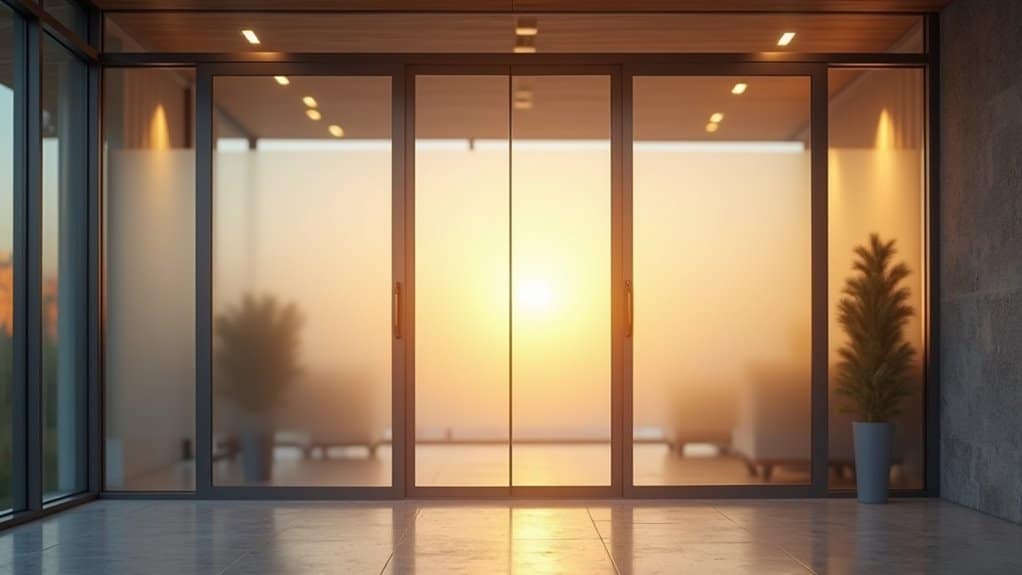
Beyond structural security, door glass covers deliver substantial privacy advantages that transform your entryway from a transparency liability into a controlled visual barrier. You’ll block outside onlookers from peering into your home while maintaining natural light entry, a benefit that blinds and curtains can’t consistently provide without regular adjustment.
Your design versatility options range from frosted and etched finishes to patterned films, allowing you to select opacity levels matching your specific privacy requirements. This aesthetic improvement augments your entryway’s visual appeal while establishing a personal sanctuary. Modern privacy glass solutions contribute a contemporary, elegant look that increases curb appeal without sacrificing brightness or interior ambiance. Whether you’re installing covers on entry doors or glass panels in densely populated neighborhoods, you’re simultaneously achieving security and sophisticated visual control. For coastal properties or humid environments, moisture-resistant glass covers prevent warping and fading while maintaining their privacy function year-round. Additionally, certain glass types effectively block harmful UV rays while allowing light penetration, which helps preserve your interior furnishings and protects your family from prolonged sun exposure. The sound-dampening properties of quality glass covers also reduce external noise, creating a more tranquil entryway experience.
Protection Against Accidents and Weather Damage
When you install door glass covers, you’re directly reducing the risk of lacerations and emergency room visits from shattered glass during accidental impacts. Impact-resistant films and tempered glass panels you choose will withstand flying debris, hurricane-force winds, and hail damage far better than standard, unprotected glass. Your response time to weather events improves dramatically because reinforced covers keep glass fragments contained, preventing rapid interior water and wind exposure that compounds property damage. The laminated glass or polycarbonate glazing in these protective covers provides tight bonds that maintain your front entryway’s structural integrity while safeguarding your family from injury and intrusion. Fiberglass frames paired with protective covers offer exceptional durability and low maintenance while enhancing your home’s long-term weather resistance. These reinforced doors also meet or exceed local building code requirements, ensuring your home receives certified protection against extreme weather conditions and potential break-ins.
Shattered Glass Safety Risks
Shattered glass poses severe and multifaceted hazards that extend far beyond the initial breaking event. When your door glass fractures, you’re exposed to sharp fragment hazards capable of inflicting devastating injuries. The jagged shards created during breakage concentrate risk on vulnerable areas, particularly your face, eyes, and hands, generating facial injury risks that can result in permanent disfigurement or vision loss.
National surveillance data documents 1,792 lacerations from faulty glass installations, with children under seven and young adults experiencing disproportionately higher injury rates. During cleanup, broken fragments remain dangerously sharp and easily penetrate skin. In addition, tempered glass’s spontaneous failure without visible cause means you face unpredictable fracture events. Experts warn that even a small nick or imperfection can compromise the structural integrity of tempered glass, making it shatter without warning. Safety glazing compliance with IBC, ANSI Z97.1, and CPSC standards ensures your glass doors meet established protection requirements. Door glass covers mitigate these risks substantially by containing fragments and reducing laceration severity during impact incidents. Installing protective security films on door glass provides extra strength to prevent break-ins while also protecting against accidental breakage and weather-related damage.
Weather Resilience and Durability
Your door glass faces relentless environmental assault, from UV radiation and thermal stress to moisture infiltration and salt-air corrosion, that gradually degrades clarity, structural integrity, and weathersealing performance. Quality protective films and covers significantly extensively mitigate these threats by enhancing corrosion resistance and providing thermal insulation that reduces expansion and contraction cycles. These systems extend your glass door’s service life by up to 20% in harsh climates while preventing microfractures from freeze-thaw cycles and stress corrosion in humid environments. Multi-layer films maintain adhesion for 10, 15 years, shielding against UV degradation and chemical exposure. By stabilizing temperature fluctuations and minimizing seal stress, protective covers preserve both glass integrity and frame longevity, ultimately conclusively reducing maintenance demands and replacement frequency.
Accident Prevention and Response
While environmental protection extends your door glass’s lifespan, accident prevention demands similarly rigorous safeguards, and that’s where impact-resistant solutions fundamentally transform how glass performs during collisions, break-in attempts, and catastrophic events.
Security film application prevents complete window replacement by holding shards together during accidents. You’re eliminating the 200 razor-sharp fragments produced per square foot of broken glass. Laminated glass construction maintains structural integrity even when fractured, dramatically slowing unauthorized entry while reducing injury risk.
| Protection Method | Impact Resistance | Fragment Control |
|---|---|---|
| Tempered Glass | 4-5x stronger | Partial |
| Security Film | High durability | Complete |
| Laminated Glass | Maintains integrity | Excellent |
You’ll simultaneously reduce heating costs through improved thermal insulation properties. Door glass covers with reinforced materials resist forceful entry while providing childproof locks, protecting families from accidental falls and cutting hazards.
Long-Term Cost Savings and Insurance Benefits
You’ll reduce your homeowners insurance premiums by 5, 15% when you install impact-resistant or reinforced glass covers, as insurers recognize these as effective risk mitigation measures. By preventing frequent glass breakage, you’ll avoid replacement costs averaging $300, $1,500 per window and lower your maintenance expenses considerably over time. Your upgraded glass covers extend door and window lifespan while maintaining a favorable insurance risk profile, which positions you for better policy terms and eligibility for future discounts.
Reducing Insurance Premium Costs
How substantially can door glass protection lower your insurance expenses? You’ll typically qualify for 10%, 45% premium discounts on high-risk coastal properties when you install impact-resistant doors and certified glass. These savings translate to $240, $900 annually on standard policies, accumulating to $15,600+ over 30 years.
To access maximum credits, you’ll need a wind mitigation inspection documenting your upgrades. Submit this assessment to your carrier for policy adjustment procedures and coverage eligibility verification. Your insurer will evaluate your protection features against local building codes and adjust your premium accordingly.
Higher discounts apply when you implement multiple protective measures, impact doors combined with reinforced garage doors yield greater aggregate reductions. Regional carriers in windstorm-prone areas mandate these credits by law, making your investment immediately cost-effective.
Minimizing Glass Replacement Expenses
Since impact-resistant and covered door glass resists breakage far more effectively than standard glazing, you’ll experience substantially fewer replacement cycles over your property’s lifetime. Tempered and laminated glass options dramatically extend durability, directly lowering maintenance needs and reduced labor expenditures.
| Glass Type | Breakage Resistance | Replacement Frequency | Cost Impact |
|---|---|---|---|
| Standard Glass | Low | High (every 3-5 years) | $800-1,200 annually |
| Impact-Resistant | High | Low (every 10+ years) | $150-300 annually |
| Laminated Glass | Very High | Minimal (15+ years) | $100-200 annually |
| Tempered Glass | High | Low (8-12 years) | $200-400 annually |
Long-Term Durability and Value
Installing quality door glass covers transforms your property’s financial trajectory by delivering substantial cost savings across multiple dimensions, from reduced replacement cycles to favorable insurance treatment. You’ll experience extended functional lifespan through tempered or laminated glass that resists environmental degradation from UV exposure, rain, and wind. Security films mitigate minor damage before it escalates into costly repairs. Beyond durability, aesthetic preservation directly boosts property valuation; well-maintained glass features minimize visible wear that undermines curb appeal and resale value. Insurance carriers recognize reinforced glass as lower-risk, potentially reducing your premiums while specialized endorsements like Building Glass Coverage prevent significant out-of-pocket expenses. Your thorough protection strategy simultaneously minimizes maintenance frequency, eliminates mismatched repairs that compromise uniformity, and certifies prompt claim resolution, creating measurable long-term financial advantages.
Choosing the Right Glass Cover Solution for Your Needs
Selecting an appropriate glass door cover requires you to evaluate multiple interconnected factors, installation complexity, privacy requirements, aesthetic compatibility, maintenance demands, and budget constraints, to identify the solution that best aligns with your specific situation.
DIY-friendly options like window films and curtains offer cost-effective installation, while etched panels demand professional expertise. Your privacy needs determine whether you’ll select translucent frosted film or opaque coverings. Consider maintenance requirements carefully: films and panels require minimal upkeep, whereas curtains and blinds need regular cleaning. Energy conservation becomes significant when you select cellular shades or insulated blinds, reducing heating costs substantially. Assess your aesthetic preferences against available styles, modern films contrasting with traditional curtains. Ultimately, balance initial investment against long-term value, recognizing that energy-efficient covers deliver cumulative savings justifying higher upfront expenses.
Frequently Asked Questions
How Long Does Security Window Film Typically Last Before Needing Replacement?
You’ll typically find that security window film lasts 10 to 20 years, depending on your specific conditions and film quality. High-quality films, like 3M products, can extend beyond 15 years when you’ve invested in professional installation. You’ll enhance your film’s typical lifespan through proper maintenance, regular gentle cleaning and avoiding harsh chemicals. You should inspect periodically for integrity issues. With appropriate care, you’ll keep your security film functioning at its best throughout its extended service life.
Can Door Glass Covers Reduce Noise From Outside Traffic or Neighbors?
Yes, you can greatly reduce outside noise by installing door glass covers that utilize sound dampening effects and vibration mitigation. Laminated glass with plastic interlayers, mass-loaded vinyl sheets, and triple-glazed systems effectively block traffic and neighbor noise by disrupting sound wave travel. You’ll achieve excellent results by combining covers with tightly-sealed frames. However, you should recognize that extensive solutions involving multiple soundproofing layers outperform single applications for superior noise reduction performance.
Do Privacy Films Allow Natural Light to Enter While Blocking Visibility?
Yes, privacy films allow some light transmission while effectively blocking visibility. You’ll find that frosted and etched varieties diffuse incoming light, maintaining brightness without compromising privacy. These films blocks glare simultaneously, reducing harsh reflections and eye strain. Depending on the VLT percentage you select, ranging from 5% to 70%, you’ll achieve varying privacy levels while controlling light penetration. Higher VLT films preserve an open, airy atmosphere while still obscuring direct outside views.
Will Applying Security Film Damage or Leave Residue on My Glass?
When you’re installing quality security film correctly, it won’t damage your glass. However, improper film installation processes can cause peeling or bubbling. Upon removal, minimal residue typically remains if you’ve used high-quality film. Your glass cleaning requirements depend on installation duration, prolonged exposure may require professional removal with specialized solvents. Following proper maintenance with gentle, non-abrasive cleaning preserves both film integrity and glass condition throughout its lifespan.
Are Door Glass Covers Suitable for Both Residential and Commercial Applications?
Yes, you’ll find door glass covers are highly suitable for both residential and commercial applications. You can apply them to diverse suitable glass types, including standard, tempered, and laminated glass, provided you meet ideal installation requirements. You’ll achieve excellent results when you guarantee clean surfaces, proper temperature conditions, and precise alignment. You’re able to customize these covers for security, privacy, or branding purposes, making them versatile solutions for any environment you’re protecting.