
You’ll greatly enhance your home’s weather resistance by selecting exterior glass doors engineered with impact-resistant tempered glass, advanced corrosion-protected steel or fiberglass frames, and multi-point locking systems. These doors feature laminated PVB interlayers, thermally broken framing, triple-glazed options with argon gas fills, and integrated weatherstripping that work together to shield against wind, water infiltration, and forced entry. The combination of Low-E coatings, sacrificial anodes, and HydroShield™ technology delivers superior thermal performance and durability. You’ll learn how each design category addresses specific environmental challenges.
Tempered Glass Doors With Impact-Resistant Capabilities
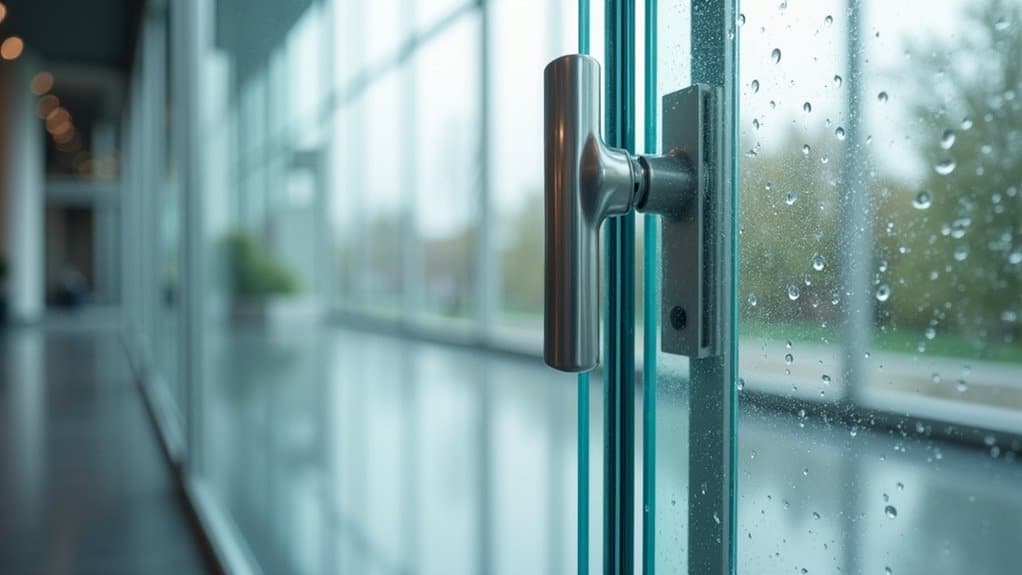
How do you protect an exterior glass door from both everyday wear and catastrophic weather events? You’ll want reinforced glass panels that combine tempered or annealed glass with a PVB interlayer. This laminated construction holds the glass together when broken, preventing penetration from flying debris and forced entry attempts.
You’ll also benefit from thermally broken framing that guarantees energy efficiency while maintaining structural integrity. Impact-resistant doors undergo rigorous testing for wind, water, and debris resistance, meeting ASTM, ANSI, and local building codes like Florida HVHZ standards. Professional installation by an experienced iron/aluminum door installer ensures optimal performance and longevity of your investment.
These doors feature multi-point locking systems that heighten both security and weather resistance. Machine-ground and polished edges ensure durability on exposed surfaces. Many manufacturers offer Low-E and insulated glass options that further enhance thermal performance and reduce energy costs year-round. Steel frames provide excellent rust resistance and structural strength in coastal and high-wind environments. Combined, these elements deliver thorough protection against hurricanes, extreme weather, and daily environmental stress while maintaining your door’s aesthetic appeal.
Steel Frame Doors With Advanced Corrosion Protection
Steel frame doors offer superior durability and security compared to aluminum or vinyl alternatives, particularly when you’re protecting your home in challenging environments. You’ll benefit from galvanized or galvannealed steel coatings (A60 grade) that create a sturdy zinc barrier against oxidation. For maximum protection, consider marine-grade stainless steel in coastal areas. You should apply powder-coated finishes and weather-resistive membranes during installation to seal against water infiltration. Early installation of weather-resistive membranes minimizes metal exposure to moisture, rain, and sea spray that accelerate corrosion over time. Installing sacrificial anodes diverts corrosive processes away from the steel frame, providing backup defense. Complement these measures with periodic paint maintenance every few years to rejuvenate worn surfaces. Regular inspection for signs of rust or deterioration will help you address issues promptly before they compromise the door’s integrity. You’ll also want stainless steel hardware for hinges and fasteners. For water-saturated environments, fiberglass doors may offer superior corrosion resistance compared to steel alternatives in extreme conditions. Combined with proper anchoring and multi-point locking systems, your steel frame doors deliver exceptional weather resistance and structural integrity.
Fiberglass Doors Featuring HydroShield™ Technology
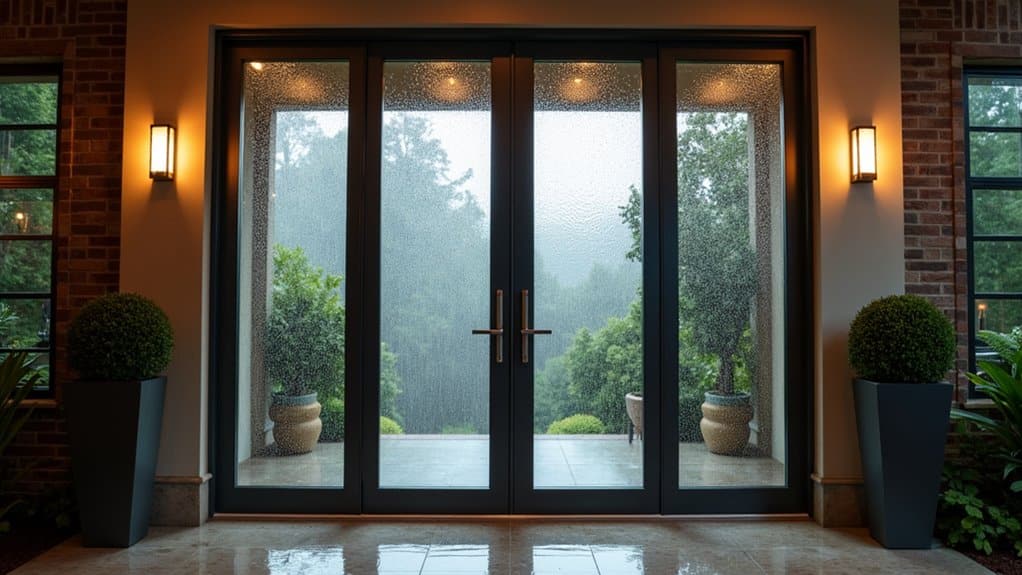
Fiberglass doors with HydroShield™ Technology represent a fundamental advancement in weather-resistant exterior design, utilizing fiberglass-reinforced skins and full-length composite stiles, rails, and frames to create a complete 360° moisture barrier. You’ll benefit from non-porous construction that blocks water infiltration while resisting mold and mildew growth in coastal and high-humidity environments.
The polyurethane core delivers superior thermal performance, achieving low U-factors that minimize heat transfer year-round. You’ll notice durable aesthetics that resist fading, chalking, and insect damage without requiring painting or sealing throughout the door’s lifespan. These durable fiberglass doors come in a wide variety of designs, finishes, and customizable styles to match any home aesthetic while maintaining their weather-resistant performance.
These doors won’t absorb moisture, warp, or delaminate, eliminating common failures affecting wood and steel alternatives. With warranties exceeding 25 years and minimal maintenance demands, you’re investing in long-term performance and reduced lifecycle costs.
Triple-Glazed Sliding Glass Doors for Maximum Energy Efficiency
While fiberglass doors with HydroShield™ Technology excel at moisture protection and structural durability, triple-glazed sliding glass doors push energy performance to new heights through advanced glazing systems that dramatically reduce thermal transfer. You’ll achieve up to 80% improved energy efficiency compared to single glazing, translating to $150, $400 annual savings per door. Triple-pane configurations with argon or krypton gas fills minimize condensation and temperature fluctuations while delivering exceptional noise reduction, up to twice that of double-glazed systems. Integrated UV protection coatings preserve interior furnishings while maintaining natural light transmission. Thermally broken frames and advanced weatherstripping resist air infiltration and meet hurricane-zone codes. Low-E coatings can further reduce heat transfer by 30-50% without affecting visibility, providing year-round benefits by controlling heat gain and loss. The U-Factor measurement determines the overall insulation quality of your door system, helping you compare products across different manufacturers. Proper installation is critical to maintain the weathertightness and thermal performance of your sliding door system. Over 20, 30 years, you’ll recoup $3,000, $8,000 in cumulative energy cost reductions, making triple-glazed sliding doors a sustainable investment for maximum thermal and weather performance.
Multi-Point Locking Systems for Enhanced Security and Weather Resistance
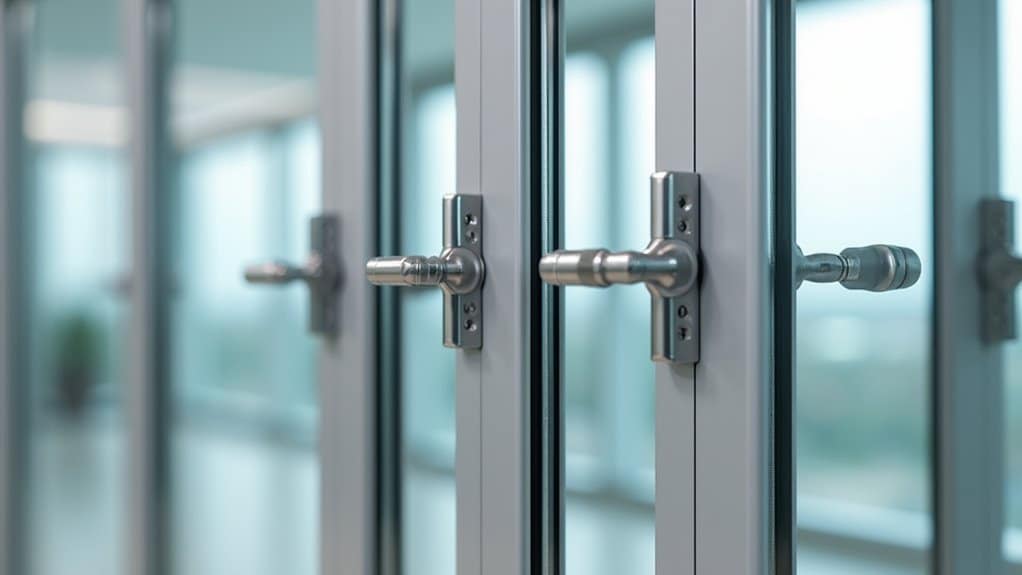
Most modern exterior glass doors rely on single-point locking mechanisms that concentrate all securing force at one location, but multi-point locking systems distribute this force across three or more strategically positioned points, typically at the top, middle, and bottom of the frame, to dramatically improve both security and weather performance.
Multi-point locking systems distribute securing force across three strategic points, dramatically improving both security and weather performance compared to single-point mechanisms.
You’ll benefit from these advantages:
- Pressure distribution, Even force dispersal prevents lock failure and door breach during forced entry attempts, eliminating vulnerable stress concentrations.
- Weather sealing, Multiple engagement points create compression that reduces drafts, water infiltration, and air leakage for superior thermal performance. This tighter seal also helps maintain consistent indoor temperatures and reduces energy costs. These systems are particularly effective in hurricane-prone areas where impact resistance is essential for safeguarding against severe weather conditions.
- Smart home integration, Compact multi-point designs seamlessly connect with modern smart locks and alarm systems, enabling remote access monitoring without compromising durability.
Laminated Glass Doors for Hurricane-Prone Regions
When you’re protecting a coastal property or structure in a storm-prone region, laminated glass doors represent a critical upgrade beyond standard single-pane or basic dual-pane options. You’ll find these doors constructed with multiple glass layers bonded by impact absorbing interlayers, typically polyvinyl butyral (PVB) or SentryGlas (SGP), that withstand continuous winds exceeding 200 mph and repeated projectile impacts. Available in thicknesses from 21.52mm to over 50mm, you can select configurations matching your specific design pressure requirements, often reaching ±60 ratings. You’ll appreciate specialty edge finishes accommodating custom architectural styles while maintaining structural integrity even after glass breakage. These systems meet Florida Building Code protocols and ASTM C 1172 standards, offering superior safety and durability for hurricane-prone applications. The two layers of tempered glass bonded with laminating material prevents the glass from shattering into large sharp pieces, significantly enhancing both safety and security during severe weather events.
Composite Door Systems With Integrated Weather Sealing
Composite doors represent a fundamental evolution in exterior door technology, engineering multiple material layers, timber cores, uPVC frames, metal reinforcement, foam insulation, and glass-reinforced plastic (GRP) facings, into unified systems that deliver exceptional weather resistance and structural performance.
Composite doors engineer multiple material layers into unified systems delivering exceptional weather resistance and structural performance.
You’ll benefit from integrated sealing technologies that eliminate water infiltration and air leakage:
- Seal pads at bottom corners and sill gaskets create watertight barriers between door and frame
- Door sweeps reduce drafts while preventing moisture penetration along bottom edges
- Hydroshield coatings guarantee airtight protection without compromising aesthetic appeal
These integrated systems safeguard material durability through extreme pressure bonding, creating tight seals that resist climate fluctuations. You’ll experience long term performance with minimal maintenance, composite doors retain their weather-resistance for up to 30 years, resisting warping, rot, and insect damage across harsh environmental conditions.
Frequently Asked Questions
What UV-Blocking Coatings Are Available to Reduce Solar Heat Gain in Hot Climates?
You’ll find several effective UV-blocking coatings for hot climates. High-performance Low-E coatings reflect 95-99% of UV rays while maintaining visibility. Solar control tint options absorb UVA rays, though they’re moderately protective. Ceramic window films block over 99% of UV wavelengths with up to 58% total solar energy rejection. Spectrally selective coatings filter specific wavelengths, minimizing heat penetration. Multi-layer aftermarket films offer 99% UV blockage with significant infrared reduction, achieving 70% fade reduction.
How Do Soft Dual Flaps in Pet-Accessible Doors Maintain Tight Weather Seals?
You’ll find that soft dual flaps maintain tight weather seals through dual flap flexibility and pressure-activated sealing. When your pet passes through, the flexible polyolefin or UV-treated vinyl flaps compress against magnetic frames and brush weatherstripping, creating redundant air barriers. This layered construction activates contact pressure at multiple points simultaneously, blocking moisture and air infiltration. The flaps’ supple material guarantees consistent performance across extreme temperatures, preventing gaps while remaining responsive to pet movement and automatic resealing.
What Rough Opening Sizes and Panel Dimensions Accommodate Large-Scale Hurricane-Resistant Installations?
You’ll find rough openings typically range from 8 to 16 feet wide, with heights between 7 and 8 feet for large-scale hurricane-resistant installations. You can configure multi-panel systems up to 20 feet wide, with individual panels sized 3 to 6 feet wide and 7 to 10 feet tall. You’ll want reinforced glass panel thickness paired with tempered glass impact resistance, ensuring maximum 60 square feet per panel. You’re looking at aluminum frames for superior strength across wider spans.
How Does Polyurethane Foam Core Insulation Prevent Condensation Buildup in Door Cavities?
You prevent condensation buildup through polyurethane foam’s closed-cell structure, which creates an impermeable vapor barrier performance blocking moisture transmission. The foam’s superior thermal expansion properties maintain interior surface temperatures above dew point, eliminating cold spots where condensation forms. You’re additionally protected by the foam’s non-absorbent nature, it won’t wick water into door cavities. Computer-controlled application guarantees seamless coverage without air pockets, while weatherstripping and insulation together minimize outdoor air infiltration, thoroughly safeguarding against moisture accumulation throughout the door cavity’s lifecycle.
Which Smart Locking Solutions Enable Remote Control and Monitoring of Door Access?
You’ll find that smartphone-enabled access through WiFi, Bluetooth, and Z-Wave locks enables remote control and observation. These keyless entry systems deliver real-time notifications for entry events, tampering, or low battery status directly to your device. You can grant temporary access to multiple users, review detailed audit trails remotely, and integrate with smart home assistants like Alexa or Google Assistant. Encryption protocols protect your communications while tamper alarms provide additional security reinforcement.