
When evaluating exterior doors with windows, you’ll need to balance three competing forces: daylighting, thermal performance, and protective measures. Check NFRC labels for U-Factor below 0.27 and climate-appropriate SHGC ratings. Keep glass area under 25% to avoid stricter regulatory thresholds. Specify tempered or laminated glass with a two-cylinder deadbolt to address forced-entry risks. Low-E double-pane configurations recover most thermal losses without sacrificing visible light, and every trade-off covered here runs deeper than it first appears.
The Real Trade-Offs Between Natural Light and Energy Loss in Entry Doors
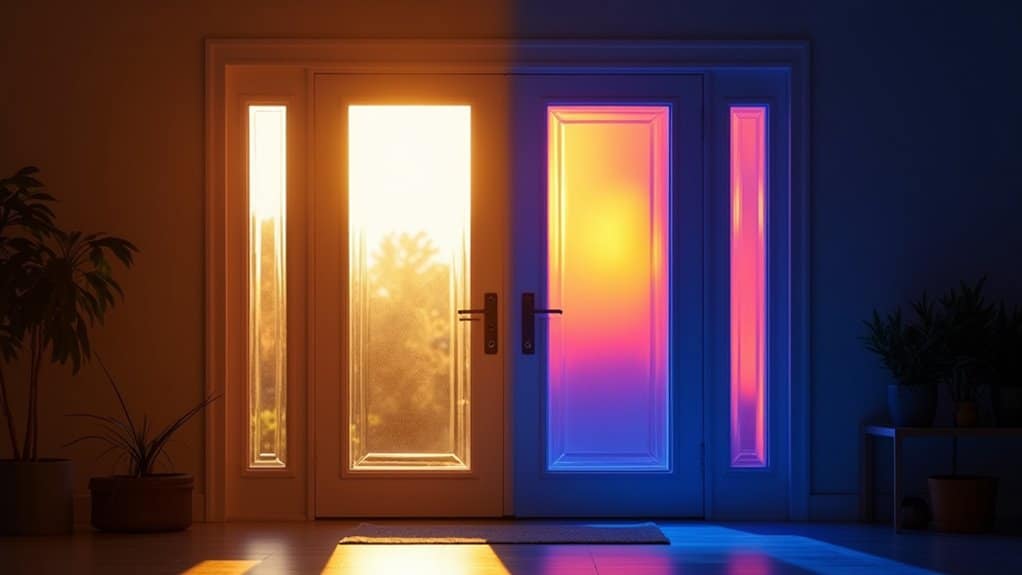
Adding glass to an entry door immediately forces a trade-off: you gain natural light but introduce a thermal weak point that drives up conduction losses. Glass areas conduct heat considerably faster than insulated panels, so every square inch of glazing reduces overall door performance. Thermal bridge considerations become critical here, glass interrupts the insulated core, creating pathways for heat transfer that undermine even high-performing fiberglass or steel construction.
A balanced design approach requires matching glass ratio to climate-specific U-Factor and SHGC targets. Doors with half or less glass must meet a U-Factor of 0.23 for ENERGY STAR certification, while greater glass coverage demands stricter thresholds. Pairing Low-E coatings with double- or triple-pane configurations lets you recover much of that lost performance without sacrificing daylighting. The NFRC label displayed on windows and doors provides standardized U-Value, Solar Heat Gain Coefficient, and Visible Light Transmittance values to help you objectively compare products before making a final selection.
How Much Glass Is Too Much for Your Exterior Door?
Once your door crosses the 25% glass threshold, energy codes stop treating it like a door and start treating it like a window, subjecting it to stricter U-factor and SHGC requirements that govern fenestration assemblies. You’ll also face total fenestration caps: most jurisdictions limit glazing to 20% of conditioned floor area, with west-facing glass restricted to 5% in certain climate zones.
Safety glazing requirements activate at 9 square feet, adding another compliance layer. Finding the ideal glass area means balancing your desired aesthetic appeal against these stacked regulatory constraints. Under 25% glass keeps you in opaque-door territory, requiring only a U-factor of 0.20 or less. Exceeding that threshold triggers window-level scrutiny, NFRC 100 rating requirements, and air leakage limits of 1.00 cfm per square foot. Glazing type, orientation and shading devices also play a major role in how your door’s glass area ultimately affects your HVAC system sizing and occupant comfort.
U-Factor and SHGC Ratings That Actually Matter by Climate

Knowing which glass percentage keeps your door in opaque-door territory only gets you halfway there, you still need to nail the thermal performance numbers that match your climate. Regional climate variations demand distinct targets: northern zones require U-Factor ≤0.26 with ideal SHGC values between 0.30, 0.50 to capture passive solar heat. Southern climates flip the priority, target U-Factor ≤0.28 and SHGC ≤0.23 to block radiant heat gain. Mixed climates split the difference, with U-Factor ≤0.26 and mid-range SHGC of 0.36, 0.50. Door orientation further refines these numbers; south-facing installations tolerate higher SHGC, while east and west exposures need lower values. Cross-reference ENERGY STAR’s zone-specific maps against your NFRC label to confirm both metrics simultaneously before purchasing. When evaluating materials, steel doors filled with high-density foam consistently deliver some of the lowest U-Factor ratings available, making them a strong option regardless of climate zone.
Low-E Glass and Double-Pane Options for Entry Doors Compared
When selecting glazing for your entry door, you’ll find that Low-E coatings and double-pane construction each target different heat transfer mechanisms, radiant and conductive, respectively. Double-pane units alone achieve U-factors of 0.40, 0.50 and SHGC values of 0.60, 0.70, while Low-E coated double-pane combinations push U-factors down to 0.20, 0.30 and SHGC to 0.25, 0.40. Combining both technologies delivers synergistic performance that neither option achieves independently, cutting energy costs 30, 50% over single-pane while maintaining 70, 80% visible light transmission.
Low-E Coating Benefits
Because entry doors with glass panels directly influence your home’s thermal envelope, Low-E coating technology represents one of the most impactful upgrades you can evaluate. The microscopically thin metallic layer delivers measurable coating performance by reducing energy loss up to 50 percent compared to standard glass. During summer, it blocks infrared transmission, limiting solar heat gain. During winter, it reflects interior radiant heat back into living spaces, minimizing HVAC runtime. UV ray blocking further protects furnishings, flooring, and artwork from photodegradation without sacrificing visible light transmission. The coating remains thinner than a human hair yet maintains transparency under most viewing conditions. A slight tint may appear under specific lighting, but thermal and protective benefits consistently outweigh this minor aesthetic consideration across seasonal performance cycles.
Double-Pane Performance Compared
Low-E coating delivers its strongest results when paired with double-pane construction, and comparing each technology’s independent performance clarifies why the combination dominates high-efficiency entry door specifications. Standard double-pane glazing system variants achieve U-factors of 0.40, 0.50, cutting energy costs 20, 30% versus single-pane. Adding Low-E shifts that thermal resistance comparison extensively, dropping U-factors to 0.25, 0.35 and increasing savings to 30, 50%. SHGC values illustrate the divergence further: standard double-pane registers 0.60, 0.70, while Low-E coated units reach 0.25, 0.40. Double-pane controls conductive transfer through its air space; Low-E manages radiant transfer through specialized coatings. Neither technology fully compensates for the other’s limitations. You get thorough thermal control only when both systems operate together within a single insulated glass assembly.
Fiberglass vs. Steel Frames for Windowed Entry Doors
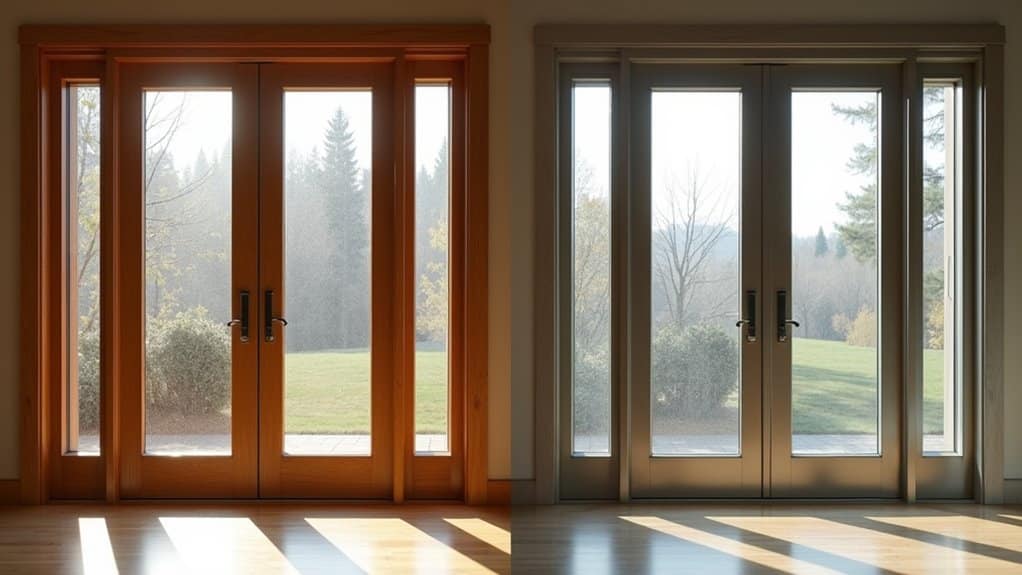
Choosing between fiberglass and steel frames for windowed entry doors requires weighing energy efficiency, durability, maintenance, protection, and cost against your specific climate and performance needs.
Consider these four critical distinctions:
- Thermal Performance, Fiberglass conducts heat 40 times slower than steel, delivering superior R-values and minimizing material environmental impact through reduced energy consumption.
- Weather Resistance, Fiberglass resists dents, rot, and moisture without coatings, outperforming steel in humid or coastal climates.
- Material Visual Appeal, Fiberglass replicates realistic wood grain textures, accepting stains or paint, while steel suits solid contemporary finishes only.
- Security & Cost, Steel offers stronger forced-entry resistance at lower upfront costs; fiberglass provides long-term savings through minimal maintenance and exceptional longevity.
How Glass Panels Affect Entry Door Security and Durability
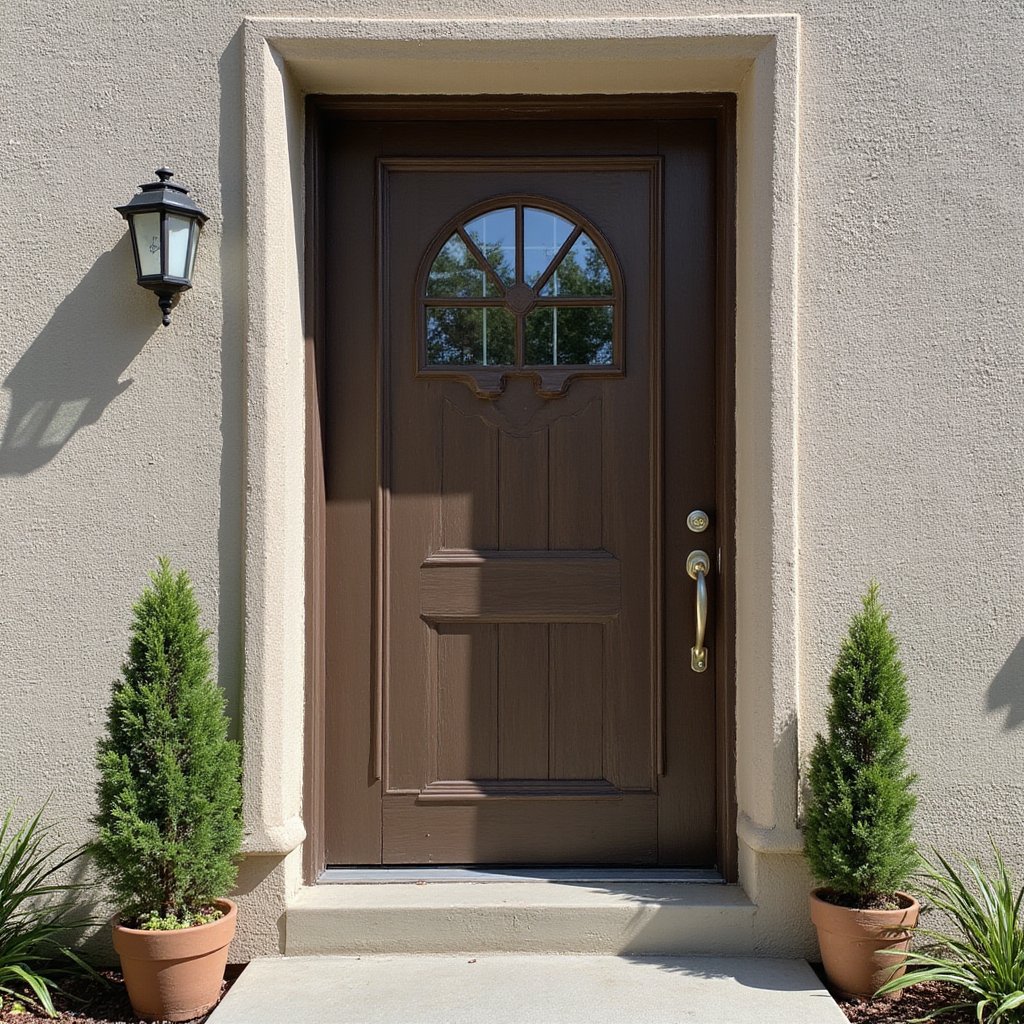
Glass panels in entry doors introduce a fundamental safeguard trade-off: they enhance curb appeal and natural light while creating potential vulnerabilities that require deliberate mitigation. Window glass aesthetics often take priority during selection, but you must evaluate structural performance simultaneously. Standard glass breaks easily, and panels positioned near hardware create direct lockset vulnerabilities, an intruder can shatter the pane and manually disengage the latch within seconds.
You’ll counter this by specifying tempered or laminated glass, both of which resist forced entry more effectively than conventional alternatives. Laminated glass keeps broken pieces bound together, physically blocking door access even after impact. Pair either option with a two-cylinder deadbolt requiring a key from both sides, eliminating reach-in latch disengagement entirely and substantially strengthening your door’s overall security integrity.
How to Read an NFRC Label and What Each Rating Actually Means
When you encounter an NFRC label on an entry door, you’re looking at independently tested, whole-product energy performance data, not manufacturer estimates based on glass alone. These glazing performance factors guide climate-specific decisions with precision.
- U-Factor (0.20, 1.20): Below 0.27 qualifies for ENERGY STAR certification, imagine a door holding interior warmth against bitter winter air.
- SHGC (0, 1): Lower values block solar radiation, picture summer sunlight deflecting rather than radiating through your entryway.
- Visible Transmittance (0, 1): Higher numbers flood interiors with daylight, envision balanced natural light without sacrificing thermal control.
- Air Leakage (≤0.3): Minimal infiltration eliminates drafts, think of a sealed threshold maintaining consistent indoor conditions.
ENERGY STAR Doors, Federal Tax Credits, and What You Can Actually Claim
If your door qualifies for ENERGY STAR certification, it must meet NFRC-rated U-Factor and SHGC thresholds specific to your climate zone, for example, opaque entry doors require a U-Factor of ≤ 0.17 regardless of region, while glazed doors carry stricter requirements in Northern and North-Central zones. Unlike windows, which require an “Most Efficient” designation, ENERGY STAR certification alone makes your exterior door eligible for the 25C Federal Tax Credit. That credit covers 30% of both purchase and installation costs, up to $250 per door with a $500 aggregate cap, but only if the door is installed in your principal U.S. residence between January 1, 2023, and December 31, 2025.
ENERGY STAR Qualification Criteria
ENERGY STAR certification for exterior doors hinges on three core requirements: the door must be manufactured by an ENERGY STAR partner, independently tested and certified by the National Fenestration Rating Council (NFRC), and meet EPA energy efficiency guidelines based on NFRC ratings.
Version 7.0 tightened North-Central zone criteria, where thermal bridging impacts insulation performance across all glazing categories:
- Opaque doors maintain ≤0.17 U-Factor, offering maximum insulation performance with minimal glass exposure
- ≤1/2-lite doors tightened to ≤0.23 U-Factor with ≤0.25 SHGC, down from ≤0.25
- >1/2-lite doors now require ≤0.26 U-Factor, reduced from ≤0.30
- Verification requires locating your door’s CPD number and cross-referencing the NFRC Certified Product Directory
Climate zone determines which thresholds apply to your specific installation.
Claiming Federal Tax Credits
Qualifying ENERGY STAR exterior doors purchased and installed between January 1, 2023, and December 31, 2025, are eligible for a federal tax credit under Section 25C, specifically 30% of product costs, capped at $250 per door and $500 annually across all exterior doors. This claiming eligibility period excludes post-2025 installations and new construction. Credit applies to product costs only; labor’s excluded.
Your door must meet ENERGY STAR requirements for your specific climate zone, confirmed via the NFRC Certified Product Directory using the door’s CPD number. The home must be your principal U.S. residence, renters and second-home owners don’t qualify.
For the claiming process, file IRS Form 5695 and retain your manufacturer certification, invoice, and QMID. Aggregate door credits with other envelope improvements within the $1,200 annual limit.
Calculating Total Cost: Price, Energy Savings, and Tax Credit ROI
When calculating the total cost of an exterior door upgrade, you’ll need to factor in three core variables: purchase price, installation, and long-term financial offsets. Door installation costs range from $200 to $5,000 depending on door type and structural complexity. Door energy performance factors like foam cores and Low-E glass directly reduce annual utility expenses.
Upgrading your exterior door involves three key costs: purchase price, installation, and long-term energy savings offsets.
Apply this formula: Total Cost = Purchase + Installation − (Annual Savings × Years + Tax Credits)
- Purchase price: $150, $5,000 depending on material and glass type
- Installation: $200, $5,000 based on structural requirements
- Annual energy savings: Variable by climate and efficiency rating
- Tax credits: Applied against qualifying Energy Star-certified installations
A $3,000 door investment can yield measurable returns within several years through combined savings and credits.
Frequently Asked Questions
Can Exterior Doors With Windows Qualify for Historic Preservation Tax Incentives?
Yes, exterior doors with windows can qualify for historic preservation tax incentives if they meet strict architectural preservation standards. You’ll need to guarantee the replacement door duplicates the original’s design, size, profile, and materials as closely as possible. Historical accuracy is non-negotiable, consult your local design review board before ordering. Storm doors with full-view glass qualify if they’re compatible. City-level credits offer 10%, while federal programs provide 20% for certified historic structures.
How Do Windowed Entry Doors Affect Homeowners Insurance Premiums or Coverage?
Windowed entry doors directly affect your premium discounts when they carry impact-resistant ratings like Miami-Dade NOA approval. You’ll reduce your insured liability exposure by installing certified impact glass, triggering windstorm mitigation discounts between 15-45% annually. You must schedule a Uniform Mitigation Verification inspection and document the installation with your carrier. Coastal Florida homeowners can recover $1,200-$3,800 yearly, while inland properties see proportionally smaller but equally percentage-consistent reductions.
Do Glass Entry Doors Require Special Permits in Hoa-Governed Communities?
Yes, glass entry doors typically require dual approval in HOA-governed communities. You’ll need to satisfy both architectural review committee requirements and local jurisdiction approval simultaneously. Submit detailed product specifications, including frame dimensions, materials, glass configurations, and energy ratings, to your HOA board while filing a separate municipal building permit application. California mandates permits when replacing over 75 square feet of glazed surfaces. Guarantee your contractor’s documentation meets HOA insurance standards before project commencement.
How Does Door Glass Placement Affect Indoor Furniture Fading Over Time?
Door glass placement directly determines your furniture’s UV exposure rate and fading timeline. West and south-facing doors create the highest damage risk, causing visible deterioration within 18-24 months. Strategic furniture placement beyond 8 feet from door glass considerably reduces cumulative UV hours. Without window film application, standard glass transmits 75% of harmful rays. Double-pane glass improves blocking to 50%, but you’ll still need UV-filtering film to achieve 99% protection.
Can Existing Exterior Doors Be Retrofitted With Energy-Efficient Glass Panels?
Yes, you can retrofit your existing exterior doors with energy-efficient glass panels without full replacement. You’ll replace outdated single-pane units with upgraded insulated glass, optimizing glass composition through dual-pane construction with argon or krypton gas fills. Apply glass coatings like Low-E to reflect infrared and UV radiation, reducing heat transfer considerably. Pairing these upgrades with Super Spacer® non-metallic edge spacers and weatherstripping achieves ENERGY STAR compliance, potentially cutting your energy bills by up to 13%.