
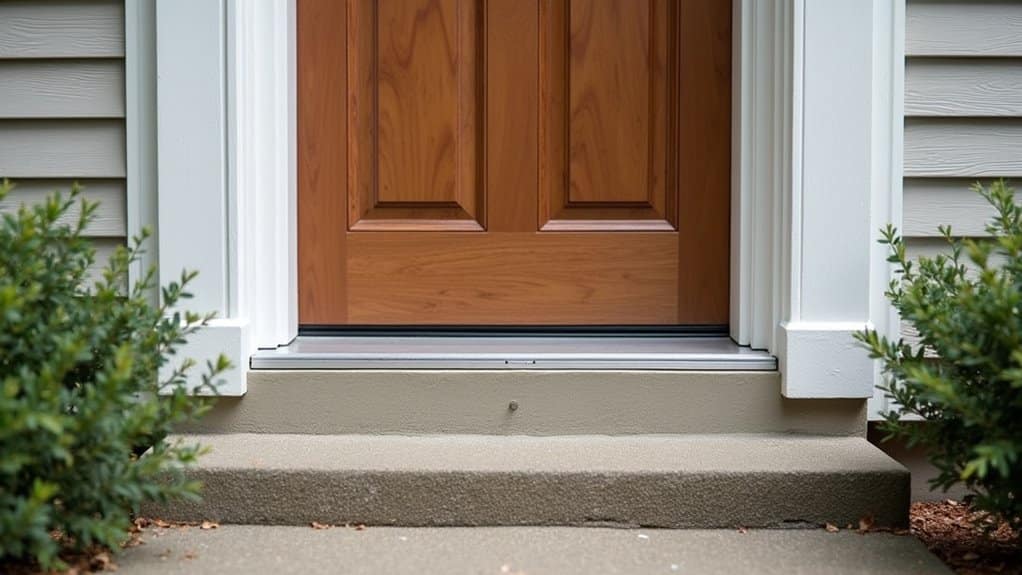
When choosing wood for exterior doors, you’ll want species that resist moisture, warping, and decay without sacrificing strength. Mahogany, White Oak, Sapele, Walnut, Western Red Cedar, and Knotty Alder each deliver proven durability and weather resistance across different climates and architectural styles. Dense grain structures, natural rot resistance, and dimensional stability separate these top performers from inferior alternatives. The details behind each species reveal exactly which wood best matches your specific performance requirements.
What Makes Wood Ideal for Exterior Doors?
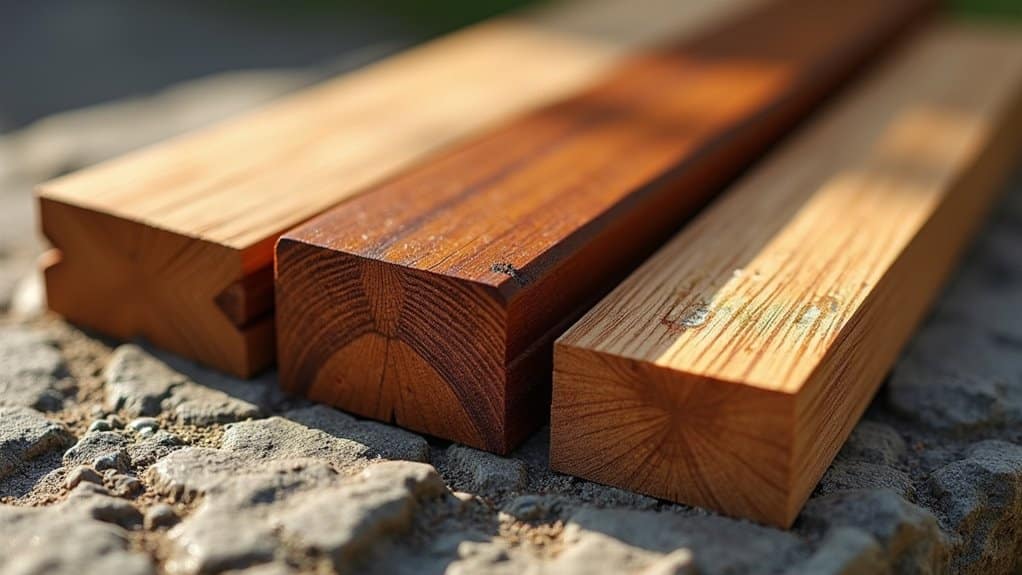
When choosing materials for exterior doors, wood stands out for its natural durability, structural strength, and aesthetic versatility. Dense species like White Oak, Cypress, and Ipe deliver exceptional moisture tolerance, resisting rot, decay, and insect damage even in extreme weather conditions. You’ll find that solid hardwood doors offer the greatest structural integrity, outperforming alternatives in long-term wear resistance.
Wood’s natural composition also allows it to reduce sound penetration effectively while providing timeless aesthetic appeal unmatched by steel or fiberglass. Species like Mahogany exhibit minimal expansion under moisture exposure, making them particularly reliable for exterior applications. However, you must apply protective finishes annually to prevent warping and splitting. When properly maintained, quality wood doors withstand generations of use while retaining their premium appearance. Wood doors are available in a wide variety of species and finishes, including oak, mahogany, and cherry, allowing you to tailor the design to complement your architectural style and interior.
Why Mahogany Has Dominated Exterior Doors for Decades
Mahogany has dominated exterior door construction for decades because it delivers a rare combination of structural stability, weather resistance, and aesthetic refinement that few species can match. Its tight grain and non-porous structure prevent drafts, moisture intrusion, and dimensional shifting under extreme conditions. You’ll find it outperforms oak, pine, and African Mahogany in decay resistance and long-term stability. Honduran Mahogany, specifically, has become the benchmark for high-performance entry doors. Its superior workability allows craftsmen to execute intricate designs with precision, while its rich reddish-brown tones deepen over time, delivering classic elegance that enhances any entryway. With proper maintenance using marine spar varnish or Waterlox, these doors endure for generations, making mahogany the most reliable and historically preferred choice for exterior applications. The story of mahogany in door construction traces back to the early 1500s, when Spanish explorers first recognized the wood’s exceptional qualities while sourcing materials for ship repairs.
White Oak Doors Built to Outlast the Elements
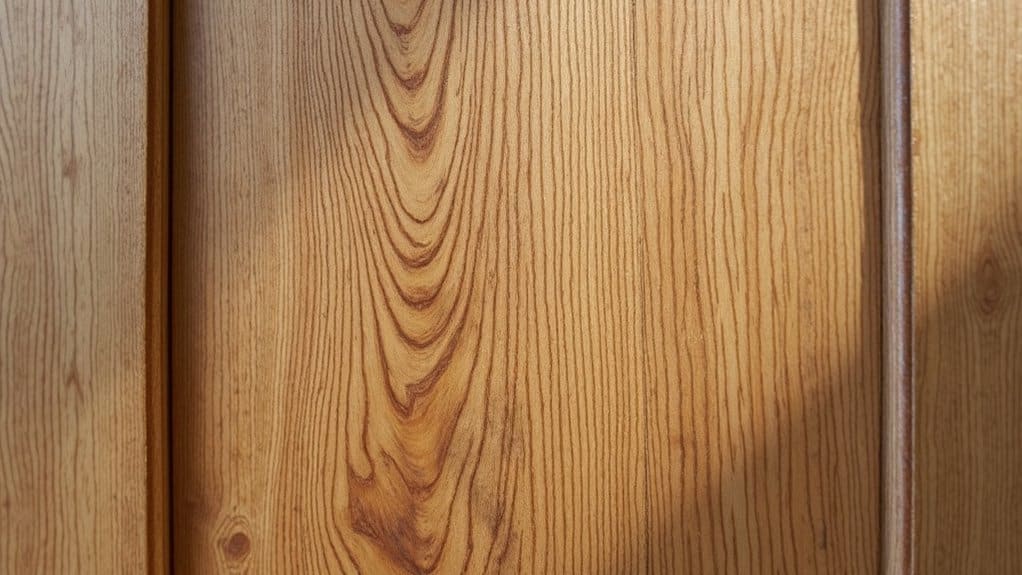
When choosing a door material built to withstand moisture and structural stress, white oak stands apart from most domestic hardwoods. Its closed-grain cellular structure contains tyloses, a natural substance that fills the wood’s pores, making it virtually impervious to water infiltration and decay. If you opt for quarter-sawn white oak specifically, you’ll gain added dimensional stability, as this milling technique minimizes seasonal expansion and contraction that can warp or distort a door over time. White oak also delivers excellent insulation properties, contributing to improved soundproofing and thermal efficiency throughout your home.
Natural Water Resistance
White oak’s natural water resistance stems from a microscopic phenomenon called tyloses, bubble-like structures that fill and seal the wood’s pores, creating a closed cellular network nearly impermeable to fluid penetration. Unlike red oak’s open grain moisture absorption, white oak’s closed structure repels humidity, preventing warping, swelling, and decay. This superior hardwood stability makes it ideal for high-moisture environments like kitchens, bathrooms, and exterior thresholds.
Key performance advantages include:
- Sealed pores block fluid infiltration that compromises structural integrity over time
- Minimal absorption prevents dimensional changes in humidity-prone installations
- Natural rot resistance eliminates premature deterioration without chemical treatment
You’re choosing a material engineered by nature to outlast moisture exposure, delivering decades of reliable performance where lesser woods consistently fail.
Quarter-Sawn Stability Benefits
Quarter-sawn white oak begins at the sawmill, where boards are cut at a precise angle, perpendicular to the wood’s annual rings, positioning the grain vertically through the board’s face. This orientation delivers reduced expansion across the board’s width, minimizing cupping, warping, and dimensional movement caused by humidity fluctuations.
For doors specifically, that stability matters. You’re installing a component that endures seasonal moisture swings, temperature changes, and constant mechanical stress. Quarter-sawn white oak handles all three better than flat-sawn alternatives.
The cutting process also increases elasticity, roughly double that of flat grain, giving the wood resilience under load without compromising structural integrity. Add the exposed medullary rays producing distinctive surface flecks, and you get a door material that performs precisely where plain-sawn lumber falls short.
Sapele Mahogany Exterior Doors Built for Harsh Weather
Sapele mahogany’s interlocking grain and tighter pore structure make it a superior choice for exterior doors exposed to harsh weather conditions. Its natural resistance to rot, insects, and marine borers means you’re investing in long-term performance without excessive maintenance. The smooth mahogany finishing elevates your home’s enhanced architectural presence while withstanding outdoor exposure.
Key performance advantages include:
- Density at 640 kg/m³ minimizes grain movement, reducing warping and shrinkage under fluctuating moisture levels
- Janka hardness of 6,700 N delivers superior scratch and impact resistance against daily exterior wear
- Tighter pore structure outperforms genuine mahogany in weather resistance, making it ideal for coastal or high-humidity environments
You can apply UV stains and sealers to further extend its lifespan.
Walnut Exterior Doors: Durable, Stable, and Low-Maintenance
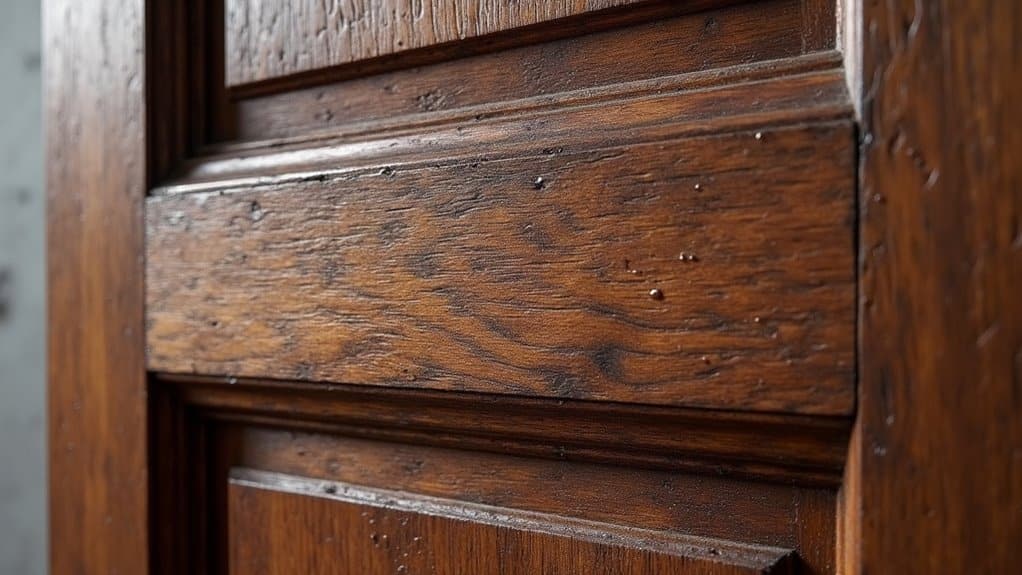
Although walnut ranks softer than oak or mahogany on the Janka scale, it delivers the durability, stability, and low-maintenance performance you’d expect from a premium exterior door material. Its design versatility extends across architectural styles, supported by solid hardwood square edges and weather-resistant constructions that resist UV, rain, and temperature fluctuations. Kiln-dried walnut limits movement to just 0.04 inches on a 6-inch-wide piece annually, preserving structural integrity with minimal warping or shrinking. WaterBarrier technology and edge-to-edge moisture protection make it viable even without overhead coverage. For coastal applications, marine varnish finishes guard against saltwater and humidity. Maintenance stays straightforward, periodic resealing every few years and routine wipe-downs keep the finish intact, protecting walnut’s rich grain and warm tones long-term.
Western Red Cedar for Large and Lightweight Exterior Doors
If you’re considering a large exterior door, Western Red Cedar stands out as a top choice due to its natural resistance to moisture, fungus, and insects. Its low density makes it ideal for oversized installations, reducing stress on hinges and frames without sacrificing structural integrity. You’ll also benefit from Grade A clear, knot-free cedar, which guarantees consistent durability and supports high-quality finishes that enhance long-term weather performance.
Natural Rot Resistance Benefits
Western Red Cedar’s remarkable rot resistance stems from a single biochemical advantage: thujaplicin, a tropolone-related volatile oil that delivers potent antifungal and antiseptic properties throughout the wood. Concentrated in the bark and sapwood, this compound provides measurable insect deterrent effects against fungal decay, bacteria, and wood-boring insects.
Cedar’s BS EN 350 Class 2 durability rating reflects these antifungal properties directly:
- Heartwood compounds actively suppress fungal colonization, ensuring decades of structural integrity
- Thujic acid amplifies insect deterrence beyond what thujaplicin achieves alone
- Pitch-free composition enhances weather resistance, particularly critical for exterior door applications
You’re choosing a species that trees themselves have relied on for over 1,000 years in persistently wet environments.
Lightweight Structural Advantages
Cedar’s lightweight density, ranging from 23 to 31 lbs/ft³, gives it a decisive structural advantage over hardwoods like oak or mahogany in large exterior door applications. Its low specific gravity of 0.32, 0.42 keeps standard 36″W x 80″H doors under 100 lbs, reducing structural load on frames and hinges. You’ll also benefit from its tensile strength exceeding 5,000 psi and a modulus of elasticity around 1.1 million psi, ensuring rigidity without excess mass. Cedar’s straight grain delivers a high strength-to-weight ratio, while its dimensional stability resists warping and checking across humidity fluctuations. This stability, combined with uniform texture that maximizes fastener holding power, supports design flexibility for custom widths exceeding 40 inches, all while maintaining structural integrity in demanding exterior environments.
Knotty Alder Exterior Doors: Rustic Look, Lower Cost
Knotty alder brings a distinctly rustic character to exterior doors, defined by its natural knots, burl patterns, and warm tones ranging from white and tan to pinkish-brown and peach-red tints. Unlike alligator grain texture or minimal knots pattern options, knotty alder embraces bold, irregular knot distribution as its defining feature. Each door delivers unique visual character through dark, resin-sealed knots and distinctive grain movement.
You’ll also benefit from its cost advantage, knotty alder provides a high-end aesthetic at a lower price than comparable hardwoods.
Key structural and performance highlights include:
- Engineered core stiles and rails with laminated construction resist warping
- Center floating panels accommodate wood expansion and contraction
- Doweled joint construction guarantees long-term structural integrity
With proper sealing on all six sides, expect 20, 30 years of reliable performance.
Frequently Asked Questions
How Often Should Exterior Wood Doors Be Refinished or Resealed?
You should follow a refinishing schedule of every three to five years for most exterior wood doors. If your door faces direct sun, you’ll need to refinish it every two to three years due to UV damage. For resealing frequency, reseal every few years based on your sealant type and weather exposure. Watch for dullness, cracking, or peeling, these signs demand immediate attention to protect your door’s longevity and structural integrity.
Can Exterior Wood Doors Be Painted Instead of Stained?
Yes, you can paint exterior wood doors instead of staining them. Paint durability surpasses stain, lasting up to seven years before reapplication. When applying proper painting techniques, you’ll need to sand, prime, and apply multiple coats for ideal adhesion. Paint forms a tough barrier against UV rays, moisture, and temperature fluctuations. It completely covers the wood grain, hides imperfections, and offers unlimited color options, making it a superior protective choice.
What Is the Average Lifespan of an Exterior Wood Door?
Your exterior wood door’s average lifespan ranges from 20 to 50 years, depending on wood species, climate, and your door maintenance schedule. Mahogany leads at 60 years, while pine averages just 20. You’ll extend longevity considerably through consistent wood door weatherproofing, including reapplying topcoats every 6, 12 months and maintaining proper seals. In humid climates like Georgia or Florida, expect a shorter 20, 30 year lifespan without rigorous upkeep.
Are Solid Wood Exterior Doors Energy Efficient for Insulation?
Solid wood exterior doors offer decent thermal efficiency, with R-values ranging from 2.0 to 3.70 depending on thickness. While they don’t match fiberglass’s insulation performance, their dense composition naturally slows heat transfer, minimizes drafts, and maintains consistent indoor temperatures. You can substantially boost their efficiency by adding weatherstripping, door sweeps, and storm doors. With proper installation and maintenance, they’ll reduce strain on your HVAC system and lower energy bills.
How Do Wood Exterior Doors Compare in Cost to Fiberglass?
Wood exterior doors typically cost more than fiberglass when you factor in both material costs and long-term maintenance requirements. You’ll pay $500, $4,000 for wood versus $250, $2,000 for fiberglass upfront. However, wood’s maintenance requirements drive costs substantially higher, reaching $9,000, $18,000 over 30 years compared to fiberglass’s minimal $200, $500. Fiberglass also delivers a stronger 71.9% ROI at resale versus wood’s 60, 65%, making fiberglass the more cost-efficient long-term investment.