
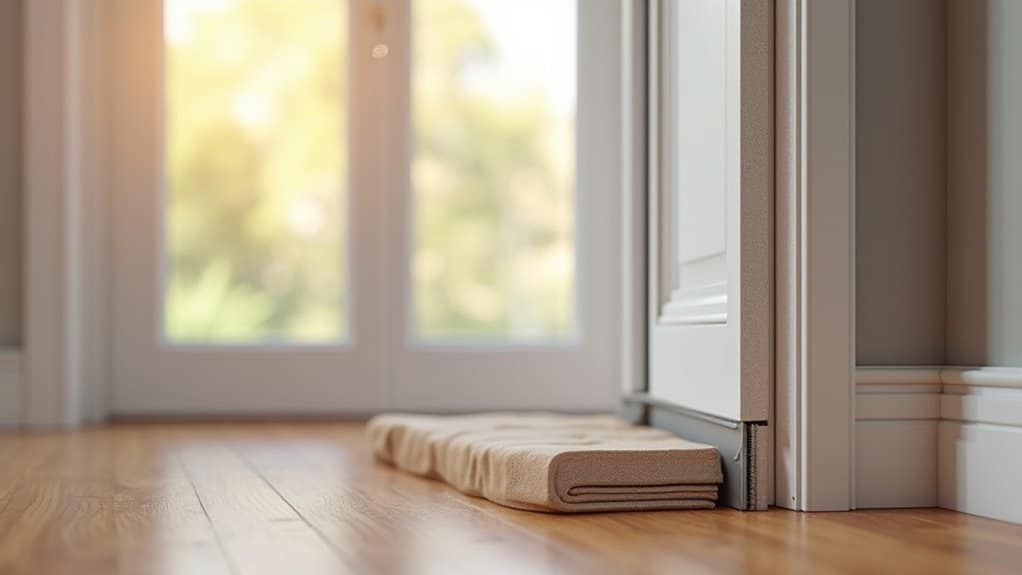
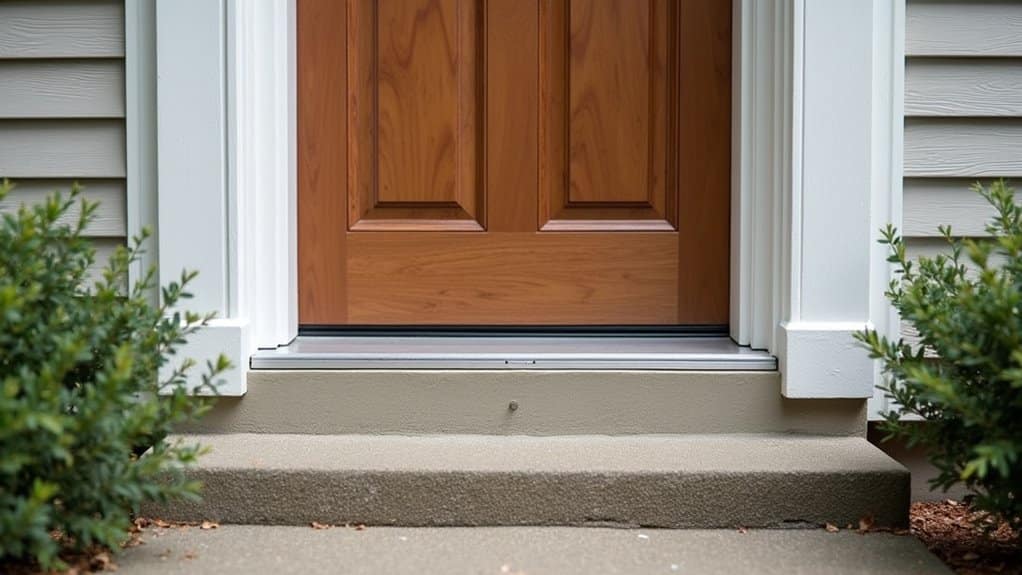
When you close a door or window, you interrupt your home’s pressure equilibrium, forcing your HVAC system to compensate for the sudden airflow restriction. Supply air continues pushing into sealed rooms while return pathways shrink, creating localized positive or negative pressure zones. Negative pressure pulls in outdoor contaminants and radon, while positive pressure forces conditioned air out through gaps. Understanding what’s actually happening inside your walls changes how you’ll approach every fix.
What Positive and Negative Air Pressure Mean in a House
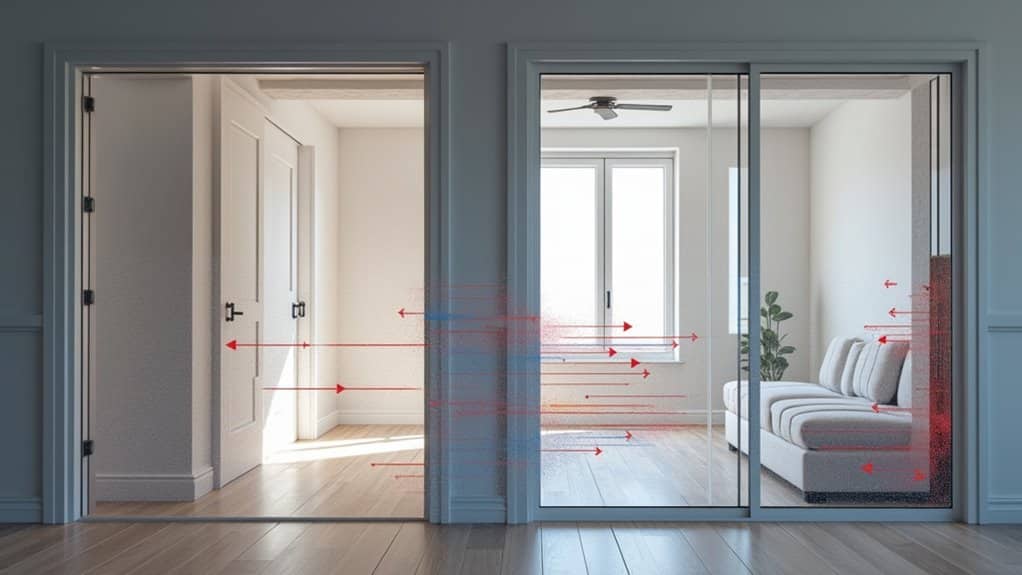
When air pressure inside your home drops below the outdoor level, you’ve got negative air pressure, a condition where outside air gets pulled inward through any available gap or opening. You’ll notice it when doors become hard to open or air rushes in with a hissing sound. It also increases radon infiltration and pulls in contaminants, creating health and energy efficiency concerns.
Positive air pressure works in reverse, your home’s interior pressure exceeds the outside level, pushing air outward. It develops when more air gets supplied than exhausted. While this blocks external contaminants from entering, it traps moisture within walls and structural cavities, triggering condensation issues and mold growth. Both conditions disrupt your home’s ventilation balance and demand careful pressure management. Specialists such as IVAeris Oy recommend maintaining a slight negative pressure of 1-2% as the optimal balance for most residential settings.
How Closing Doors and Windows Throws Air Pressure Off
Something as simple as closing a door or window can disrupt your home’s pressure balance in ways you wouldn’t immediately expect. When you seal off a space, you’re adjusting pressure differences that your HVAC system continuously manages. Managing ventilation disparity becomes critical because exhaust exceeding supply by 10, 15% pulls outside air through gaps, slamming doors shut unexpectedly.
Closing a single door can quietly throw your entire home’s pressure balance into chaos.
Consider these pressure-driven scenarios:
- Negative pressure bows window sashes inward, stressing hinges, locks, and crank operators under sustained force.
- Positive pressure resists door closure when supply exceeds exhaust by 150 cfm or more, pushing air outward.
- Stack effect at lower levels draws cold air inward when indoor temperatures reach 21°C against -1.11°C outdoors.
Each closed door or window shifts your system’s equilibrium immediately. Supply fans with filters are required to maintain positive pressure systems that prevent outside contaminants from infiltrating your living spaces.
Why Your Home’s Air Pressure Gets Out of Balance
Your home’s air pressure falls out of balance when HVAC systems push more supply air than return air can offset, when exhaust fans pull more air out than infiltration replaces, or when the stack effect drives warm air upward and out through upper-level gaps while drawing cold air in at the base. Leaky ducts, oversized blower motors, and poorly balanced supply-and-return systems compound these disruptions by creating localized pressure zones that don’t equalize across the building envelope. Understanding these three pressure-shifting mechanisms, HVAC airflow disruptions, stack effect dynamics, and supply-versus-exhaust imbalances, gives you a clear framework for diagnosing why your home’s air distribution breaks down. When indoor air pressure drops below outdoor levels, negative air pressure pulls outside air through gaps, cracks, and leaks in the building envelope, worsening air quality and driving up energy costs.
HVAC Airflow Disruptions Explained
Balanced air pressure in your home depends on your HVAC system moving the right volume of conditioned air, measured in cubic feet per minute (CFM), through a properly sealed and unobstructed distribution network. Several mechanical failures disrupt this balance, reducing system efficiency by up to 30% and creating uneven temperatures throughout your home.
Common HVAC airflow disruptors include:
- Clogged filters and blocked vents physically restrict CFM circulation, forcing your system to overwork while delivering weak, unbalanced airflow.
- Leaky ductwork and inadequate duct sizing allow conditioned air to escape before reaching target spaces, creating pressure imbalances between rooms.
- Faulty blower motors and insufficient fresh air intake generate inadequate CFM output, leaving distant rooms warmer and compromising whole-home air distribution.
Stack Effect Pressure Shifts
When indoor and outdoor temperatures diverge, your home experiences the stack effect, a buoyancy-driven pressure imbalance that forces air through every unsealed gap in your building envelope. Building pressurization patterns shift seasonally, stressing air-tightness considerations throughout your structure.
| Condition | Pressure Delta | Primary Risk |
|---|---|---|
| Winter (per story) | 4 pascals | Cold infiltration below the neutral plane |
| Summer (per story) | 1.5 pascals | Moisture intrusion at upper floors |
| Extreme cold (60, 80°F delta) | Amplified substantially | Severe drafts, energy loss |
| Stairwells/shafts present | Dramatically higher | Accelerated uncontrolled airflow |
| Sealed envelope | Near zero | Minimal infiltration risk |
Your neutral pressure plane determines where infiltration switches to exfiltration, sealing that boundary stops cyclical energy waste cold.
Supply Versus Exhaust Imbalances
Exhaust fans, leaky ducts, and mismatched HVAC components all strip air from your living spaces faster than your system replaces it, driving your home into negative pressure. Duct pressure measurements confirm when leakage exceeds 10%, signaling urgent energy-efficient upgrades. Oversized units short-cycle, while undersized systems strain without delivering balanced airflow.
- Bathroom fans left running past steam clearance pull makeup air through wall cracks, spiking energy costs
- Duct leaks in attics exhaust 20, 30% of conditioned air before it reaches your rooms
- Closed doors without undercuts block return airflow, creating isolated pressure pockets room by room
Install makeup air ducts, seal duct gaps, and adjust supply dampers to restore measurable pressure equilibrium throughout your home.
Why Doors Slam Shut or Won’t Close All the Way
Doors that slam shut or refuse to close properly often trace back to one of several interconnected mechanical and environmental causes. Hydraulic fluid viscosity changes alter how your closer controls sweep and latch speeds, while door closer component failure from continuous high-traffic use degrades internal mechanisms entirely. Negative air pressure pulls doors shut faster than damping systems absorb, whereas positive pressure forces air outward, resisting closure. Loose hinges, worn hinge pins, and misaligned hardware eliminate controlled movement, producing forceful slamming. Wind forces and ventilation imbalances compound these issues when standard closers lack sufficient capacity to counteract external pressure differentials. You’ll need to systematically evaluate each variable, fluid integrity, spring tension, hinge condition, and building pressure balance, before determining the correct corrective action.
What Unbalanced Air Pressure Quietly Does to Your Windows
Unbalanced air pressure quietly works against your windows in ways that compound over time, degrading both operation and structural integrity before you notice the damage. Negative pressure bows sashes inward, strains locks, and accelerates lubricant breakdown. Positive pressure forces air through frame gaps, stressing seals and increasing window condensation risks as moisture infiltrates structural cavities.
- Inward-bowing sashes grinding against frames during every open-and-close cycle
- Frost or condensation streaking glass edges where cold infiltrating air meets warm interior surfaces
- Darkened frame corners revealing mold colonies fed by pressure-driven moisture
Adopting air leakage prevention strategies, sealing frame perimeters, balancing mechanical ventilation, and inspecting weatherstripping regularly, stops cumulative seal degradation before pressure differentials compromise your windows structurally and energetically.
Simple Fixes That Balance Air Pressure in Your Home
Balancing air pressure in your home starts with adjusting the manual dampers inside your supply trunk ducts, these control how much conditioned air reaches each zone. Use duct airflow proportioning by starting at the weakest vent, then incrementally restricting stronger ones until all registers measure within 10% of design CFM. Install transfer grilles through walls where closed doors trap pressure. For inaccessible finished floors or ceilings, insert passive self-adjusting cartridges into register necks for automatic vent grille adjustments.
| Fix | Application |
|---|---|
| Manual damper adjustment | Supply trunk duct zones |
| Transfer grilles | Closed bedroom doors |
| Passive flow regulators | Finished floors/ceilings |
| Proportional balancing | All registers to design CFM |
Lock dampers once airflow measurements stabilize.
Frequently Asked Questions
Can Air Pressure Imbalances Affect My Home’s Energy Bills Significantly?
Yes, air pressure imbalances can substantially impact your energy bills. When you’re detecting pressure imbalance early, you’ll prevent your HVAC system from overworking to compensate for conditioned air losses. Extreme static pressure increases can raise energy costs by approximately 9%, while negative pressure forces your system to run longer cycles. Optimizing HVAC system performance through proper duct sealing, balanced airflow, and makeup air solutions directly reduces operational costs and eliminates unnecessary energy waste.
How Does Air Pressure Change Differ Between Single and Multi-Story Homes?
In your single-story home, pressure differentials stay minimal due to limited vertical height. In multi-story homes, you’ll experience intensified interfloor pressure differentials, where low pressure pulls air in below the neutral plane and expels it above. Your multi-story stairwell dynamics amplify the stack effect, accelerating warm air movement between floors. This forces greater air infiltration at lower levels while simultaneously driving exhaust at upper levels, substantially straining your energy systems.
Can Pets or Children Accidentally Trigger Dangerous Air Pressure Imbalances Indoors?
Yes, your pets and children can accidentally trigger dangerous air pressure imbalances. Through curious exploration behavior, they’ll repeatedly open and slam doors, disrupting pressure differentials and resuspending settled PM2.5 and VOCs from carpets. Their rapid breathing patterns, small dogs cycling 20, 40 breaths per minute, crawling toddlers inhaling twice the air adults do, amplify pollutant exposure. You’re compounding risk when movement disturbs floor-level contaminants in low-ventilation zones, creating localized pressure fluctuations that concentrate airborne irritants.
Does Outdoor Weather Directly Worsen Existing Indoor Air Pressure Imbalances?
Yes, outdoor weather directly worsens your existing indoor air pressure imbalances. When barometric pressure drops before storms, it amplifies negative pressure already present in your home, pulling unfiltered air through cracks and gaps at higher rates. Outdoor temperature fluctuations intensify pressure gradients between interior and exterior environments, while seasonal humidity changes accelerate moisture infiltration into wall cavities. You’ll experience compounded effects as radon, allergens, and backdrafted carbon monoxide infiltrate more aggressively during these weather-driven pressure shifts.
How Quickly Can Unbalanced Air Pressure Damage a Home’s Structural Integrity?
Unbalanced air pressure damages your home’s structural integrity across multiple time scales. You’ll experience sudden pressure drops immediately when doors close, instantly driving infiltration to 0.99 ach and stressing wall assemblies with moisture. Over months, persistent depressurization accelerates foundation degradation, creating cracks and misaligned frames. Long-term exposure triggers structural reinforcement requirements as wall cavities accumulate moisture damage. You can’t afford to ignore pressure differentials exceeding -0.02 in w.g. without risking compounding structural consequences.