
To improve airflow, point your windows toward prevailing winds so fresh air enters and stale air exits naturally. Place low windows at 0.60, 0.75 meters to draw in cooler ground-level air, and install high windows above 1.8 meters to expel warm air through stack effect convection. Position inlets and outlets on opposing walls to establish cross-ventilation across every room. Mastering door and window placement through these strategies becomes even more effective when you understand the precise mechanics behind each approach.
Point Windows Toward Prevailing Winds for Better Airflow

Positioning your windows toward prevailing winds is one of the most effective passive strategies for improving indoor airflow. By making targeted window orientation adjustments, you’ll align openings with local wind patterns, guaranteeing fresh air entry and stale air exit simultaneously. Consult local climate data to identify predictable wind directions, then optimize wind capture by placing operable windows directly in those paths.
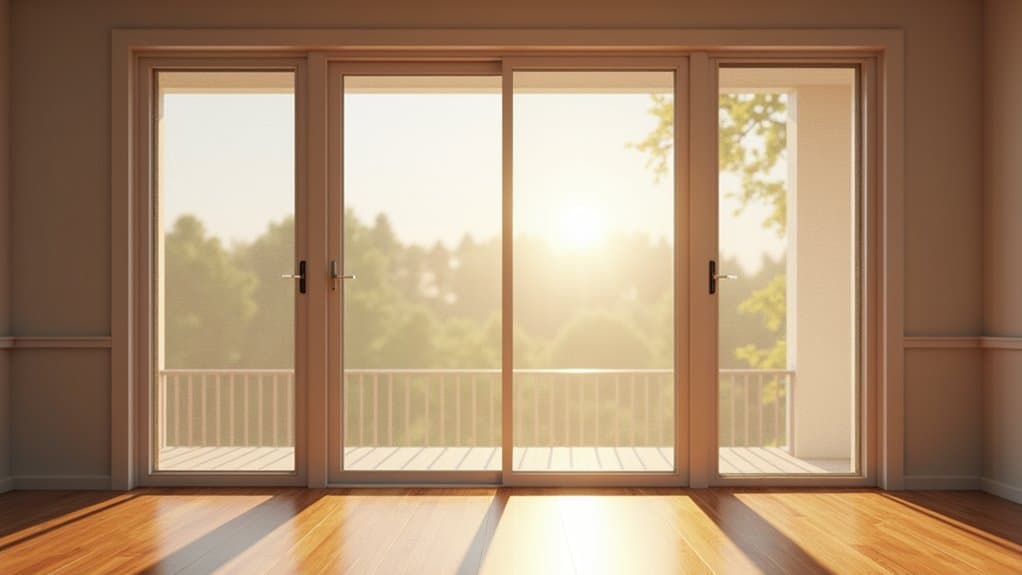
Cross-ventilation occurs when windows on opposite facades align with the wind’s direction, creating pressure differentials that drive consistent airflow through your living spaces. This approach reduces mechanical ventilation dependency, particularly in tropical climates where wind-driven designs perform most efficiently. Casement, tilt-turn, or sliding windows work best in these orientations. Strategic positioning in bedrooms, kitchens, and living rooms certifies circulation reaches every occupied zone without energy expenditure. Proper orientation combined with operable windows and well-placed vents can reduce indoor humidity and improve air quality without additional energy consumption.
Place Windows at the Right Height to Control Airflow
Window height directly determines which air layers your openings intercept, making it one of the most precise variables in passive ventilation design. Position low windows at 0.60, 0.75 meters to draw cooler ground-level air inward. Place mid-level windows between 3, 6 feet to align with seated and standing occupants while maintaining balanced intake and exhaust. Install high windows above 6 feet to expel warm air through stack effect convection.
To optimize room geometries for ventilation, maintain minimum ceiling heights of 2.5 meters and distribute openings evenly across facades. Maximize window opening areas by targeting at least 30% of floor area in total glazing. Pairing low intake windows with high exhaust windows creates an efficient convection loop, regulating indoor temperatures without mechanical systems. Cross-ventilation is significantly enhanced when windows are strategically positioned on opposite walls, maximizing air exchange throughout the room.
Use Cross Ventilation to Move Air Through Every Room

Once you’ve optimized window height to control which air layers your openings intercept, the next variable to address is directionality, specifically, how air moves laterally through your floor plan.
After mastering window height, shift your focus to directionality, how air travels laterally across your floor plan.
Position inlets and outlets on opposing walls to establish a direct, unobstructed airflow path. To maximize window openings, keep pathways between rooms clear of furniture and partitions. Utilize low-profile windows on windward walls to capture cooler ground-level air efficiently.
- Inlet side: Fresh air enters through windward openings
- Outlet side: Warm, stale air exits leeward openings
- Path length: Shorter cross-room distances increase velocity
- Room alignment: Stagger openings slightly to sweep entire floor areas
This configuration drives continuous air exchange without mechanical assistance. Effective cross ventilation also reduces stagnant air buildup, preventing the accumulation of odours and maintaining a fresher, more comfortable indoor environment throughout the home.
Frequently Asked Questions
How Does Window Size Affect Overall Home Ventilation Efficiency?
The window opening size directly controls your home’s ventilation efficiency. You’ll achieve suitable airflow by sizing windows between 1.2 and 1.4 metres wide, as oversized openings increase thermal loads while undersized ones restrict fresh air circulation. Window orientation amplifies this effect, you must align openings with prevailing winds to maximize cross-ventilation. Strategic window opening size distribution across opposing walls creates pressure differentials that drive consistent airflow, reducing your dependence on mechanical cooling systems.
What Door Placements Best Enhance Airflow in Compact Spaces?
To maximize airflow in compact spaces, you’ll want to align doors opposite windows to establish cross-ventilation pathways. Prioritize ideal door swing orientation at a minimum 90-degree arc to eliminate airflow obstructions. Install sliding or bi-fold doors to create wide openings without consuming floor space. You can augment circulation further by incorporating strategically placed doorway fans at key junctural points. Additionally, use door undercuts exceeding 1.5 inches to maintain continuous air exchange between rooms.
How Should Furniture Be Arranged to Avoid Blocking Window Airflow?
To optimize furniture placement and prevent airflow obstruction, you should position pieces at least 4-6 inches from window sills and push larger items toward walls. You’ll want to avoid placing wardrobes or bulky furniture directly in front of windows, as they divert airflow and reduce cross-ventilation efficiency by up to 20%. Centrally placed furniture increases airflow irregularities, while peripheral arrangements maintain unobstructed pathways, improving air distribution performance by nearly 20.9%.
Which Window Styles Provide the Most Adjustable Ventilation Options?
Louvered and casement windows offer you the most adjustable ventilation options. Louvered windows let you fine-tune airflow through precisely angled slats, while casement windows allow you to control directional airflow by adjusting the outward swing angle. You’ll also find awning windows effective for regulated ventilation in varying weather conditions. Double-hung windows give you dual-sash control, enabling simultaneous warm air exhaust and cool air intake through independent sash adjustments.
How Do Transoms and Interior Doors Improve Multi-Room Air Circulation?
Transoms and interior doors markedly enhance multi-room air circulation when you apply strategic door placement and optimized transom design. You’ll enable hot air to vent upward through operable transoms while maintaining privacy. Fixed transoms facilitate passive convection currents, transferring light and airflow between adjacent spaces. By positioning transoms above interior doors, you’re creating continuous air pathways that reduce stagnant zones, support cross-room breezes, and decrease your dependence on mechanical ventilation systems.