
Steel Door Frames: Maximum Impact Resistance and Durability
Steel door frames consistently deliver superior impact resistance and durability that you won’t find in comparable materials. You’ll benefit from frames rated Level A per ANSI A250.5, withstanding up to 1,000,000 use cycles. Impact testing confirms steel resists higher PSF loads than wood or fiberglass, making it ideal for storm-prone regions. Welded steel frames offer maximum deformation resistance under blast conditions, meeting ASTM F2247-18 standards with Category I response, zero permanent deformation post-blast. You’ll appreciate lower steel frame maintenance requirements; frames resist rot, splitting, and pest damage while retaining finish strength for years. Prefinished steel frames are available in 16 and 20 gauge options manufactured from ASTM A366 cold rolled steel or ASTM A653 galvanized steel, ensuring consistent quality and corrosion protection. Steel frames used in fire-rated wall assemblies must be labeled and identified to confirm proper fire-door construction compliance. Supplementarily, you gain superior steel frame acoustic performance, reducing sound transmission better than aluminum alternatives. These advantages position steel as the industry’s most cost-effective choice for extreme weather protection.
Aluminum Door Frames: Lightweight Strength for Coastal Protection
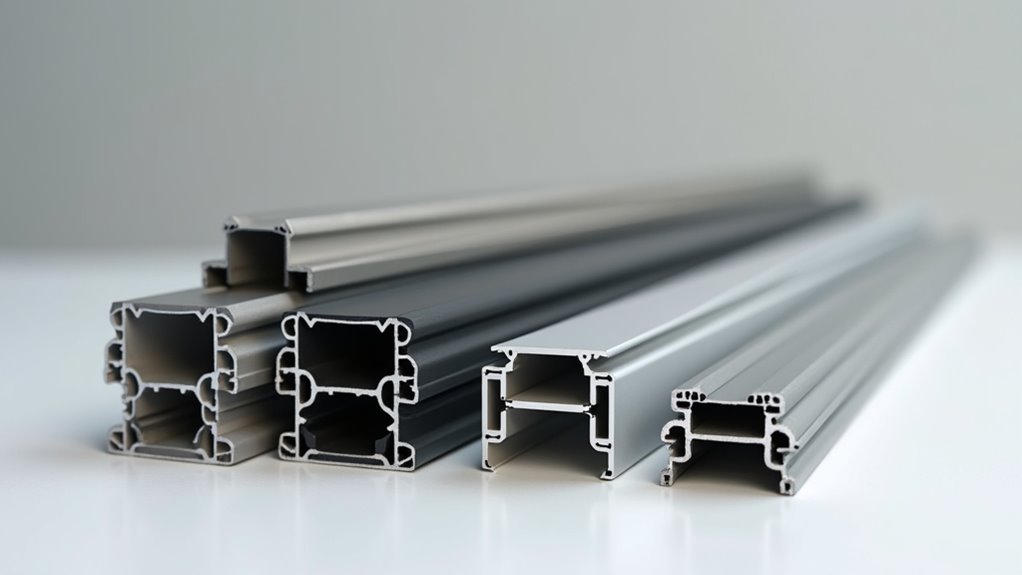
While steel frames excel in high-impact environments, aluminum door frames offer a distinct advantage for coastal properties, they combine lightweight construction with exceptional corrosion resistance that makes them superior to steel in saltwater climates. Aluminum’s natural oxide layer provides outstanding surface oxidation resilience, preventing rust without requiring maintenance staining or repainting. You’ll benefit from multi-chambered designs that deliver impact-rated performance while supporting modern, oversized glass panels. EPDM gaskets and UV-resistant coatings guarantee superior weatherproofing, minimizing water infiltration and drafts. This airtight construction delivers energy conservation benefits by reducing HVAC strain. You can expect lifespan exceeding several decades in harsh marine conditions. Aluminum frames can be further protected with pre-anodised paint coatings for additional durability in extreme coastal environments. Reinforced profiles and multi-point locking systems amplify security, while lighter weight simplifies installation and reduces structural load on your property’s supporting elements. Aluminum windows and doors are fully recyclable, contributing to environmental conservation efforts and making them a sustainable choice for coastal homeowners committed to reducing their carbon footprint.
Fiberglass Door Frames: Superior Weather and Impact Performance
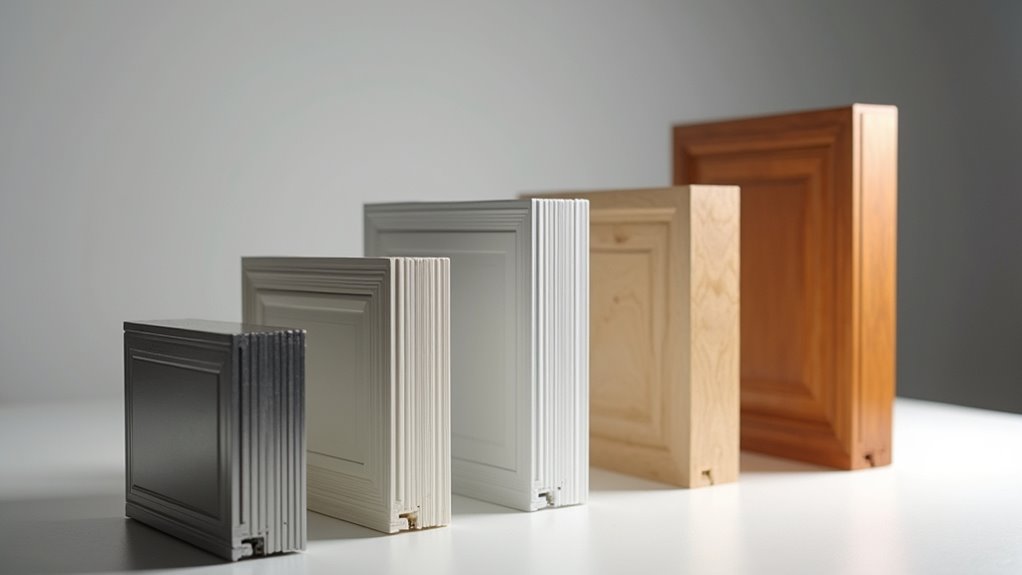
When storm conditions demand uncompromising performance, fiberglass reinforced polymer (FRP) door frames deliver engineered resilience that outperforms traditional materials. You’ll find they withstand Category 5 hurricane forces while maintaining structural integrity, thanks to their 30,000 psi tensile and compressive strength. FRP frames absorb negligible moisture (0.27%), preventing warping or rot, critical advantages in humid coastal environments. Their superior UV resistance and thermal expansion management eliminate the dimensional instability plaguing aluminum and wood alternatives. You gain corrosion immunity without maintenance, plus air infiltration rates as low as 0.31 cfm/ft² at 25 mph. Missile impact tests confirm debris resistance, while polyurethane cores provide thermal performance comparable to or exceeding wood frames. Unlike steel frames which are prone to rust in coastal salt air environments, fiberglass maintains corrosion resistance indefinitely. The fully pultruded, completely sealed design ensures water and chemical resistance for long-term durability in the harshest commercial environments. These engineered properties translate to 25-year warranties and decades of reliable service.
Engineered Wood and Composite Frames: Traditional Aesthetics With Modern Durability
You’ll find that laminated veneer technology gives you dimensional stability and wind resistance 2-3 times greater than conventional lumber framing, while composite core reinforcement systems, including concealed structural steel and impact-rated materials, enable compliance with ICC500 and FEMA 361 hurricane codes up to 250 mph wind loads. When you apply weather-resistant sealants to these engineered assemblies, you create a multi-layered defense against moisture infiltration, rot, and debris impact without sacrificing the traditional wood appearance that architectural fidelity demands. This combination of factory-sealed lamination, structural reinforcement, and protective coatings delivers storm performance comparable to fiberglass while preserving classic aesthetics and customization options. These tornado-resistant door units are tested as complete assemblies to ensure optimal performance and reliability under extreme weather conditions. Meticulous sealing and finishing during manufacturing prevents moisture issues that compromise structural integrity in high-wind regions, ensuring dimensional stability across seasonal temperature and humidity changes. Prior to installation, measure the rough opening and verify that your frame depth accounts for wall thickness including drywall, as improper sizing can compromise the weather seal integrity of your storm-resistant assembly.
Laminated Veneer Technology Advantage
Because traditional solid wood frames can’t match the structural performance demands of modern storm-resistant doors, engineered wood and composite frames‘ve emerged as the superior alternative. You gain exceptional structural integrity through laminated veneer construction, where multiple wood layers bonded with advanced adhesives create frames considerably stronger than solid wood counterparts.
Your reinforcement methods include strategic grain orientation optimization and multi-directional layering that effectively disperses impact forces and wind loads. These engineered frames resist warping, splitting, and cracking under extreme conditions, maintaining dimensional stability through repeated wet/dry cycles. Composite frames offer mold and moisture resistance that traditional wood cannot provide, making them ideal for storm-prone coastal regions. Hurricane-certified products featuring these advanced engineering techniques have been tested to withstand flying debris impact and high-wind pressure conditions.
You’ll also benefit from amplified moisture resistance compared to solid wood, reducing rot and decay risk in storm-prone regions. Factory-applied protective finishes and hybrid composite jambs further extend service life while preserving authentic hardwood aesthetics, delivering both performance and traditional visual appeal. The 10 Series full view laminated storm door exemplifies this advanced engineering, combining durable construction with customizable color options and hardware finishes for homeowners seeking reliable storm protection.
Composite Core Reinforcement Systems
While laminated veneer construction substantially improves frame durability, composite core reinforcement systems push performance boundaries even further by integrating engineered materials, fiberglass-reinforced polymers (FRP), foam cores, and embedded metal components, that deliver measurable structural advantages. You’ll find layered reinforcements strategically positioned within composite frames, utilizing polyurethane engineered adhesives that create seamless, rigid bonds between face sheets and cores. These systems achieve tensile strengths of 30,000 psi and compressive strengths matching or exceeding traditional wood. Aluminum-reinforced posts augment security, while mortised hinge edges support doors up to 75 kg. Testing confirms compliance with fire and impact safety standards (NFPA 252, UL10C). Composite materials offer a balance of strength and durability without the downsides of wood or metal, making them an ideal choice for long-term structural integrity. The result: you gain superior load distribution, dimensional stability, and structural consistency that outperforms conventional frame designs across decades of service. Additionally, the diverse material composition of composite frames provides enhanced security features that protect homes from sustained forced entry attempts while maintaining energy efficiency benefits.
Weather-Resistant Sealant Application
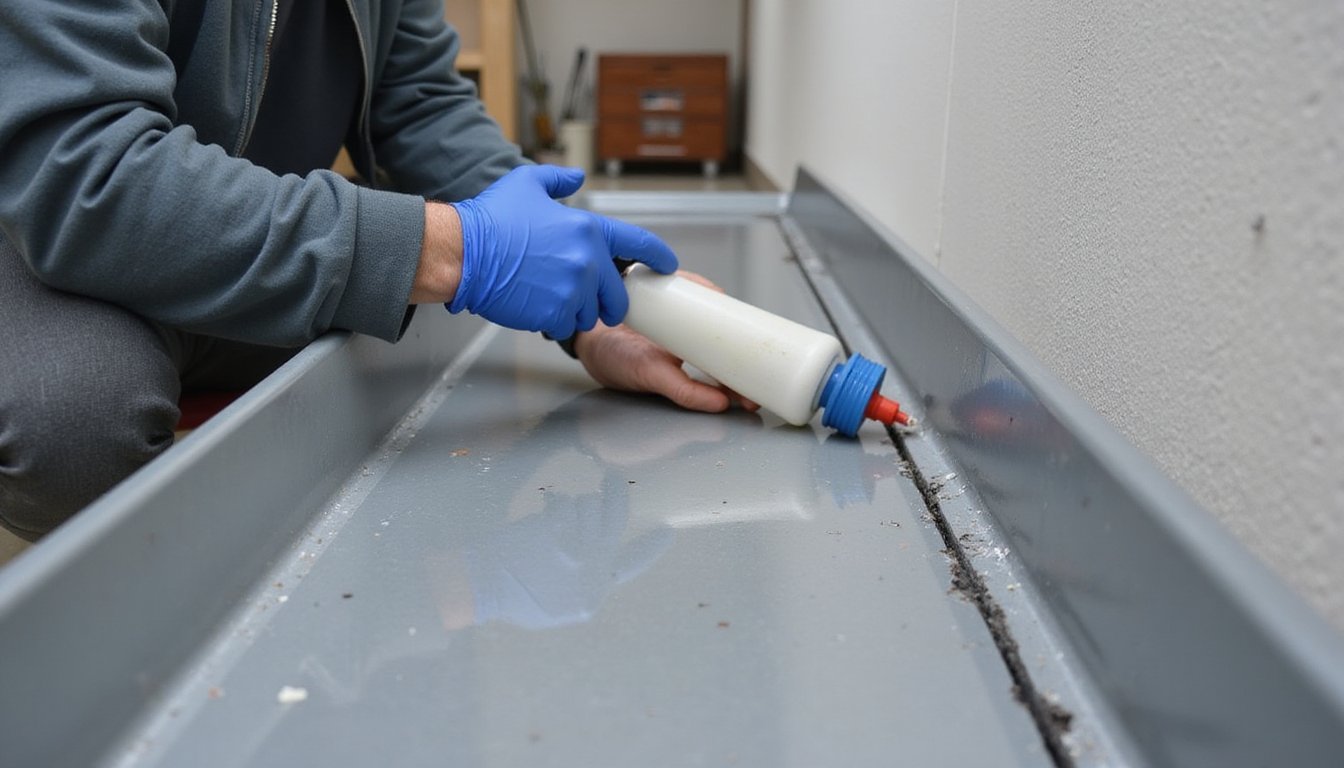
Protecting engineered wood and composite frames from moisture infiltration demands strategic sealant selection and careful application at all external joints, gaps, and substrate interfaces. You’ll achieve optimal weather resistance by implementing these proven techniques:
- Surface Preparation: Clean all areas thoroughly, removing dust, oil, and deteriorated sealant before application to ensure maximum adhesion and performance longevity.
- Sealant Selection: Choose neutral cure silicone or hybrid polymer products certified for ±25% movement capability, ensuring durability through temperature fluctuations.
- Application Method: Apply continuous beads with uniform thickness, smoothing for complete coverage that prevents water ingress at critical shift points.
- Aesthetic Finishing: Select paintable acrylic sealants offering mold-free performance, allowing you to match your frame’s finish while maintaining traditional visual appeal without compromising weather protection.
Vinyl Door Frames: Energy Efficiency and Moisture Resistance
You’ll find that vinyl door frames deliver thermal performance with U-factors reaching 0.20-0.25 when paired with Low-E glass and argon gas, reducing your HVAC costs by 20-30% and recouping installation expenses within 1-3 years. Their non-porous construction provides inherent moisture resistance, eliminating warping, rot, and corrosion while extending frame lifespan to 20-30 years without painting or sealing maintenance. Installation simplicity and lower material costs make vinyl frames a cost-effective choice, especially when combined with ENERGY STAR incentives and the improved resale value they bring to your home.
Thermal Performance and Insulation
How does vinyl achieve superior energy efficiency in storm-resistant door frames? Vinyl’s inherent low thermal conductivity outperforms metal alternatives by up to 1,000 times, vastly reducing heat transfer. You’ll benefit from strategic thermal bridging reduction through multi-layered insulation design:
- Multi-chamber construction, Premium frames feature 4-6 air-filled chambers that create thermal barriers, mimicking thermos bottle insulation principles.
- Foam-filled chambers, Polyurethane insulation virtually halts interior air movement, dramatically lowering U-factor performance beyond standard air pockets.
- Homogeneous composition, PVC’s consistent molecular structure eliminates weak heat leakage points, maintaining uniform insulation throughout.
- Draft elimination, Improved thermal resistance reduces HVAC reliance and measurable utility bill savings while improving indoor comfort.
This combination delivers energy efficiency rivaling fiberglass at lower cost.
Moisture and Weather Durability
While vinyl’s multi-chambered construction excels at minimizing thermal transfer, its performance against moisture and weather exposure proves just as compelling. You’ll find vinyl frames are inherently waterproof, preventing swelling, warping, and rot, issues that plague wood alternatives. Their thermal expansion mitigation properties maintain structural integrity through temperature swings, resisting the brittleness that affects other materials in extreme cold.
Vinyl’s corrosion resistance attributes eliminate rust concerns associated with metal frames. UV stabilizers embedded in the PVC compound reduce fading and warping risks. Welded frame and sash corners create water-tight seals, delivering near-total imperviousness to weather damage.
Unlike wood requiring regular sealing or metal demanding protective coatings, vinyl demands only minimal maintenance. You’ll wipe it with a damp cloth occasionally. This combination of durability and low upkeep makes vinyl exceptionally cost-effective for storm-resistant applications.
Installation Ease and Cost
Three key advantages make vinyl door frames exceptionally practical for residential storm applications: pre-fabricated kits that streamline setup, lightweight construction that simplifies handling, and standardized sizing that minimizes on-site modifications. You’ll find budget-friendly options that reduce comprehensive project expenses while maintaining performance standards.
- Installation costs average $357, $551 per door, with vinyl typically positioned in the lower to mid-range
- Labor requirements run $32, $38 hourly, often totaling less due to easier vinyl handling compared to steel alternatives
- Single-component replacements cost $75, $200 materials plus $150, $300 labor, providing economical partial upgrades
- Retrofit considerations demand higher expenses for older homes requiring frame removal and opening preparation
Vinyl’s flexibility prevents splitting or warping, reducing alignment complications during installation. Skilled DIY enthusiasts can handle standard openings, though professional installation guarantees proper sealing and long-term durability.
Understanding Design Pressure Ratings and Installation Best Practices
Design pressure ratings establish the maximum wind and pressure loads a door frame can withstand before structural failure occurs, and you’ll need to understand these metrics to select appropriate storm-resistant frames for your specific climate zone. Structural integrity requirements vary based on local building codes and exposure categories. You’ll calculate impact and pressure load calculations using factors like wind speed, elevation, and terrain roughness. Steel frames typically achieve the highest pressure ratings due to superior strength, while aluminum’s multi-chambered construction and fiberglass’s reinforced cores provide comparable performance. Proper installation proves critical, you must guarantee frames are secured with reinforced fastening systems and aligned precisely to withstand design pressures. Neglecting installation specifications can compromise even premium frame materials, reducing their actual performance below rated capacity.
Frequently Asked Questions
How Do Door Frame Material Costs Compare When Budgeting for Hurricane-Resistant Installation?
When you’re budgeting for hurricane-resistant door frames, you’ll find steel costs $1,500, $4,000 installed, while aluminum runs $2,500, $8,000+. Impact-resistant upgrades add 20, 100% premiums over standard frames. Your total investment, $2,900, $4,000+, significantly exceeds traditional doors ($796, $2,479+). Budgeting factors include certifications, hardware reinforcements ($200, $800), professional installation ($500, $1,000+), and permits ($50, $200). Material strength versus cost considerations help you optimize storm resistance within your financial constraints.
What Is the Typical Lifespan of Each Material Type in Extreme Coastal Environments?
You’ll find lifespans vary notably based on typical weathering patterns in coastal humidity. Steel frames last 30, 50 years with anti-corrosion maintenance; aluminum marine-grade alloys manage 15, 25 years; fiberglass and composites reach 20, 40 years requiring minimal upkeep; wood frames deteriorate fastest at 10, 15 years unless you’re using premium hardwoods treated annually, which can stretch to 25, 30 years. You’re balancing durability against maintenance intensity when selecting materials for extreme environments.
Can Existing Door Frames Be Retrofitted With Reinforcement, or Must They Be Replaced?
You can retrofit most existing door frames using reinforcement techniques like steel inserts, multi-point locking systems, and high-gauge metal plates. However, replacement considerations become necessary if your frame’s base material shows rot, severe warping, or structural damage. You’ll want professional assessment to determine viability, as retrofitting rarely achieves factory-built impact ratings. For maximum storm resistance in hurricane zones, complete replacement with certified, impact-rated frames often proves more effective than reinforcement alone.
Which Material Requires the Least Maintenance Over a 10-Year Period in Salt Spray Areas?
You’ll find that uPVC frames demand the least maintenance over a 10-year period in salt spray areas. They’re highly corrosion resistant and moisture-proof, requiring only occasional cleaning with a damp cloth. Unlike aluminum frames that risk pitting corrosion or stainless steel’s higher upfront costs, uPVC delivers exceptional durability with virtually no maintenance demands. Their mildew-proof properties and inherent resistance to environmental degradation make them your most practical, low-effort choice for coastal environments.
How Do Frame Materials Perform in Freeze-Thaw Cycles Common in Certain Storm-Prone Regions?
You’ll find that frame material thermal performance and expansion/contraction directly determine freeze-thaw durability. Fiberglass frames outperform competitors, exhibiting minimal dimensional changes during temperature cycles. Steel and aluminum frames maintain structural integrity when properly coated, though aluminum can become brittle in prolonged subzero conditions. Wood frames don’t rank well, they’re prone to warping, cracking, and moisture infiltration. You’re best served selecting fiberglass or thermally broken metal frames for superior freeze-thaw resistance in storm-prone regions.