
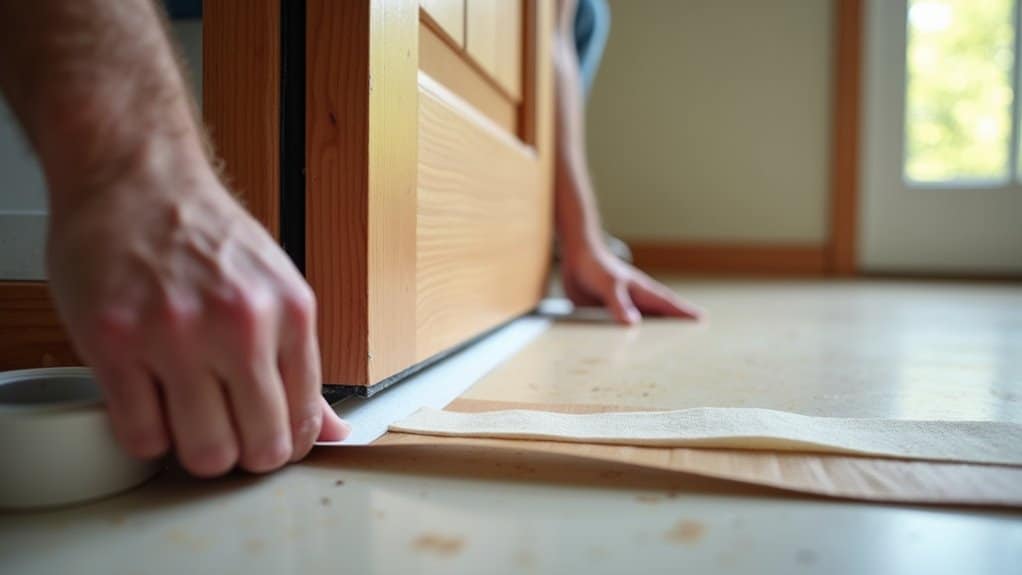
Door protection plates strengthen safeguard by reinforcing the exact surfaces where forced entry concentrates its impact. They absorb kicks, resist prying, and distribute strike force across your door’s frame rather than letting it fracture at a single point. Upgrading to thicker steel gauges and longer fasteners anchored into wall studs reduces kick-in success by 85%. Choosing the right plate combination transforms your entire door assembly into a layered barrier, and there’s considerably more to understand about doing it correctly.
What Are Door Protection Plates and Why Do They Matter?
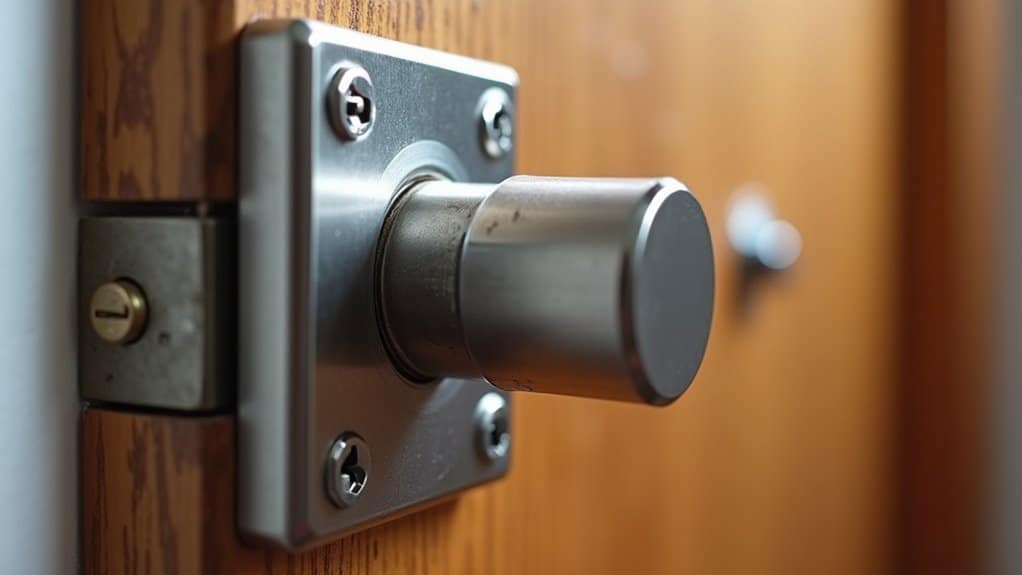
Door protection plates are surface-mounted hardware components that shield vulnerable door areas from damage, dirt, and chemical exposure. You’ll find these metal or plastic strips installed across institutional and commercial buildings where high traffic use cases demand consistent door performance. They absorb impacts from feet, carts, gurneys, and cleaning equipment that would otherwise deteriorate door surfaces rapidly.
The importance of appearance in professional environments makes these plates essential beyond simple durability. Schools, hospitals, and commercial facilities rely on them to maintain clean, professional aesthetics while extending door lifespan considerably. Without protection plates, repeated daily contact creates scratches, dents, and surface wear that compromise both function and presentation.
Fastened with sheet metal screws for maximum holding power, these plates represent a straightforward, cost-effective investment in long-term door integrity. The main categories include armor plates, kick plates, mop plates, and stretcher plates, each designed to address specific types of door exposure and traffic conditions.
Signs Your Current Strike Plate Is a Security Risk
Your strike plate may already be compromising your door’s safeguard through three critical failure points: visible wear and damage, inadequate screw length, and frame vulnerability to spreading. If you notice rust, cracks, or peeling finish on the plate’s surface, those aren’t cosmetic issues, they’re structural warnings that the hardware can’t withstand forced entry. Short screws that don’t reach wall studs and a frame that shifts or spreads under pressure compound the risk, effectively reducing your door to a minimal deterrent against kick-in attacks. Upgrading to a security strike plate made from heavier gauge steel with a reinforced box behind the mortise significantly improves your door’s resistance to forced entry.
Visible Wear and Damage
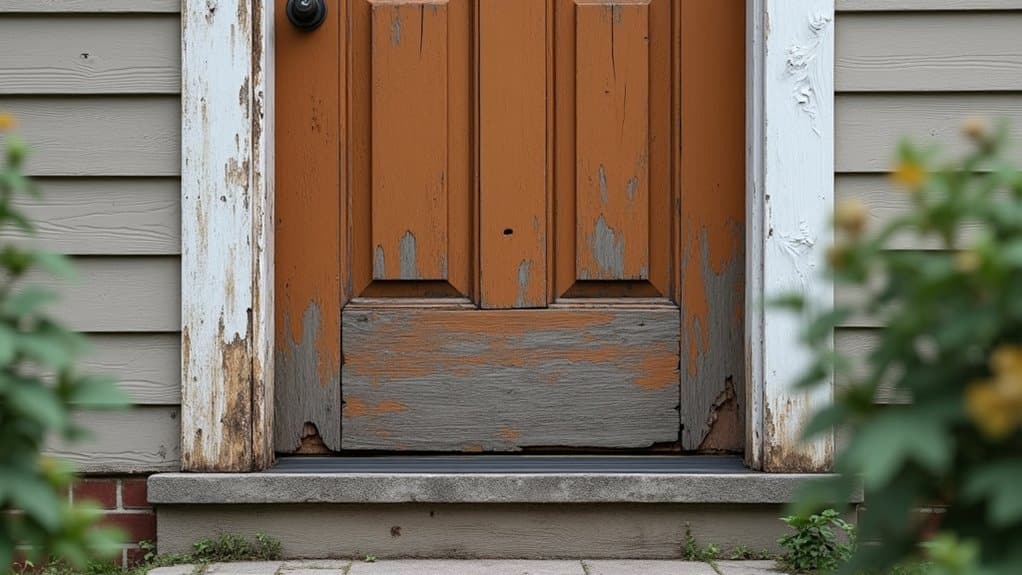
A strike plate showing visible wear or damage is no longer performing its primary function, keeping your door protected. Corrosion patterns on the plate’s exterior signal material breakdown that weakens structural integrity. Scratches, dents, or bending indicate tampering attempts, while deterioration symptoms like rust compromise the plate’s ability to resist forced entry.
You should also inspect the surrounding wood frame. Hairline cracks, splintering, or splits near the strike plate reduce its support foundation, making it considerably easier for intruders to compromise. High-traffic exposure accelerates wear, and a worn plate requires much less force to defeat.
Don’t ignore physical damage, bent or corroded strike plates allow latch misalignment, reducing locking effectiveness. Replace any strike plate displaying these warning signs immediately to restore your door’s protective performance. Soft or spongy wood surrounding the strike plate indicates rot from moisture, which prevents screws and hardware from remaining securely anchored in the frame.
Short Screws Present
While visible damage is easy to spot, short screws present a hidden vulnerability that’s just as dangerous. If your strike plate uses standard factory screws, they’re likely 1 inch long, a critical short screw risk you can confirm by removing them with a Phillips screwdriver and measuring directly.
These short screws anchor only into the thin door jamb, never reaching the structural 2×4 framing behind it. That’s a severe framing vulnerability, under a forceful kick, the plate shifts, the jamb splits, and your deadbolt fails within seconds.
Replace them immediately with #10 3-inch construction screws. Drill 1/8-inch pilot holes, install one screw at a time to maintain alignment, and use a T25 Torx bit. Three-inch screws increase holding strength tenfold over 1-inch versions.
Frame Spreading Vulnerability
Frame spreading is a structural failure mode that turns your door frame into a liability, and your strike plate is often the first thing that exposes it. When lateral force hits your door, the frame acts as a fulcrum, concentrating stress directly around the lock. Three warning signs confirm you’re dealing with frame fastening vulnerabilities:
- Visible light gaps between the door and frame indicate poor alignment that prying tools exploit immediately.
- Rot, warping, or damage near the strike plate and hinges signals compromised structural integrity.
- Hollow or thin-gauge metal frames that flex under pressure release the latch from its strike pocket.
Poor anchor positioning accelerates every failure point. Without proper frame anchoring into wall studs, the entire assembly shifts during forced entry.
Why Standard Strike Plates Fail Under Forced Entry
When a burglar kicks your door, standard strike plates fail for three interconnected reasons: shallow screw penetration, thin-gauge metal, and short lips. Your typical strike plate uses 3/4-inch screws that barely reach the door jamb’s soft wood, pulling out under a single forceful kick rather than anchoring into the structural framing. The plate’s thin gauge bends on impact, and its short lip gives the latch bolt just enough room to spread the frame apart, compromising the entire assembly.
Shallow Screw Penetration Fails
Standard strike plates ship with 1-inch screws that anchor only into the door jamb, never reaching the wall studs behind it. This inadequate anchoring creates a critical vulnerability, your jamb absorbs the full kick impact alone. Force concentration on that thin wood causes rapid splintering and frame deformation under attack.
Three failure mechanisms explain why standard screws collapse under forced entry:
- Jamb splintering, 1-inch screws can’t distribute impact energy into solid framing, causing wood to fracture immediately.
- Strike plate pullout, The plate rips free as the flexible jamb twists under pressure.
- Deadbolt dislodgement, Without stud penetration, the bolt throw loses its seat entirely.
Replacing standard screws with 3- to 3.5-inch screws eliminates these failures by anchoring directly into rough framing.
Thin Gauge Deflects Easily
Most residential strike plates ship in 18-gauge steel, just 0.048 inches thick, and that thin material deflects under the same impact loads your door absorbs every day. Deformation characteristics emerge quickly: a 350-pound side load bends 18-gauge steel enough to misalign the bolt channel, preventing full latch engagement. These deflection patterns worsen under forced entry, where kick impacts generate concentrated stress the thin plate can’t redistribute. Once deformed, the plate never fully recovers, leaving a permanent gap between bolt and frame. Upgrading to 12-gauge (0.104 inches) eliminates this failure mode entirely. That material absorbs equivalent forces without measurable deflection, maintaining precise bolt alignment through repeated impacts. Thin-gauge strikes don’t just underperform, they actively compromise the door assembly you’re relying on for protection.
Short Lips Allow Spreading
Every standard strike plate ships with a lip too short to anchor meaningfully into the door frame, and that single dimensional shortfall opens the door, literally, to frame spreading. When you apply kicking force, the frame deforms, disengaging the bolt entirely without withdrawing it.
Short lips create three critical failure points:
- Frame deformation occurs under side loads below 350 pounds, accelerating breach attempts.
- Bolts bottom out instead of latching, bypassing engagement geometry completely.
- Screws strip rapidly, loosening the plate and enabling progressive frame shift.
Strengthening door frames requires extended lips that demand deeper mortising and distribute impact forces evenly. Frame vulnerability reduction depends entirely on lip depth, short lips simply can’t resist the spreading forces that standard kicks generate within seconds.
Why Steel Gauge Is the First Number to Check
When shopping for door protection plates, steel gauge is the first specification you should check, it directly determines how much physical resistance the plate provides. Lower gauge numbers mean thicker steel, which translates to stronger steel durability considerations against denting, prying, and forced entry. Standard 24-gauge plates measure only 0.0239 inches thick, adequate for basic applications but insufficient for serious safeguarding needs. Gauge thickness comparisons reveal why upgrading matters: 22-gauge measures 0.0299 inches, while 20-gauge reaches 0.0359 inches, containing up to 49% more steel than 24-gauge. That additional material directly resists bending and cutting. For high-crime areas, you’ll want 20-gauge or lower. For moderate protection, 22-gauge balances cost, weight, and guardianship effectively. Don’t overlook this number, it’s foundational to every other performance claim a plate makes.
How Longer Fasteners Make Door Frames Harder to Kick In
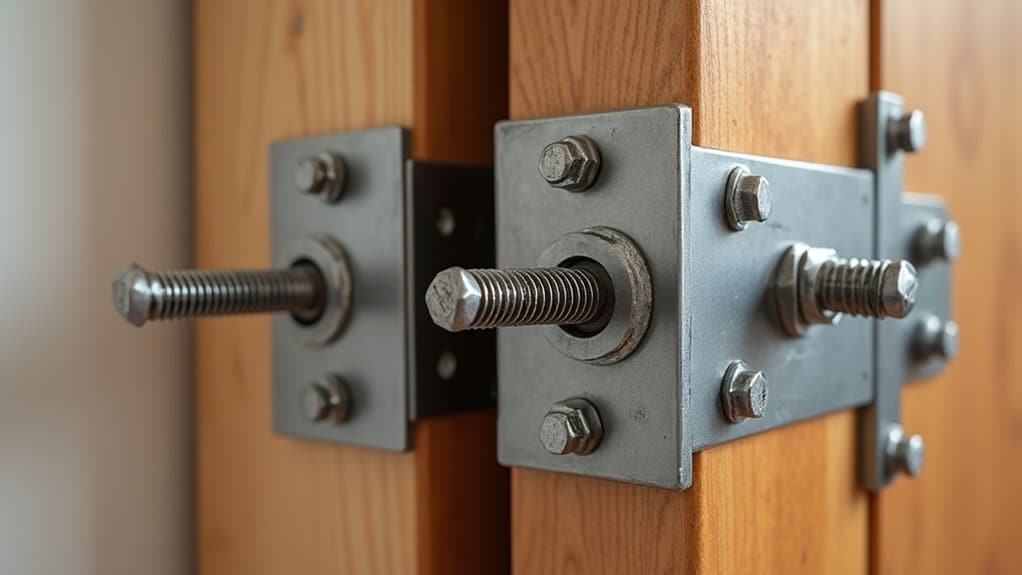
When you swap out standard one-inch factory screws for three-inch stainless steel fasteners, you drive past the jamb and anchor directly into the wall stud behind it. That deeper penetration transforms your strike plate and hinges from jamb-dependent fixtures into stud-secured components, distributing kick-force across the structural framing rather than concentrating it on splintering wood. You’re fundamentally turning a single weak point into a load-sharing system that makes forced entry exponentially harder.
Deeper Frame Penetration
Standard screws typically sink just 1 inch into a door frame’s stud, but longer fasteners, 3 inches or more, drive deeper into the structural framing, anchoring the jamb directly to the wall’s load-bearing members. This depth transforms rigid wall reinforcement and impact load mitigation into measurable outcomes:
- Force Distribution, Deep fasteners spread kick impact across multiple structural members, preventing concentrated stress fractures.
- Jamb Stability, Extended screws resist pull-out forces exceeding 4 psi, keeping the frame seated during impulse durations up to 200 ms.
- Entry Resistance, Forensic studies confirm 3-inch frame screws reduce kick-in success by 85%.
You’re fundamentally converting a vulnerable joint into a structurally integrated connection that withstands both sustained and sudden forced-entry loads.
Load Distribution Benefits
Anchoring your frame with longer fasteners is only half the equation, what those fasteners connect to determines how effectively impact energy gets managed. Kick plates bolted across a wider span achieve structural integrity reinforcement by tying multiple frame points together, preventing any single zone from absorbing concentrated stress. When a boot strikes the door, the metal plate’s surface area immediately begins impact force distribution, redirecting energy laterally rather than funneling it into the frame’s weakest section. Broader plates, ranging from 18 to 48 inches, reduce peak pressure per square inch, cutting frame flex by over 50% under repeated assault. That measurable reduction translates directly into harder breach attempts, with plated doors requiring three times more force to kick in than unprotected alternatives.
Wide Lip vs. Standard Strike Plates: Which Is More Secure?
Although both strike plates serve the same fundamental purpose, the wide lip variant outperforms its standard counterpart in nearly every safeguard metric that matters. You’ll notice three critical protective differentials:
- Frame spreading resistance, The extended 1-1/4″ to 1-1/2″ lip demands substantially more deformation before latch slip occurs.
- Deadbolt accommodation, Wide lip plates support full 1″ throw versus standard’s vulnerable 1/2″ latch bolts.
- Fastener depth, 3-inch screws anchor directly into wall studs, replacing short 3/4-inch jamb-only screws.
Standard plates introduce plate alignment issues and surface damage concerns under repeated impact, while Grade 1 wide lip strikes withstand 800 pounds of pull force. For high-protection environments, the wide lip’s 12-gauge construction isn’t optional, it’s essential.
Wrap Plates, Latch Guards, and Kick Plates: How Each Stops a Different Attack
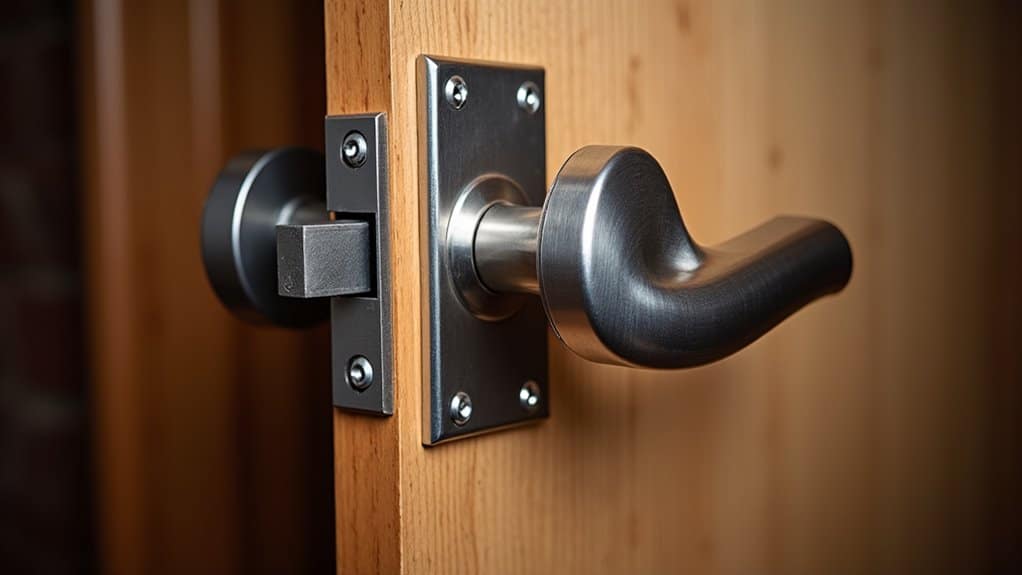
When forced entry occurs, attackers exploit three distinct vulnerabilities, the lock face, the strike zone, and the door’s lower panel, which is precisely why wrap-around plates, latch guards, and kick plates each target a different attack vector. Wrap-around plates surface-mount across the door corner, blocking lock-picking and prying attempts. Latch guards replace standard strikes with one-piece reinforcements secured by 3-inch screws anchored into wall studs, preventing frame separation during kick-ins. Kick plates create 2mm stainless steel barriers at impact zones, absorbing strike force across metal, fiberglass, and wood doors. A door strength comparison between single-layer and combined systems reveals dramatically reduced forced entry success rates. Integrating all three components delivers protective benefits by addressing every attack vector simultaneously, creating layered safeguarding no single plate achieves alone.
What Grade 1 Certification Actually Means for Your Door
Grade 1 certification isn’t just a marketing label, it’s the highest performance tier under ANSI/BHMA standards, and it tells you exactly how a lock or door hardware component will perform under real-world pressure. When you’re evaluating hardware using ANSI/BHMA certification criteria, you’re measuring durability and protective performance metrics against rigorous benchmarks.
Grade 1 certification isn’t a marketing label, it’s measurable proof of how hardware performs when real-world pressure demands it.
- 1 million operational cycles, confirming long-term mechanical reliability under heavy use.
- Torque resistance of 9 lbf-in, validating strength against forced rotation attacks.
- Pull strength, impact resistance, and tamper protection testing, ensuring the hardware holds under physical assault.
Look for ANSI A156.2 or A156.13 references on packaging. If a product lacks independent BHMA verification, don’t install it on a high-traffic or critical-entry door.
Wood vs. Metal Frames: Which Door Protection Plates Work Where?
Your frame material is the single most decisive factor in determining which door protection plates will actually perform under stress. In any door materials comparison, steel frames integrate protection plates seamlessly, supporting multi-point locking systems and resisting impact without structural compromise. Hollow metal frames with plates outperform wood counterparts consistently.
Wood frames can accept protection plates, but moisture weakens the surrounding material over time, reducing the plate’s effectiveness. You’ll face higher long-term costs from cracking, swelling, and eventual frame failure.
Cost benefit analyses favor steel decisively. Steel frames require minimal maintenance, hold plates securely under forced-entry attempts, and won’t deteriorate seasonally. If you’re installing plates on wood frames, you’re compensating for an inherently vulnerable substrate, a temporary fix to a structural problem.
How to Choose the Right Door Protection Plate for Your Setup
Choosing the right door protection plate starts with narrowing down the plate type to match your specific traffic conditions. Consider these three critical selection factors:
Choosing the right door protection plate begins with one essential step: matching the plate type to your traffic conditions.
- Traffic type, Use kick plates for foot traffic, armor plates for cart and rolling equipment, and stretcher plates for healthcare environments.
- Material options, Select metal construction in finishes like rustic black or hand-distressed for durability against heavy impact, scratches, and dents.
- Sizing accuracy, Subtract 2 inches from your door’s total width, and use custom sizing availability for oversized or architecturally unique doors.
For fire-rated doors, you’ll need plates at or below 16 inches to meet compliance standards. Matching plate height, type, and material to your environment guarantees lasting, effective protection.
Frequently Asked Questions
How Much Does Professional Strike Plate Installation Typically Cost Homeowners?
Professional strike plate installation typically costs you $15, $45 for combined hardware materials pricing and labor. You’ll pay $4.98, $25 per plate for the component itself, while average labor costs run within your locksmith’s standard door lock service, ranging $137.65, $216.26 per door. If you’re adding reinforced strike shields, expect materials and installation to reach $45 total. Don’t forget the flat $15 trip fee contractors typically charge.
Can Door Protection Plates Be Painted or Finished to Match Door Hardware?
Yes, you can paint or finish door protection plates to match your door hardware precisely. Steel and aluminum plates accept customized color finishes when you apply proper sanding, priming, and metal-specific paints. Powder coating, anodized finishes, and custom electroplating deliver tailored aesthetic designs that coordinate seamlessly with existing hardware. You’ll want to use manufacturer-approved paints on fire-rated plates to maintain certifications. Clear coats preserve your chosen finish, ensuring long-term durability under high-traffic conditions.
Do Door Protection Plates Affect Home Insurance Premiums or Coverage Rates?
Door protection plates can positively impact your home insurance premiums by delivering enhanced safeguarding advantages that insurers recognize as reduced risk. When you install these reinforcements, you’re actively lowering break-in vulnerability, which may qualify you for potential insurance discounts. You should notify your insurer about this upgrade, as improved door safety demonstrates proactive risk mitigation. Insurers typically reward verifiable security improvements with reduced premiums, giving you both better protection and potential cost savings.
How Often Should Existing Door Protection Plates Be Inspected or Replaced?
You should conduct periodic inspections of your door protection plates at least annually, though high-traffic areas demand quarterly checks. Inspect for corrosion, loose fasteners, dents, and edge separation that compromise structural integrity. Proper maintenance includes monthly cleaning and lubrication of contact surfaces. Replace plates immediately when you detect warping, significant surface damage, or failing mounting hardware. Following NFPA 80 guidelines, address any defects without delay to maintain ideal protection.
Are Door Protection Plates Compatible With Smart Lock Systems and Technology?
Yes, door protection plates are compatible with smart lock systems. You’ll find that manufacturers design them specifically for smart lock compatibility, ensuring they don’t interfere with electronic components or wireless signals essential for home automation integration. Lockly’s stainless steel cover plates fit their Secure latch models, while August’s mounting plates support 3rd and 4th Gen locks. You can install most protection plates without drilling, maintaining your door’s structural integrity alongside your smart lock system.