
Engineered wood doors run $150, $500 and resist warping under humidity fluctuations through their cross-grain layered cores, while solid wood doors cost $300, $1,000+ but deliver superior structural integrity and support multiple refinishing cycles. You’ll choose engineered wood for moisture-variable environments and easier installation, or solid wood when long-term durability and natural aesthetics take priority. Each factor, core construction, climate, budget, and maintenance tolerance, shapes which door performs best in your specific application, and every detail is worth examining closely.
What’s Inside Solid Wood and Engineered Wood Doors?
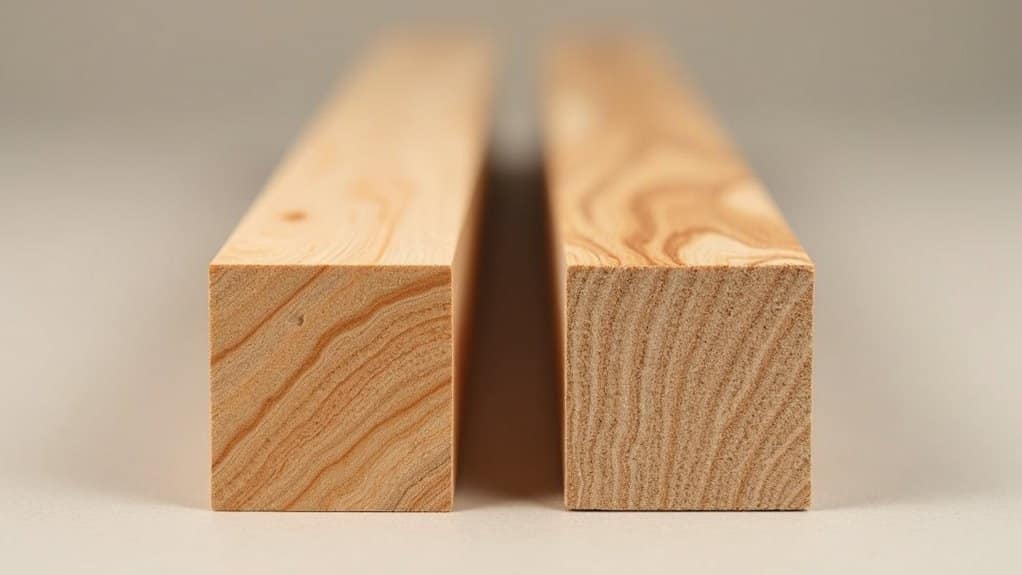
When selecting a door for your project, understanding what’s inside matters as much as what’s on the surface. Core construction methods vary considerably between engineered and solid wood doors, directly affecting performance, weight, and cost.
Engineered wood doors use cores like particleboard, structural composite lumber (SCL), stave lumber, or mineral cores. Particleboard offers low cost and sound insulation. SCL delivers superior durability and minimizes lite/lock conflicts. Mineral cores support specialty fire rated options at 45, 60, or 90 minutes, though they require internal wood blocking for screw-holding.
Solid wood doors rely on hardwood stiles and rails, edge-glued panels, and veneer substrates like Medex or MDF. Innerbond construction offsets grain layers to resist warping, making solid wood a premium, structurally refined choice.
Which Door Type Is More Durable Long-Term?
Understanding what’s inside a door sets the stage for evaluating how long it’ll actually hold up under real-world conditions. In any longevity comparison, solid wood consistently outperforms engineered wood. Its single-timber construction delivers superior structural integrity, resisting dents, scratches, and heavy impact across decades of daily use.
Engineered wood performs adequately in the short term, but its thin veneer layer degrades faster under prolonged wear. You can’t sand it deeply without compromising the surface, limiting your refinishing options considerably.
Solid wood, however, supports multiple rounds of sanding and refinishing, effectively extending its service life. If you’re selecting a door for a main entrance expecting decades of performance, solid wood is the technically superior, more enduring choice. Popular options in India include teak, sheesham, and mahogany, each known for their exceptional hardness and resistance to wear over time.
How Moisture and Humidity Damage Each Door Differently
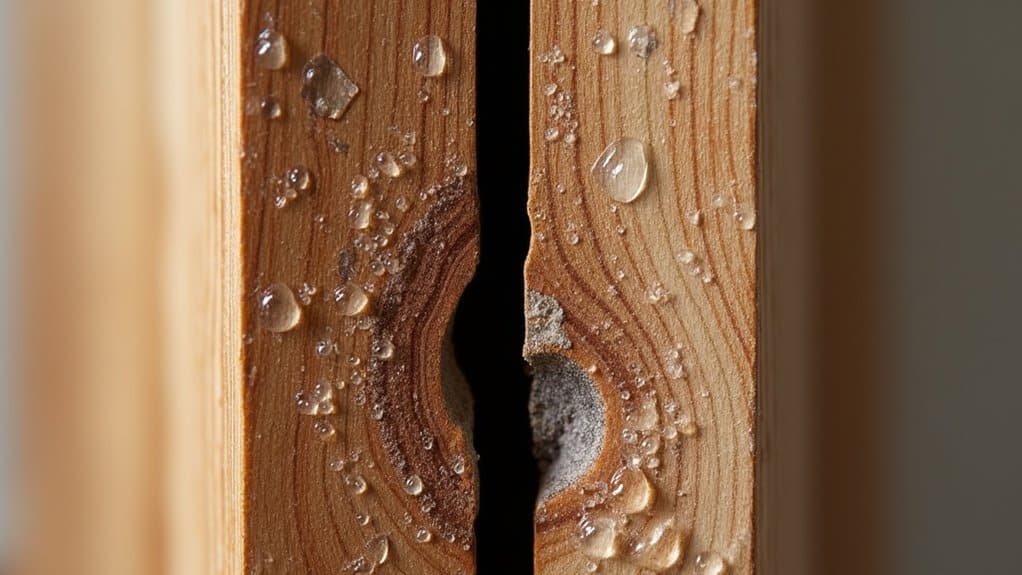
Moisture is one of the most damaging environmental forces acting on any door, and each material responds to it through fundamentally different mechanisms. Solid wood’s hygroscopic nature makes it highly vulnerable to exposure effects, absorbing and releasing atmospheric moisture, which triggers expansion, contraction, warping, and cracking. You’ll find these problems intensify in variable or humid climates without strict environmental controls.
Engineered wood handles humidity implications far more effectively. Its cross-grain, layered core structure distributes moisture-induced stress evenly, resisting dimensional changes that would compromise a solid panel. The composite construction minimizes warping and cracking under fluctuating conditions, making it suitable for kitchens, bathrooms, and regions with unstable weather.
However, severe and prolonged moisture exposure can still degrade engineered wood, so you shouldn’t treat it as entirely impervious without proper sealing and maintenance protocols. Engineered wood’s superior moisture resistance also contributes to greater dimensional stability, making it less prone to warping or cupping over time.
Do Engineered Doors Really Insulate Better Than Solid Wood?
When comparing insulation performance, you’ll find that engineered doors use cross-layered cores to resist heat transfer more consistently than solid wood, which loses efficiency as warping and dimensional shifts create thermal gaps. You also gain measurable sound-dampening advantages with engineered construction, since perpendicular grain layers interrupt both acoustic and thermal transmission pathways that a single-piece solid wood panel cannot block as reliably. Factor in moisture resistance, and engineered doors maintain tighter dimensional stability under humidity fluctuations, preserving seal integrity and insulation performance without the climate-controlled upkeep that solid wood demands.
Layered Core Insulation Benefits
Engineered doors achieve thermal efficiency not through raw material density alone, but through dimensional stability built into their layered cores. When solid wood warps under humidity fluctuations, it creates gaps at the jamb that compromise heat retention. You’re left managing drafts, not just aesthetics.
Layered cores counter this through perpendicular grain orientation, which distributes moisture-induced stress across multiple plies rather than concentrating it in a single timber mass. That humidity proof construction maintains consistent contact between door and frame across seasonal shifts, preserving your thermal envelope without intervention.
The thermal resilience of engineered doors comes from structural consistency rather than material thickness. Natural wood layers within the core still deliver comparable insulation to solid oak, but only because warping doesn’t erode their performance over time.
Sound And Thermal Performance
Layered core construction gives engineered doors a measurable edge in both sound dampening and thermal retention. Cross-laminated layers bond under pressure, creating a dense, stable matrix that resists dimensional shifts from humidity and temperature swings. That dimensional stability directly preserves thermal barrier integrity, preventing the gaps and drafts that warping solid wood consistently produces.
Solid wood does insulate naturally, but its performance degrades without climate control and regular sealing. You’ll find that engineered doors maintain consistent sound reduction efficacy across seasons without refinishing or resealing schedules. The bonded construction blocks both exterior noise infiltration and interior acoustic transfer in commercial settings.
Where solid wood loses efficiency through structural movement, engineered doors hold their geometry, keeping both sound and thermal barriers performing to specification year-round.
Moisture Resistance And Efficiency
Moisture consistently exposes the performance gap between engineered and solid wood doors. Engineered doors use cross-grain layered construction bonded with adhesives, delivering dimensional stability that resists swelling, warping, and contraction in high-humidity zones like bathrooms and coastal regions. You’ll find this architecture eliminates most moisture control tactics solid wood demands, including periodic resealing, professional refinishing, and strict climate regulation.
Solid wood expands and contracts dramatically with humidity fluctuations, requiring consistent maintenance investment to preserve structural integrity. Without controlled environments, solid doors crack, twist, and decay, particularly softwoods in basements or seasonal climates.
From an environmental sustainability perspective, engineered doors optimize material usage through veneers and composites, reducing raw timber consumption. You get reliable performance in moisture-variable conditions while maintaining authentic wood aesthetics and requiring only routine cleaning for long-term upkeep. Composite wood doors are an excellent choice for eco-conscious homeowners, as they combine durability with aesthetic appeal.
Solid Wood vs Engineered Wood Doors: The Real Cost Breakdown
When comparing door materials, costs extend well beyond the initial price tag. You’ll find engineered doors range from $3, $10 per square foot, while solid wood commands $5, $15 per square foot, reflecting natural timber and craftsmanship premiums.
Consider these three cost factors:
- Initial investment, Engineered interior doors run $150, $500; solid wood reaches $300, $1,000+
- Refinishing performance, Solid wood supports decades of restoration cycles, avoiding full replacement costs
- Visual appeal value, Solid wood’s unique grain patterns drive premium resale returns, while engineered doors deliver consistent aesthetics at lower price points
Moisture-prone environments amplify long-term cost differences, as solid wood warping and cracking generate repair expenses that engineered construction eliminates through layered structural stability.
Weight, Installation, and What Each Door Demands
Beyond price, the physical demands of each door type shape installation complexity and long-term hardware performance. Solid wood doors carry substantial weight, requiring three or more heavy-duty hinges, reinforced frames, and professional installation to prevent sagging and misalignment. Without adequate hardware support, you’ll face increased friction, frame stress, and accelerated wear on locks and hinges.
Engineered wood doors reduce those demands considerably. Their layered construction distributes weight evenly, allowing standard hardware and DIY installation in most applications. You’ll maintain frame stability more easily, particularly in high-humidity environments where solid wood warps and shifts.
Both types require secure wall anchoring, but solid doors need additional brackets and stronger framing materials. If you’re prioritizing reduced installation complexity and consistent long-term operation, engineered wood delivers measurable structural and mechanical advantages.
Grain, Finish, and Appearance: What Each Door Type Offers
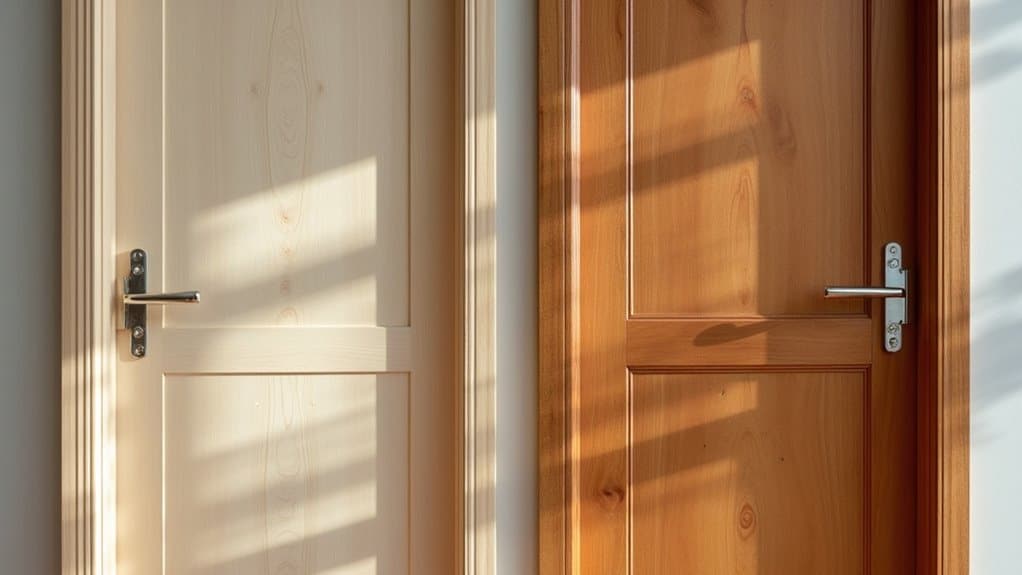
The visual character of your door begins with grain, and each type delivers it differently. Solid wood‘s grain character produces unrepeatable knots, color shifts, and blemishes defining true door artistry. Engineered wood applies uniform veneer, eliminating natural variation for predictable aesthetics.
Every door tells a story through its grain, solid wood writes it uniquely, engineered wood edits it uniformly.
Key appearance distinctions include:
- Grain Patterns, Solid wood offers one-of-a-kind natural formations; engineered veneer replicates wood grain with consistent, controlled uniformity.
- Finish Options, Solid wood supports multiple refinishing cycles, deepening character over time; engineered wood excels in smooth, polished painted finishes.
- Appearance Uniformity, Engineered doors match seamlessly across rooms; solid wood presents intentional irregularities suited for bespoke, high-end installations.
You choose based on whether organic variation or precise consistency serves your design specifications better.
How Much Maintenance Does Each Door Actually Need?
When choosing between solid wood and engineered wood doors, you’ll find that each type carries distinct maintenance demands that directly affect your long-term costs and effort. Solid wood doors require frequent cleaning, quarterly inspections, seasonal refinishing, and strict humidity control, while engineered wood doors offer more stability with simpler upkeep routines. Understanding these differences helps you match the right door to your maintenance capacity before committing to either option.
Solid Wood Maintenance Requirements
Solid wood doors demand a consistent, multi-layered maintenance regimen to preserve their structural integrity and appearance. Wood species selection directly influences maintenance frequency, as denser hardwoods resist moisture and wear more effectively than softer varieties. Annual conditioning treatments, combined with seasonal inspections, prevent premature deterioration.
Your maintenance schedule should address three critical requirements:
- Cleaning Protocol, Dust weekly using a microfiber cloth; deep clean monthly with mild soap and warm water, rinsing thoroughly to prevent residue buildup.
- Finish Maintenance, Apply touch-up coatings every two to three years, with UV-protective finishes each spring for sun-exposed installations.
- Hardware and Weatherstripping, Lubricate moving components regularly, tighten loose fasteners, and inspect weatherstripping periodically to prevent moisture infiltration and structural misalignment.
Engineered Wood Upkeep Needs
Compared to solid wood’s intensive conditioning cycles, engineered wood doors operate on a noticeably lighter maintenance schedule, though you’ll still need to follow specific protocols to protect their composite construction. Use a soft dry microfiber cloth weekly to remove dust, and wipe with a damp cloth as needed, never saturate the surface. Maintain indoor humidity between 45, 60% to prevent warping. Inspect engineered wood finishes annually and refinish in spring if you detect peeling or wear. Avoid polishes and harsh cleaners; use only mild detergent with a soft cloth periodically. Lubricate hinges and locks annually, and inspect hardware every six months for rust or loose screws. Conduct quarterly checks in high-traffic areas to catch deterioration early and delay engineered wood replacement through proactive upkeep.
Long-Term Care Comparison
Two environmental forces, humidity and temperature, determine how much long-term maintenance each door type actually demands. Understanding these environmental durability concerns clarifies your long term performance tradeoffs before committing to either material.
- Solid wood requires repeated sanding, refinishing, and sealing cycles to counteract warping, shrinkage, and moisture absorption across seasons.
- Engineered wood needs only periodic wiping and polishing, as its cross-grain layered construction resists dimensional changes without major intervention.
- Refinishing capacity favors solid wood, multiple sanding cycles extend lifespan, while engineered wood’s thin veneer limits this option but reduces routine upkeep considerably.
For humid or high-traffic environments, engineered wood delivers consistent performance with minimal input. Solid wood rewards diligent maintenance but demands noticeably more sustained effort.
Which Door Works Best for Each Room and Climate?
Where you install a door determines which type performs best. Matching door material to location protects your investment and aligns with both functional requirements and aesthetic preferences driving current interior design trends.
| Location/Climate | Recommended Door |
|---|---|
| Entryway/Exterior | Engineered or sealed hardwood |
| Kitchen/Bathroom | Engineered wood |
| Bedroom/Interior | Either type |
| Living Room/Office | Engineered preferred |
| Humid Climates | Engineered wood |
Engineered doors outperform solid wood in moisture-heavy rooms, high-traffic areas, and humid climates due to dimensional stability. Solid wood suits climate-controlled bedrooms and living spaces where you prioritize natural grain aesthetics and can commit to routine maintenance. Match your selection to the specific environmental conditions of each installation point.
The Four Factors That Should Drive Your Final Decision
Once you’ve matched your door type to its installation environment, four measurable factors should anchor your final selection: stability, cost, durability, aesthetics, and maintenance.
Engineered doors outperform solid wood in humidity-prone zones, while solid wood delivers unmatched aesthetic appeal and long term investment value when properly maintained. Hardwood options for durable doors can provide the perfect blend of functionality and style. Choosing the right material for your entryway not only enhances the overall look of your home but also ensures longevity.
Use these criteria to evaluate each option:
- Stability, Engineered doors resist warping across moisture fluctuations; solid wood requires sealed, climate-controlled conditions.
- Cost vs. Durability, Engineered doors lower upfront and maintenance costs; solid wood justifies higher pricing through refinishable longevity.
- Aesthetics vs. Maintenance, Solid wood offers unique grain patterns but demands periodic refinishing; engineered doors deliver consistent, polished surfaces with minimal upkeep.
Match each factor against your project’s specific performance requirements before committing.
Frequently Asked Questions
Can Engineered Wood Doors Be Painted the Same as Solid Wood?
Yes, you can paint engineered wood doors identically to solid wood. You’ll need to sand, prime, and apply latex or oil-based paint using the same process. Paint durability remains equivalent when you use quality polyurethane topcoats, maintaining finish integrity for 10-15 years. For stain application, verify your veneer exceeds 1/16 inch in thickness. You should also acclimate the door for 72 hours before painting to prevent moisture-related complications.
How Long Does an Engineered Wood Door Typically Last Before Replacement?
You can expect your engineered wood door to last 20, 35 years before replacement becomes necessary. Its layered MDF or plywood core delivers dimensional stability, directly reducing environmental impact from humidity fluctuations and temperature changes. Your maintenance requirements remain minimal, regular cleaning, moisture protection, and hardware upkeep sustain peak performance throughout its service life. Neglecting these protocols accelerates deterioration, shortening the door’s functional lifespan considerably below its specified performance threshold.
Are Solid Wood Doors Better for Exterior Use Than Interior Applications?
Solid wood doors actually excel in both applications, but you’ll find their weatherproofing capabilities make them particularly demanding for exterior use. You’ll need regular sealing and refinishing to prevent moisture damage and warping. Interior installations require considerably less maintenance since they’re not exposed to harsh conditions. However, their insulation properties remain superior in both settings, naturally reducing heat transfer and noise penetration regardless of placement, making them a technically sound choice throughout your home.
Can Solid Wood Doors Be Repaired if They Crack or Split?
Yes, you can repair cracked or split solid wood doors using several proven methods. For hairline fractures, you’ll apply wood putty in a matching color, pressing it firmly into the crack before smoothing with a damp cloth. For deeper splits, you’ll pack a natural fiber string soaked in wood glue into the damaged area. After repairs are cured, sanding and refinishing damaged areas restores the door’s original appearance, though addressing underlying panel movement prevents recurring cracks.
Do Engineered Wood Doors Add Resale Value to a Home?
Yes, engineered wood doors can add increased property value to your home. You’ll benefit from higher resale appeal since wood doors, including engineered variants, typically boost sale prices by 2-5%. You can expect to recoup approximately 70-80% of your installation costs upon resale. Buyers increasingly prioritize high-quality, aesthetically appealing features, and engineered wood doors, particularly FSC-certified options, meet modern eco-conscious preferences, making your property more competitive and marketable in today’s real estate setting.