
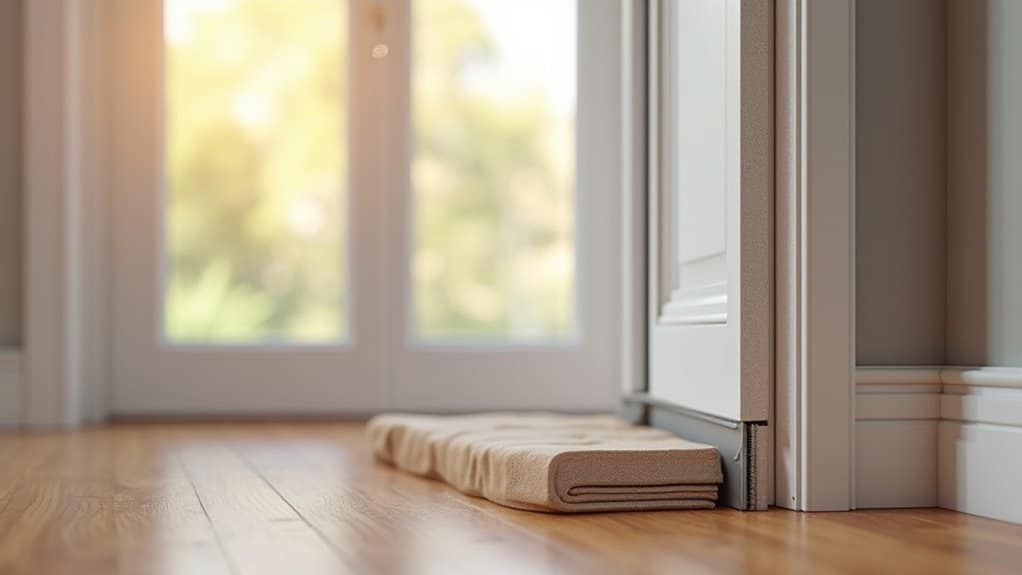


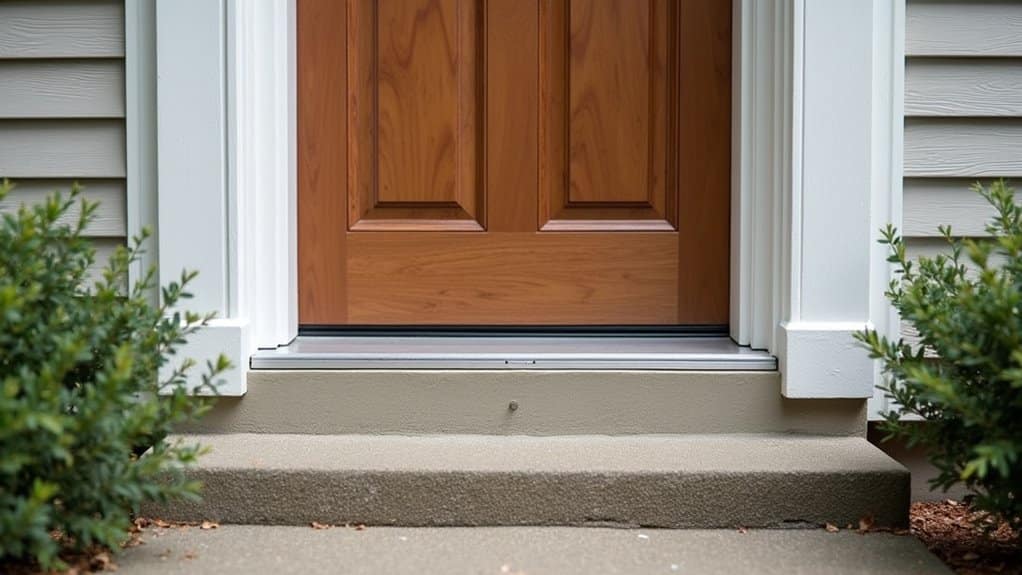
To protect your door from water damage, you’ll need to work through five key steps. Inspect your weatherstripping monthly for gaps and compression loss. Re-caulk jamb corners, thresholds, and frame seams using silicone or polyurethane caulk. Replace worn sweeps and thresholds to seal gaps up to 3/8-inch. Clear gutters and downspouts twice yearly, verifying discharge extends 4-6 feet from your foundation. Install drip caps and water-activated barriers for extra defense. Each step below breaks down exactly how to execute this system.
Check Door Seals and Weatherstripping First
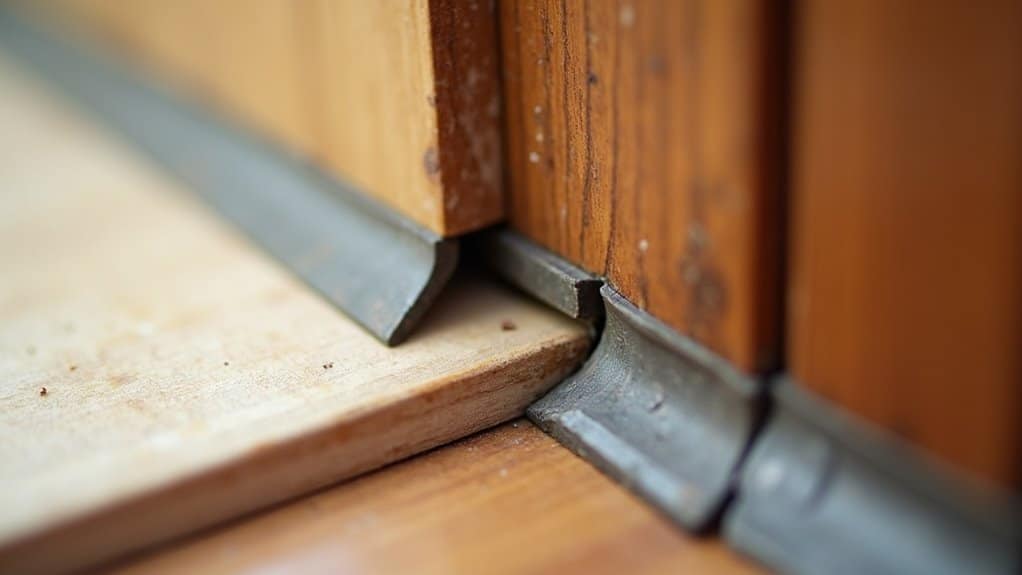
Before addressing any other potential sources of water damage, check your door seals and weatherstripping first, they’re your door’s primary defense against moisture intrusion. Inspect for degradation by examining the entire gasket perimeter monthly for cracks, cuts, tears, or missing sections. Monitor for gaps where light penetrates, indicating active air and moisture leaks. Run your hand along the seal to detect brittleness or separation from the frame.
Use the paper test to confirm adequate compression, if the paper slides out easily, your seal has failed. Areas staying flat when the door opens signal loss of rebound elasticity. Frayed edges or peeling strips allow moisture to penetrate immediately. Identify these issues early before they escalate into structural water damage requiring costly repairs. Properly functioning weatherstripping can also improve energy efficiency, potentially reducing your energy bills by up to 10% by eliminating air and moisture leaks.
Re-caulk Every Gap You Find
Even one overlooked gap in your door frame’s caulk line can funnel water directly into your home’s structure. Inspect jamb corners, the threshold base, and frame-to-concrete seams carefully. Use high quality caulk, 100% silicone or polyurethane, to guarantee flexibility and strong adhesion under wood expansion. Guarantee proper curing time of 24 hours before rain exposure. Clogged weep holes can bypass exterior drainage entirely, so clear them out before sealing surrounding areas.
One missed gap in your door frame’s caulk line can funnel water directly into your home’s structure.
Follow this sequence precisely:
- Clear debris from door edges to fully expose every gap.
- Insert foam backer rod into gaps wider than 1/4 inch before applying caulk.
- Cut the tube tip at a 45-degree angle and apply a continuous, unbroken bead.
- Tool the bead smooth with a wet finger to create a watertight seal.
Replace Worn Door Sweeps and Thresholds
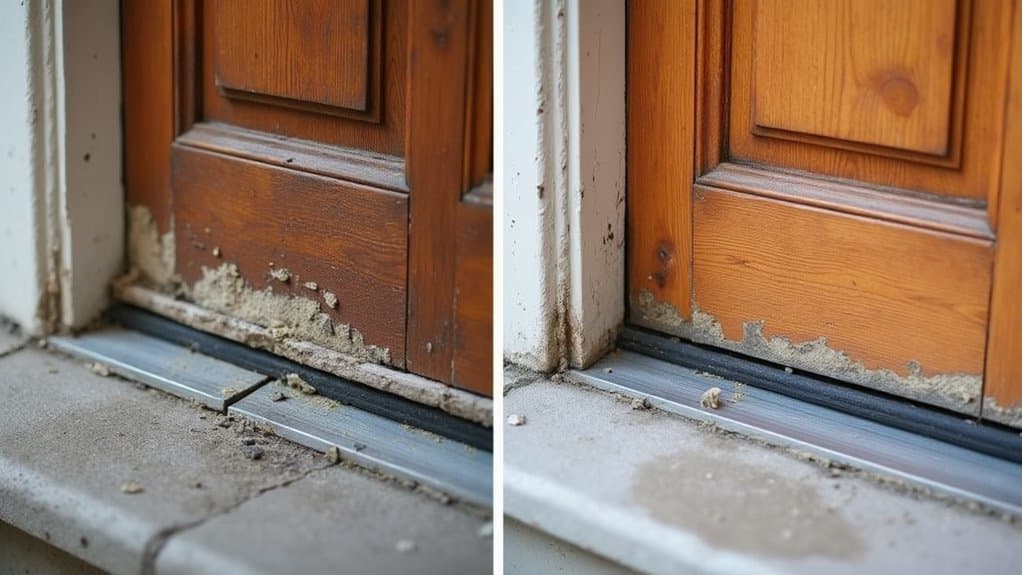
A worn door sweep or threshold turns every rainstorm into a slow infiltration event, driving moisture under your door and into the subfloor. Review door frame condition and inspect for proper threshold fit before selecting replacements.
| Component | Function |
|---|---|
| Automatic door bottom | Drops EPDM seal on closure, bridging gaps up to ¾ inch |
| Adjustable threshold | Raises or lowers via screws to eliminate raw gaps |
| Fluted saddle threshold | Adds traction and durability in high-traffic entries |
| Thermal break threshold | Separates interior and exterior surfaces to cut heat transfer |
| Twin nylon brush sweep | Seals 3/8-inch gaps on wood doors with controlled airflow |
Treat sweeps and thresholds as a coordinated system, neither component performs reliably without the other on exterior doors facing weather exposure. A door sweep mounts to the bottom of the door leaf and uses a flexible vinyl, neoprene, or brush insert to close the gap between the lower edge of the door and the floor, making it most effective on flat, stable floors.
Clear Gutters and Drains Around Your Door
Sealing the base of your door stops ground-level infiltration, but water pouring off a clogged roof puts the entire entry system under pressure regardless of how well your sweeps and thresholds perform. Monitor seasonal debris buildup and inspect downspouts and attachments twice yearly, more often if trees overhang the roofline.
- Scoop out leaves, twigs, and compacted material, then flush gutters with a hose to confirm unobstructed flow.
- Inspect downspouts and attachments for firm connections, disconnecting at the elbow to clear stubborn blockages.
- Verify discharge distance, downspouts must direct water 4, 6 feet from the foundation to prevent soil saturation near your entry.
- Check after major storms for sudden debris accumulation that reduces gutter capacity immediately.
Add Diverters and Barriers for Extra Protection
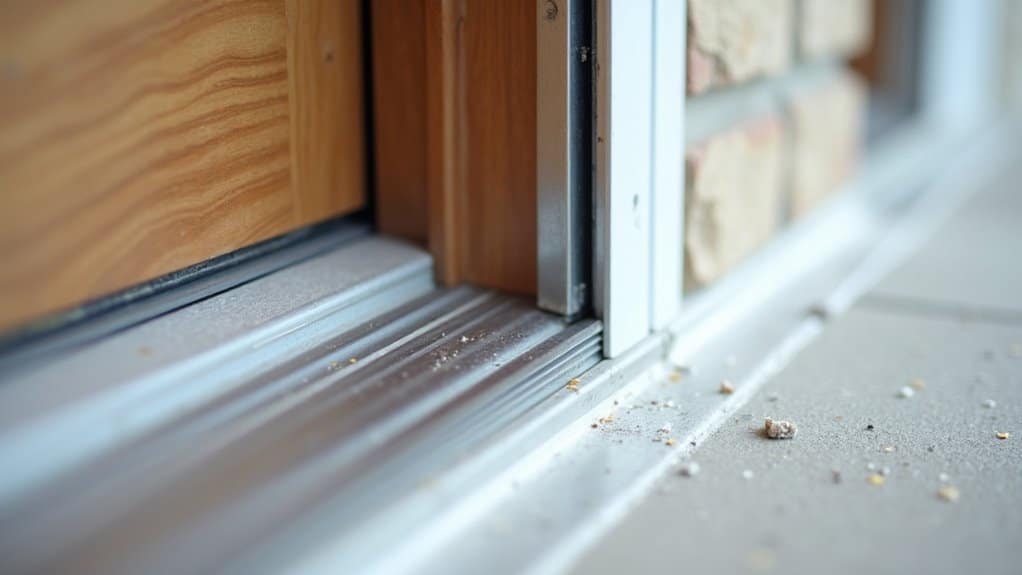
Once gutters and drains are clear, you’ll want mechanical barriers and diverters working at the door level itself to intercept water before it reaches frames, thresholds, and seams. Prioritize drip cap placement 1, 2 inches beyond door width, securing with roofing nails and silicone caulk. For thresholds, layer barrier tape extending 6 inches up jambs, then follow with water activated barrier deployment using expandable tubes behind the tape.
| Protection Layer | Primary Function |
|---|---|
| Drip Cap | Diverts rain off frames |
| Door Sweep | Blocks wind-driven rain |
| Barrier Tape | Seals threshold gaps fast |
| Water-Activated Barrier | Secondary flood defense |
Replace worn sweeps annually and store pre-cut tape rolls with flood kits for rapid deployment during storm warnings.
Frequently Asked Questions
Can Aluminum Door Frames Cause Hidden Moisture Problems During Temperature Changes?
Yes, aluminum door frames can cause hidden moisture problems during temperature changes. You’ll face thermal conductivity concerns as aluminum rapidly transfers heat, making frames cold enough to trigger moisture condensation risks. When warm indoor air contacts these cold surfaces, water droplets form in joints, gaps, and drainage channels you can’t easily inspect. Without thermal breaks, you’re allowing continuous condensation cycles that promote mold growth, structural damage, and deteriorating seals before you notice visible signs.
How Do Storm Doors Provide Additional Protection Against Heavy Rain Intrusion?
Storm doors provide an additional protective barrier that shields your primary door from direct rainfall and wind-driven moisture. When you apply proper storm door installation approaches, you create an air gap between both doors that slows water penetration rates considerably. Storm door insulation further reduces moisture transfer while protecting your existing weatherstripping and seals from direct element exposure. This dual-layer defense system guarantees redundancy, maintaining protection even if one barrier experiences minor compromise during heavy rain events.
What Caulk Products Are Recommended by Door and Window Manufacturers?
Door and window manufacturers recommend several trusted flex seal caulks and waterproof caulking compounds for ideal protection. You’ll find GE Advanced Silicone 2 and GE Supreme Silicone among the top-rated silicone options, delivering superior flexibility and mold resistance. Gorilla Waterproof Caulk & Seal offers extreme temperature resistance, while hybrid caulks combine silicone and polyurethane advantages for paintable applications. For wood and masonry surfaces, Red Devil Lifetime Ultra 230 Premium Acrylic Sealant provides reliable, versatile performance.
How Does Foundation Settling Create New Water Infiltration Pathways in Doors?
When your foundation settles unevenly, it misaligns door frames, breaking weatherproof seals and creating gaps where water infiltrates during rainfall. Foundation cracks develop as shifting pressures split walls, opening direct moisture pathways near door openings. Soil erosion beneath footings accelerates differential settlement, pulling structural components apart and widening existing gaps. You’ll notice doors sticking or failing to latch properly, clear indicators that compromised frame alignment is actively allowing water intrusion into your structure.
How Often Should Door Seals Be Inspected Before Storm Season Begins?
You should conduct seasonal door seal inspections at least twice yearly, with one check scheduled directly before storm season begins. Don’t wait for visible damage, proactive maintenance schedules require you to assess weatherstripping, thresholds, and compression seals 4-6 weeks before monsoon or winter conditions arrive. This window gives you adequate time to source replacement materials and complete repairs before moisture intrusion becomes a structural concern. High-traffic doors demand additional monthly spot-checks regardless of seasonal timing.