

Visible Cracks, Splits, and Warping in Your Door Frame
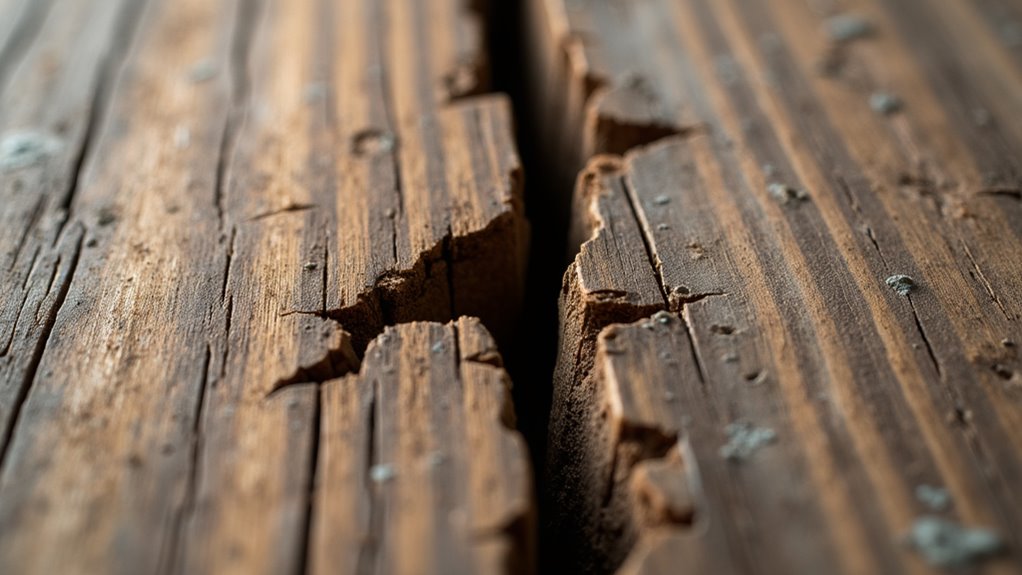
When you notice cracks, splits, or warping in your door frame, you’re observing visible signs of structural compromise that demand prompt attention. These frame instability factors, including vertical cracks along the jamb, cupping, bowing, and twisting, indicate serious structural integrity threats. You’ll likely experience difficulty opening or closing the door, or notice gaps between the frame and wall.
Foundation shifts, moisture absorption cycles, and temperature fluctuations cause these deformations in wood and composite materials. Physical impacts accelerate damage further. Regular inspections can help catch early signs of water damage from leaks that may contribute to frame deterioration. A damaged door frame also creates security vulnerabilities that compromise your home’s protection against potential intruders. Identifying the specific type of warping, such as bowing or cupping, is crucial for determining whether repair or replacement is necessary. Deformation exceeding 1/8-inch warrants replacement rather than repair. Hairline cracks might respond to putty treatment, but extensive splits signal ongoing structural issues requiring new frame installation. Recurring damage after simple repairs confirms you need full replacement to restore your home’s security and stability.
Signs of Rot and Moisture Damage at the Frame Base
You’ll notice rot and moisture damage primarily at your door frame’s base, where water naturally pools and splashes against the threshold during rain. Press a screwdriver or your finger into the bottom corners, soft, spongy wood or crumbling edges indicate advanced wood deterioration and compromised structural integrity. Dark patches, mold growth, and swelling wood fibers signal prolonged moisture exposure that requires immediate frame replacement to prevent further deterioration and potential health hazards from fungal colonization. Untreated mold growth accelerates the deterioration process and compromises both the structural integrity and air quality of your home. If you observe difficulty opening or closing your door alongside these visual indicators, the warping of the doorframe has likely progressed significantly and demands urgent replacement. Early detection of these warning signs allows you to address moisture issues before wood-destroying fungi establishes itself and causes extensive structural damage requiring costly replacement.
Bottom Frame Deterioration
Since door frames sit at ground level where moisture naturally collects, the bottom section’s structural integrity depends entirely on its resistance to water damage and rot. You’ll notice frame instability when the base loses density and becomes spongy under pressure testing. Dark staining typically appears initial at the lowest sections, where rain splashing concentrates moisture exposure. These frame foundation issues progress rapidly once wood absorbs water beyond 48 hours. You might observe peeling paint, cracking, or bubbling as trapped moisture works beneath the surface. Fungi break down wood fibers as decay accelerates through the compromised material. Visual deformation, warping, cracking, or splitting, signals advanced deterioration. As structural compromise worsens, you’ll experience operational problems: difficulty opening or closing doors, misalignment, and drafts indicating seal failure. A musty odor emanating from the frame base often signals mold or mildew growth within the deteriorating wood structure. Addressing bottom frame deterioration promptly prevents complete structural collapse and protects your home’s weather resistance.
Moisture Infiltration Indicators
Identifying the specific signs of rot and moisture damage at your frame’s base allows you to catch deterioration before it becomes catastrophic. Excessive moisture exposure produces distinct visual surface defects that warrant immediate inspection.
- Discoloration patterns, Dark spots, yellowish tints, or streaked patches indicate fungus growth and water absorption, typically concentrated near the bottom where external water sources concentrate. Fungus that is not cleaned away will reproduce and continue to deteriorate the wooden frame structure.
- Structural deformation, Swelling, warping, or bowing sections create gaps between the door and frame, compromising weatherproofing and security while signaling internal expansion from moisture.
- Material degradation, Soft, spongy textures, peeling paint, and splintered surfaces reveal advanced rot where substrate integrity has failed beneath surface finishes.
These indicators demand prompt replacement to prevent further water intrusion and structural compromise.
Compromised Lock Security and Forced Entry Vulnerability

When you’re installing a new door frame, understanding why lock failures occur, and how they relate to frame weaknesses, is critical to effective security. You’ll find that 64% of institutional personnel encounter doors appearing locked but aren’t, revealing widespread vulnerabilities. Lock tampering concerns, including jamming and manipulation, affect 50% of corrections staff.
However, your frame weakness implications matter more critically. Research shows 74% of successful break-ins exploit frame vulnerabilities rather than defeating locks directly. Criminals target frame gaps with pry bars, causing splitting and deformation under impact. Staff turnover increases when safety concerns persist in facilities with inadequate security measures. Upgrading to reinforced steel frames distributes force proficiently, whereas traditional wood frames splinter easily. Installing long strike plates with deep screws substantially strengthens frame integrity. Adding a strike plate reinforcer anchors the plate deeper into wall studs for maximum resistance against forced entry attempts. A powerful lock provides minimal protection if your frame yields to forced entry.
Persistent Gaps Between Door and Frame Reducing Safety
How critical are the clearances you’re leaving between your door and frame? Excessive gaps directly undermine your building’s safety infrastructure. When gaps exceed code standards, maximum 1/8 inch vertical, 3/4 inch bottom per NFPA 80, you’re creating pathways for fire and smoke penetration during emergencies.
Excessive door-frame gaps exceed code standards and create direct pathways for fire and smoke penetration during emergencies.
Your frame misalignment causes three critical failures:
- Intumescent and smoke seals disengage entirely, nullifying fire-rated protection
- Toxic gases and heat spread rapidly through compartments, triggering delayed fire alarm failures
- Smoke hazard exposure increases dramatically, particularly affecting occupant evacuation success
Nearly one-third of installed fire doors fail inspection due to persistent gap issues. Substandard frame materials and weak mounting points compound this vulnerability. Regular inspections and adjustments are paramount to ensure continued adherence to these critical clearances. You’re not just risking code violations and insurance coverage loss, you’re compromising life safety itself.
Difficulty Opening or Closing Your Door Smoothly

When you’re struggling to open or close your door smoothly, you’re likely experiencing one of three interconnected problems: frame warping and misalignment that throws off the door’s geometry, sagging caused by structural failure in hinges or the frame itself, or hardware strain and friction from improper installation or wear. Frame warping commonly stems from moisture exposure or foundation settlement, which shifts the door’s relationship to its frame and creates binding points. Hardware issues compound these problems when hinges aren’t properly aligned vertically or when screws loosen over time, forcing your door to drag against the frame rather than swing freely.
Frame Warping and Misalignment
Because environmental conditions like humidity fluctuations, temperature swings, and moisture exposure directly affect wood composition, door frames become susceptible to warping that compromises smooth operation. Excessive humidity impacts wood stability, causing dimensional changes that distort frame geometry.
You’ll recognize frame warping and misalignment through these indicators:
- Doors stick or rub against frames during opening and closing cycles
- Uneven gaps appear at the top, bottom, or sides when doors close
- Latches fail to engage strike plates, preventing secure closure
Improper installation issues, including mismeasured jambs or crooked attachment, exacerbate misalignment severity. Sun exposure, direct rain, and inadequate weatherproofing accelerate warping in exterior frames. Shifted hinges and foundation settling compound these problems. Persistent frame distortion allows drafts and pests to penetrate your home, undermining insulation and security. Early detection through regular inspection prevents costly full-frame replacement.
Sagging Door Structural Failure
Three primary structural issues, compromised frames, foundation shifts, and material deterioration, commonly cause doors to stick, drag, or fail to operate smoothly. You’ll notice operational difficulties when excessive weight bearing stresses unsupported frame corners, accelerating sagging and misalignment.
| Failure Indicator | Root Cause | Urgency Level |
|---|---|---|
| Persistent sticking/dragging | Frame deformation | High |
| Visible gaps at edges | Foundation movement | Critical |
| Creaking sounds | Hinge wear and stress | Moderate |
When you experience consistent operational resistance despite repairs, your frame likely requires replacement. Deteriorating structural integrity compromises both security and energy efficiency. Monitor for uneven gaps, rubbing against the frame, and hardware looseness. These warning signs indicate mounting stress that’ll worsen without intervention. Prompt replacement prevents complete frame failure and protects your home’s weatherproofing and safety.
Hardware Strain and Friction
Most door operation problems stem from hardware strain and friction rather than structural failure alone. You’ll notice resistance when opening or closing doors due to several mechanical failures:
- Hinge deterioration, Worn hinges cause squeaking and grinding sounds as metal parts rub together, forcing you to apply extra pressure during operation.
- Bearing malfunction in roller systems, Dirt accumulation and metal wear create stiffness that progresses from temporary stiffness to permanent binding.
- Roller looseness and misalignment, Loose rollers and bent brackets cause uneven movement and increased friction throughout the door’s swing.
You’ll experience clicking sounds and dragging as latches fail to engage properly. These hardware issues compound over time, making smooth door operation increasingly difficult and compromising your home’s security and protection.
Drafts and Energy Loss Around Frame Edges
When you notice cold air seeping around your door frame or catch glimpses of daylight through the edges, you’re witnessing the early stages of energy loss that can substantially impact your home’s efficiency. Door openings account for approximately 11% of total building energy leakage, with windows and doors combined responsible for roughly 25% of heating and cooling energy consumption.
Seasonal temperature fluctuations and thermal expansion impacts cause frame materials to shift, creating gaps that deteriorate weatherstripping. Poorly sealed frames force your HVAC system to work harder, elevating utility costs annually. Even minor frame gaps generate significant infiltration expenses over time.
Inspect hinges, thresholds, and frame edges regularly for visible light, rattling, or compressed sealing. Upgrading to insulated materials, such as fiberglass doors with U-values as low as 0.09, substantially reduces drafts and energy loss compared to traditional wood frames rated at 0.65.
Mold, Mildew, and Water Stains on Frame Surfaces
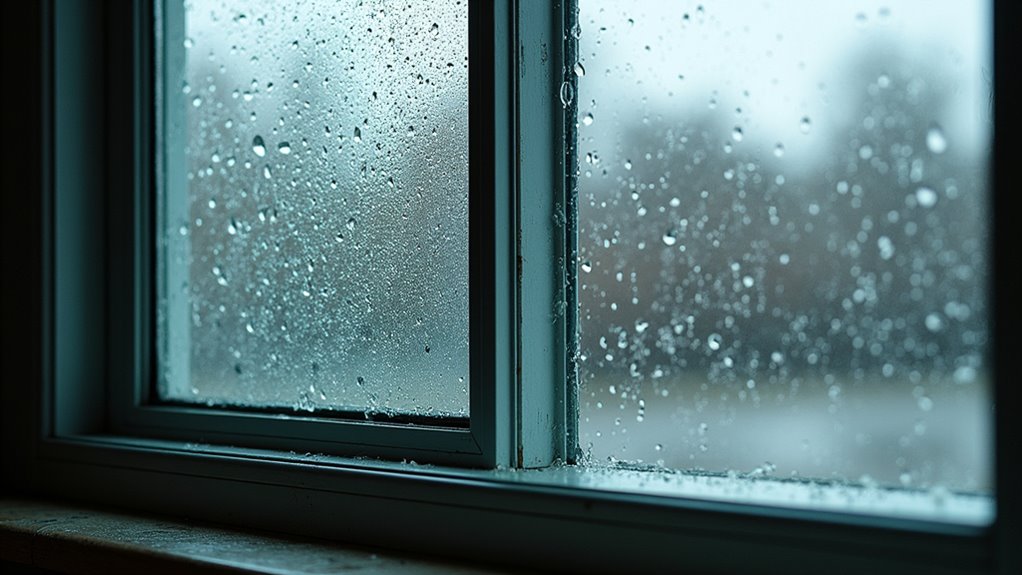
Because door frames exist at the boundary between your home’s interior and exterior environments, they’re particularly vulnerable to moisture accumulation and biological growth. When warm, humid indoor air contacts cold frame materials, condensation forms, creating ideal conditions for mold proliferation. Leaky seals and compromised door frame insulation integrity accelerate this process, allowing water infiltration that degrades thermal conductivity performance.
Door frames at the boundary between interior and exterior environments are particularly vulnerable to moisture accumulation and mold proliferation.
You should watch for these warning signs:
- Black, green, or grey patches visible on frame surfaces or hidden beneath paint
- Recurrent water stains, blistering paint, or frame swelling indicating persistent moisture ingress
- Musty odors suggesting internal deterioration and widespread mold colonization
Routine cleaning temporarily removes surface mold, but persistent regrowth signals that frame material itself requires replacement. Mold penetrating deeply renders surface treatments ineffective, compromising both structural integrity and your home’s protection against water damage and health hazards.
Sagging or Misaligned Doors From Structural Shifting
When you notice your door won’t close properly or gaps appear between the frame and door edge, you’re likely experiencing frame settlement and subsidence caused by foundation movement. Your hinges will begin to strain under the uneven load, pulling away from their mounting points and accelerating the sagging pattern. Watch for these warning signs, doors that stick consistently, visible frame distortion when checked with a carpenter’s square, and mounting holes that’ve enlarged, as they indicate structural shifting that demands professional assessment before attempting replacement.
Frame Settlement and Subsidence
As your home’s foundation shifts beneath its own weight or responds to environmental pressures, you’ll likely notice the initial signs of trouble in your door frames.
Frame settlement and subsidence stem from multiple factors. Clay soil moisture changes destabilize foundations, while tree roots extract water and increase subsidence risk. Water leaks from burst pipes cause subsurface infrastructure damage, eroding soil beneath foundations. Historical mining activity may trigger abrupt ground movement.
You’ll identify progression through:
- Cracks widening from less than 5mm to 25mm or beyond, correlating with severe structural impact
- Diagonal cracks exceeding 3mm, wider at the top, visible both inside and outside
- Sticking doors, misaligned windows, and noticeably sloping floors
Structural engineers should assess cracks reaching 5mm or larger, as service pipes may fracture, causing additional soil washing and compromising weather tightness.
Hinge Stress and Misalignment
While foundation movement creates visible cracks and floor shifts, it also exerts secondary stress on your door’s supporting hardware. Structural shifting disrupts the precise alignment your hinges require, triggering progressive hinge damage that accelerates with each opening cycle.
Misaligned hinges prevent smooth door closure and create binding resistance against the frame. You’ll notice gaps around the door perimeter and difficulty latching, clear indicators that load distribution‘s shifted. Without intervention, this binding intensifies wear on both hinges and frame structure.
Proper hinge lubrication cycle maintenance becomes critical during this period. However, lubrication alone won’t restore severely misaligned doors. When foundation settling compromises frame geometry, your hinges can’t compensate. You’ll need professional frame assessment to determine whether repositioning suffices or complete frame replacement is necessary for safe, functional operation.
Foundation Movement Warning Signs
Foundation settling doesn’t announce itself through a single symptom, rather, it reveals itself through a constellation of physical indicators concentrated around your home’s door openings. You’ll observe multiple warning signs signaling that foundation movement’s affecting your frames:
- Erratic wall cracks forming diagonal or stair-step patterns near door corners, widening progressively over time
- Unusual door frame separation from adjacent walls, creating visible gaps that allow moisture and pests to infiltrate
- Sticking doors that won’t close properly, with one side sitting noticeably higher than the other
These manifestations indicate your foundation’s shifting unevenly beneath the structure. Sagging floors adjacent to doorways, combined with cracked exterior brickwork near entry points, confirm the problem’s severity. When you notice unusual door frame separation alongside erratic wall cracks, immediate professional evaluation becomes essential to prevent further structural compromise and costly damage escalation.
Outdated Materials Lacking Modern Security Features
When you’re evaluating an older door frame, you’ll likely uncover that its materials can’t match the security performance of modern alternatives. Hollow wood or low-grade composites fail to resist forced entry effectively, creating frame integrity compromise that weakens over time. These outdated materials warp, crack, and delaminate, misaligning locks and facilitating breaches.
Your aging frame lacks reinforced steel cores and tamper-resistant features that modern security standards demand. Without interior reinforcement, your door can’t adequately support advanced locking hardware or impact-resistant glass. Insufficient modernization updates mean your frame cannot accommodate multi-point locking systems, smart locks, or integrated security technology.
Upgrading to a reinforced frame with modern materials restores structural integrity and enables contemporary security solutions that substantially reduce break-in risk.
Age-Related Deterioration Beyond Repair in Older Frames
As moisture infiltrates your door frame over years or decades, it triggers a cascade of structural failures that eventually exceed repair capabilities. Seasonal humidity fluctuations accelerate wood expansion and contraction, creating cracks that deepen with each cycle. Advanced deterioration stages manifest through:
- Softened wood that crumbles when pressed, indicating fungal decay has penetrated structural layers beyond surface treatment
- Visible separation between frame and wall, signaling frame shifting that realignment can’t correct
- Persistent door binding despite repeated adjustments, confirming frame warping has compromised operational integrity
When you observe musty odors, widespread discoloration, or creaking that worsens over time, your frame has exceeded restoration viability. Attempting repairs at this stage merely postpones inevitable failure while compromising your home’s security and energy efficiency. Replacement becomes the only reliable solution.
Frequently Asked Questions
How Much Does a New Door Frame Installation Typically Cost Compared to Frame Repair?
You’ll typically spend $200, $700 for new installation versus $50, $200 for basic repairs. Your frame material options markedly influence this cost comparison, wood frames cost more to replace than non-wood variants, while metal or custom frames increase expenses further. Installation becomes economical when you’re addressing severe rot or misalignment. Though repair’s cheaper initially, installation delivers superior long-term protection and value for structurally compromised frames.
Can I Install a New Door Frame Myself, or Should I Hire a Professional Contractor?
You can install a new door frame yourself if you’ve got renovation experience and proper tools, but hiring a professional contractor is typically safer. DIY installation considerations include ensuring precise leveling, alignment, and foam application, mistakes cause sticking doors and drafts. Professional installation advantages include expertise handling complications, warranty coverage, code compliance, and faster completion. Given the complexity and risks of misalignment affecting security and durability, contractors offer better long-term value for most homeowners.
What Door Frame Materials Offer the Best Combination of Security, Durability, and Energy Efficiency?
You’ll find that fiberglass/composite frames offer the best balance for your door material selection needs. They combine superior security with excellent durability against moisture and temperature fluctuations. Their internal door frame insulation properties minimize heat transfer effectively, delivering high energy efficiency without demanding maintenance. Steel frames provide maximum security and fire resistance but offer moderate insulation. Aluminum works well for modern applications with decent thermal breaks. Wood and uPVC excel in specific areas but don’t match fiberglass’s extensive, all-encompassing, or broad-spectrum performance.
How Long Does a Quality Door Frame Last Before Requiring Replacement or Major Repairs?
You’ll discover that quality door frames generally endure 20 to 100+ years, depending on material and maintenance. Solid wood frames can exceed 60, 100 years, while steel frames often supersede a century. Fiberglass provides 70, 100 years of durability, but vinyl averages just 20 years. You’ll boost longevity through an annual inspection schedule and proper maintenance requirements, regular refinishing, prompt repairs, and professional installation greatly extend your frame’s lifespan and performance.
Will Replacing My Door Frame Improve My Home’s Resale Value and Insurance Rates?
Yes, you’ll likely see meaningful improvements in both areas. Your potential home value boost can reach 7% or more, with steel door frame replacements recouping 100.9%, 188% of costs at resale. Regarding impact on homeowner’s insurance, upgrading to steel or reinforced frames often qualifies you for premium reductions since insurers recognize amplified security, weather resistance, and reduced claim likelihood. Documentation of your upgrades supports discount eligibility discussions.