
Your casement window works through a side-mounted hinge system that enables outward swinging motion, similar to a door. The window’s operation relies on a precision-engineered crank mechanism that converts your rotary hand movement into smooth lateral motion of the sash. When you turn the crank handle, it activates an arm mechanism that controls the window’s position, while multi-point locks and stays guarantee stability. Understanding these core mechanics will help you maximize your window’s performance.
The Basic Mechanics of Casement Windows
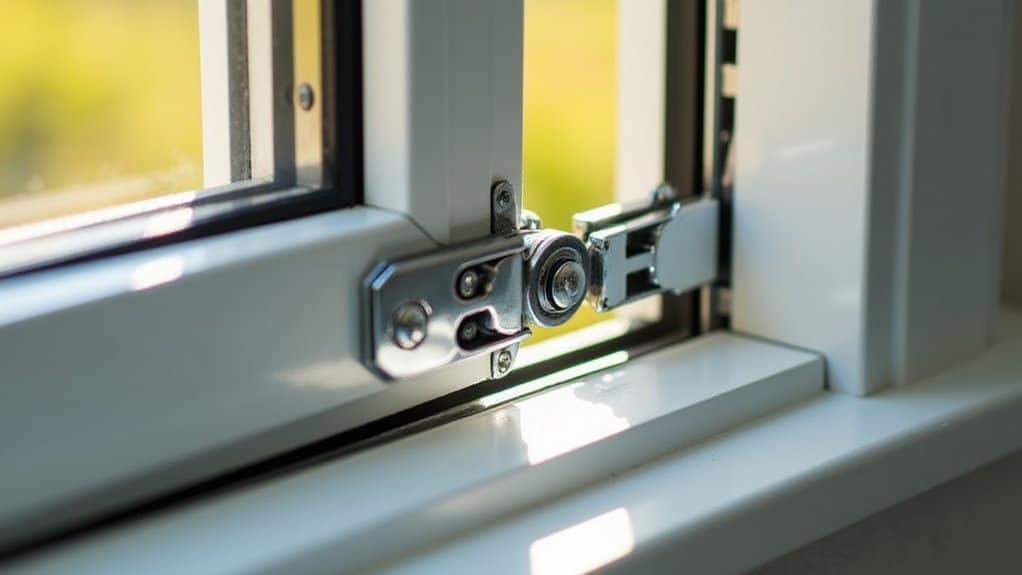
A casement window operates through an integrated system of mechanical components that work in concert to enable smooth outward movement. You’ll find that the window’s side-mounted hinges allow it to open and close smoothly, much like a door, while the precision-engineered crank mechanism gives you granular control over the opening angle. The window’s design incorporates specialized hook-shaped locks that engage tightly when closed, creating an airtight seal that prevents drafts and enhances thermal efficiency.
The mechanical assembly includes strategically positioned stays, latches, and slide bolts that coordinate to maintain stability throughout the window’s range of motion. This configuration not only facilitates easy cleaning of both surfaces but also safeguards reliable security when locked. The entire system leverages these components to deliver optimal performance while maintaining structural integrity.
Essential Hardware Components and Their Functions
The mechanical integrity of casement windows depends on several key hardware components working in precise coordination. You’ll find casement stays available in lift-off, sliding, or friction variants that secure your sash when opened or closed, preventing unwanted movement and warping. The casement window hardware system includes essential latching mechanisms – you can choose between horizontal, vertical, or ring handle designs that both secure and operate the window.
For enhanced security and structural stability, you’ll need slide bolts mounted at the sash’s top, particularly indispensable for taller windows exposed to strong winds. When you’re dealing with paired casements without center support, cremone bolts offer an elegant solution, using a single-piece mechanism with a central handle that controls connecting rods to guarantee proper alignment and security.
Operating Methods and Control Features
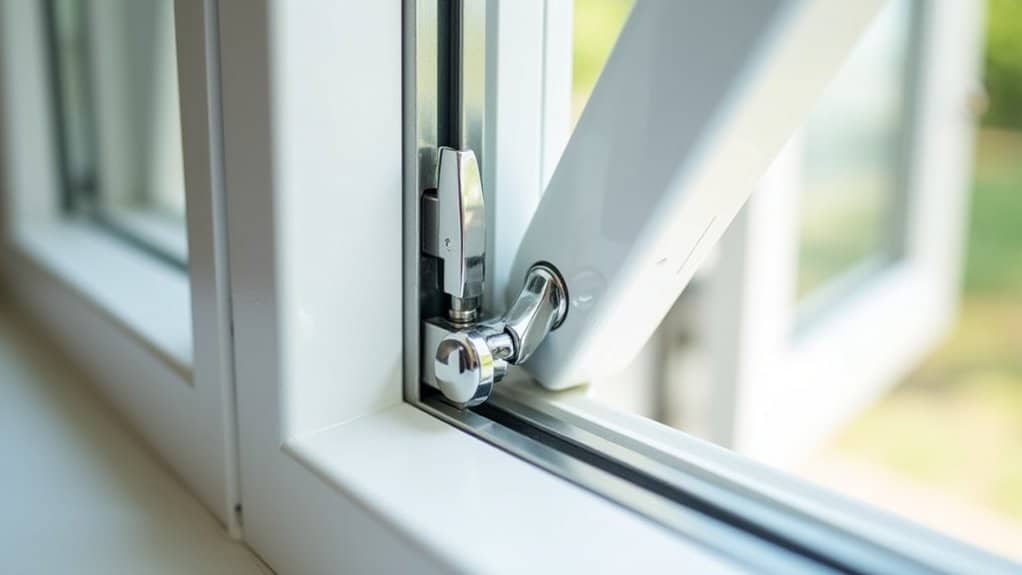
You’ll find the crank mechanism central to a casement window’s operation, featuring precision-engineered gears that convert your rotary motion into smooth lateral movement of the sash. Through the window’s innovative positioning system, you can adjust the opening angle with exact control, allowing you to fine-tune ventilation according to weather conditions and personal comfort preferences. The window’s multi-point locking system employs hook-shaped fasteners that engage with the frame when you close the window, creating an airtight, secure seal that prevents both unauthorized entry and energy loss.
Crank Mechanisms and Hardware
Operating swing windows effectively requires understanding their specialized crank mechanisms and control hardware. You’ll find a rotary crank operator mounted at the window’s base, which connects to an arm mechanism that enables the casement window to open and close smoothly. The crank’s gear system multiplies your turning force, making operation effortless even with large windows.
The window’s butt hinges attach securely to the frame’s side, allowing for proper weight distribution and smooth pivoting motion. You’ll notice the multi-point locking system that engages at various points along the frame when you close the window. The hardware includes friction adjusters that let you control how easily the window swings and stays in position. Premium models feature stainless steel components for corrosion resistance and extended durability in various weather conditions.
Window Position Control
How precisely you control a casement window’s position depends on its integrated crank mechanism and versatile operating features. The window frame’s design makes it a good option for customized ventilation control, allowing you to adjust airflow exactly as needed.
- You’ll achieve precise window position control through the crank handle, which lets you open the window partially or fully without straining
- You can make incremental adjustments to fine-tune ventilation, especially beneficial during varying weather conditions
- You’re able to maintain your preferred position securely, even in hard-to-reach locations, thanks to the window’s locking mechanism
The outward-opening design enhances your ability to direct airflow effectively, while the crank’s smooth operation guarantees you won’t struggle with positioning adjustments, regardless of the window’s height or location.
Locking System Features
The locking system in casement windows combines multiple security features with user-friendly operation. When you swing open your casement window, you’ll notice a sophisticated system of hook-shaped locks positioned along the sash’s interior, creating a tight seal when engaged. You’ll find various latch options available, including horizontal, vertical, and ring handle styles, each designed for specific operational preferences.
For enhanced security and structural stability, you can install slide bolts at the sash’s top, particularly beneficial for taller windows that might be susceptible to bowing. In dual-window configurations without central support, you’ll appreciate the cremone bolt system‘s efficiency, where a single handle controls both upper and lower locking rods simultaneously. These locking system features work together to provide thorough security while maintaining smooth, controlled operation.
Ventilation and Energy Performance Benefits
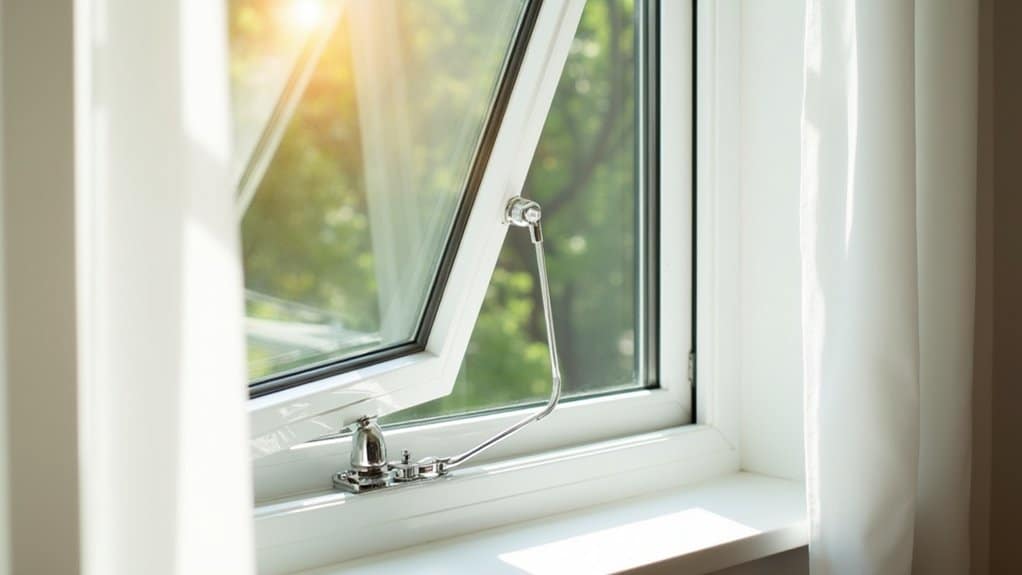
Your casement window’s outward-swinging design gives you precise control over airflow, letting you adjust the sash angle to capture and direct breezes exactly where you need them. You’ll benefit from the window’s exceptionally tight seal when closed, which prevents heat loss in winter and unwanted heat gain in summer through advanced compression weatherstripping. The window’s versatile operation helps you maintain ideal indoor temperatures year-round, as you can fully open the sash to maximize natural ventilation during mild weather or seal it completely for peak energy efficiency during extreme conditions.
Maximum Airflow Control
Optimizing ventilation control becomes effortless with casement windows, which offer precise airflow management through their adjustable positioning system. You’ll find these windows particularly effective when addressing your specific needs for fresh air circulation and temperature regulation.
When considering a window replacement, casement windows deliver superior ventilation control through:
- Multiple positioning angles that let you direct and regulate airflow based on weather conditions
- Airtight seals that prevent energy loss when closed, maximizing your heating and cooling efficiency
- Full-frame opening capability that captures maximum breeze, unlike traditional sliding windows
The outward-opening mechanism creates a natural wind-catching effect, channeling fresh air into your living space. This design feature enables you to maintain ideal indoor comfort while reducing your reliance on mechanical ventilation systems throughout the year.
Energy-Saving Airtight Design
While traditional window designs often struggle with air leakage, modern casement windows excel at maintaining an exceptionally airtight seal when closed, directly contributing to improved energy efficiency in your home. These windows work well in preventing drafts through their compression seal mechanism, which activates when you close the sash against the frame.
You’ll notice significant benefits in your home’s energy efficiency as the tight seal minimizes heat loss during winter months. The design allows you to precisely control ventilation when needed while maintaining ideal thermal performance when closed. This dual functionality helps reduce your energy costs year-round: you can keep your living spaces warm in winter without excessive heating, and maximize natural cooling through controlled ventilation in summer. The result is a more environmentally conscious and comfortable living environment.
Temperature Regulation Features
Modern casement windows excel at temperature regulation through their versatile design features, offering precise control over both ventilation and thermal performance. When you’re considering Casement Windows replacement, you’ll benefit from their superior temperature management capabilities.
- You can position the sash at various angles to direct and control airflow, allowing you to maintain excellent indoor temperatures throughout changing seasons
- The outward-opening mechanism maximizes natural ventilation, particularly effective during summer months when you need enhanced cooling
- When closed, these windows create an exceptionally tight seal, preventing heat loss and maintaining your desired indoor temperature
The thermal efficiency of casement windows greatly impacts your home’s climate control. Their airtight design reduces energy costs while ensuring consistent indoor comfort. This combination of ventilation control and thermal performance makes casement windows an ideal choice for year-round temperature regulation.
Security Features and Locking Mechanisms
Several robust security features distinguish casement windows’ locking mechanisms, with hook-shaped locks on the interior sash serving as the primary defense against intrusion. You’ll find these locks particularly effective at the edge of the window, making them a good choice for areas prone to drafts and security concerns.
For enhanced protection, you can utilize slide bolts at the top of the sash to prevent bowing, while cremone bolts offer both security and aesthetic appeal for paired windows. You’ll also have options among horizontal, vertical, and ring handle latches, each providing distinct securement profiles. To further strengthen your window’s security, you can complement these mechanisms with strategic landscaping and privacy-enhancing window treatments, creating an extensive defense system that doesn’t compromise functionality.
Maintenance and Cleaning Advantages
Casement windows excel in maintenance efficiency by providing full access to both window surfaces from the interior of your home. This design feature enables you to perform regular maintenance without the need for exterior ladders or professional cleaning services, helping you make an informed decision about window selection.
Casement windows offer unmatched convenience, allowing complete interior and exterior cleaning access without stepping outside your home.
- Access both interior and exterior glass surfaces from inside your home, ensuring thorough cleaning of upper-level windows
- Perform all-encompassing maintenance tasks safely without requiring outdoor equipment or climbing
- Clean hard-to-reach windows efficiently through the window’s full-swing capability
The practical design allows you to maintain pristine windows regardless of their location on your home’s exterior. You’ll appreciate the straightforward cleaning process as the window’s operational mechanism provides complete access to all surfaces, making routine maintenance vastly more manageable and time-efficient.
Frequently Asked Questions
How to Operate a Crank Window?
To operate a crank window, you’ll need to maintain proper crank tension and keep the mechanism well-maintained. Start by gripping the handle firmly and turn it clockwise to open the window outward, or counterclockwise to close it. For smooth operation, regularly lubricate crank components with silicone spray or light oil. If you notice resistance while adjusting crank tension, inspect the gears and hardware for wear or damage.
How to Operate a Tilt and Turn Window?
To operate a tilt and turn window, you’ll first locate the handle on the window sash. For tilt mode, rotate the handle 90 degrees upward, which engages the window locking mechanism to release the top hinge operation. For turn mode, rotate the handle 180 degrees horizontally, activating all perimeter hinges for complete window sash movement. Always guarantee the window’s fully closed before switching between modes to prevent damage to the hardware.
How to Open a Window That Opens Two Ways?
To operate a dual-action window, you’ll first need to identify your window hardware type. Position the handle vertically to tilt the window inward from the top for ventilation. For full opening, return the handle to the closed position, then rotate it horizontally to activate different window operation methods. The window opening mechanisms allow you to swing the entire sash inward like a door. Always guarantee proper handle positioning before switching modes.
How to Tell Which Way a Casement Window Opens?
You can determine your casement window’s opening direction by examining the window hinge configuration. Look for the window hardware components along the frame’s edges if the hinges are on the left side, your window will swing left, and if they’re on the right, it’ll swing right. You can also identify the window opening mechanism by locating the crank handle, which is typically positioned on the opposite side from the hinges.