
A composite wood door combines a solid timber or high-density foam core, a rigid uPVC or steel-reinforced frame, and a tough GRP outer skin into one engineered unit. It outperforms traditional wood by resisting warping, rot, and UV damage while delivering superior thermal efficiency and protection through multi-point locking systems. You’ll also get a lifespan of up to 45 years with maintenance, far beyond standard timber’s 20, 25 years. There’s plenty more to unpack about what makes these doors worth the investment.
What Exactly Is a Composite Wood Door?
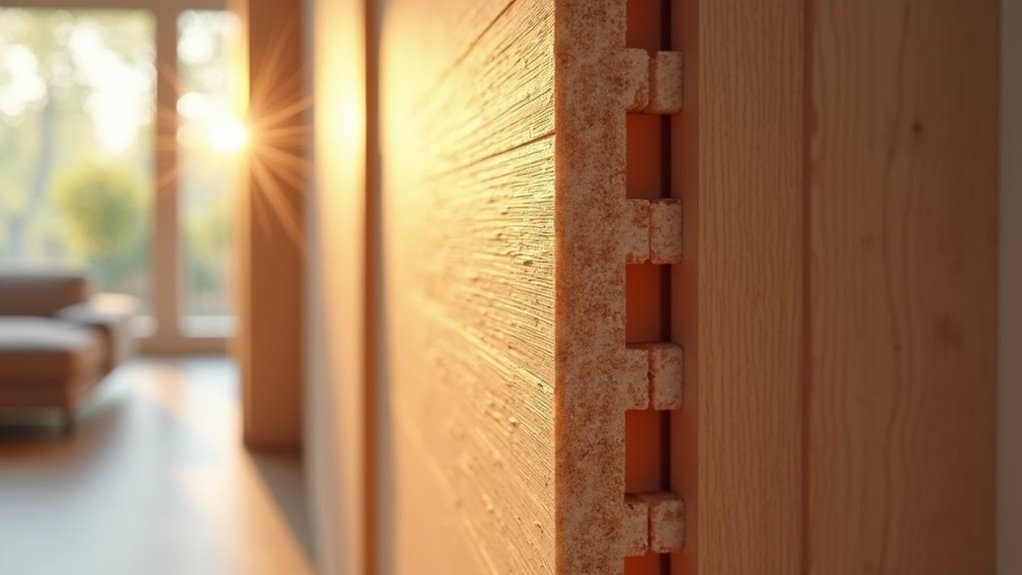
A composite wood door isn’t simply a wood door with a few added materials, it’s an engineered product built from multiple distinct layers, each serving a precise structural or thermal function. At its center, you’ll find a solid timber or high-density foam core, with internal core density typically ranging from 40, 60 kg/m³. Surrounding that core, polyurethane foam is injected under high pressure, penetrating every internal cavity. External GRP panels, measuring 1.5, 2.5 mm thick, encase the assembly, delivering UV resistance and impact protection. The door slab thickness sits at a standard 44 mm, nearly twice that of uPVC panels. Together, these layers produce a door that combines thermal performance, structural rigidity, and weather resistance within a precisely engineered, dimensionally stable unit. The door frame is typically constructed from uPVC, aluminum, or wood, and often incorporates steel reinforcements to significantly enhance the door’s overall security and resistance to forced entry.
Does a Composite Wood Door Actually Look Like Real Wood?
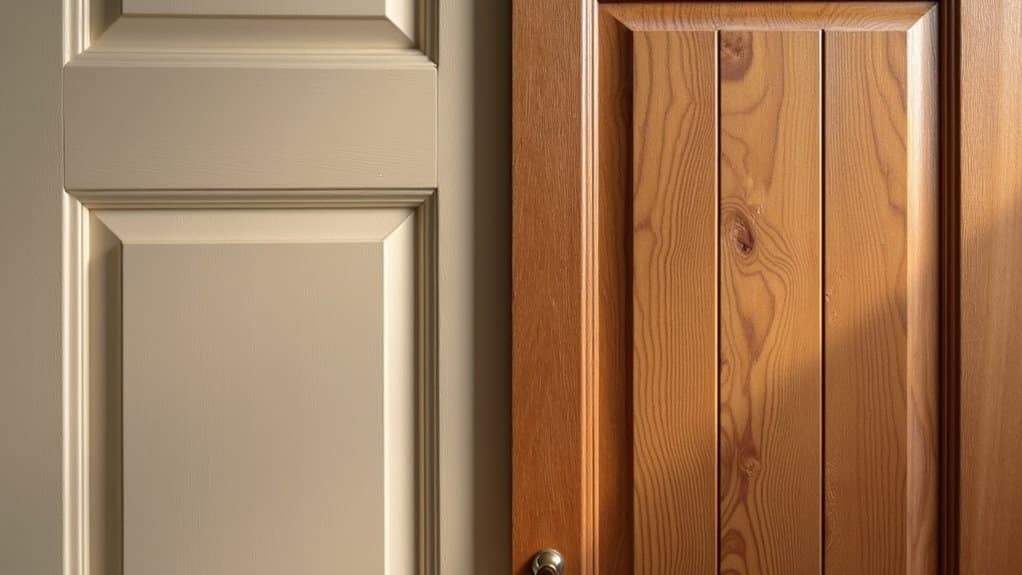
When you examine a composite wood door up close, you’ll notice that manufacturers use glass-reinforced polymer (GRP) to replicate wood grain patterns with striking accuracy. The molding process captures surface texture and finish details that closely mirror traditional timber, making visual distinction genuinely difficult for the untrained eye. You’re fundamentally, at the core, looking at an engineered surface engineered to deceive, where synthetic materials achieve a level of aesthetic authenticity that continues to narrow the gap between composite and real wood. However, while composite doors impressively mimic the appearance of wood, they do fall short in replicating the natural feel of real wood grains.
GRP Wood Grain Replication
Most homeowners considering a composite wood door ask the same question: does it actually look like real wood? The answer lies in GRP manufacturing precision. Manufacturers start with an actual wood door template, apply silicone to replicate every grain detail, then use that silicone mold to produce a metal cast for fiberglass production. The result is an authentic cherry species wood grain replication that rivals natural timber. Engineered wood door options have become increasingly popular due to their durability and aesthetic appeal. Many consumers appreciate the ability to customize these doors, choosing finishes that complement their home decor.
You’re also getting custom color finish options, including Sunburst Green and Anthracite Grey, across a wide range of door sizes and glass designs. The Class A fiberglass face sheet delivers superior impact resistance capabilities, resisting stains, scuffs, and surface damage that regularly compromise real wood. The appearance is premium; the performance is industrial-grade. If you ever encounter issues accessing supplier or manufacturer websites while researching options, the site may be using a security service provider like Cloudflare to protect against online attacks, which can sometimes block users unexpectedly.
Visual Authenticity Achieved
Though GRP manufacturing has advanced considerably, the question of whether a composite wood door truly looks like real wood remains central to any honest comparison. You’ll find that visual quality enhancements in modern production deliver convincing wood grain textures across dozens of styles, from Victorian to contemporary. Manufacturing details like the GRP skin veneer simulate natural timber patterns with measurable accuracy, and manufacturers confidently claim their products are virtually indistinguishable from authentic wood. Custom glazing and hardware options further strengthen that realism. However, you should acknowledge one honest limitation: composite doors lack the authentic grain depth and true tactile feel of natural timber. Visually, they’re impressive; texturally, real wood still holds a distinction that no engineered panel has fully eliminated. When selecting wood types for door jambs, it’s essential to consider the specific characteristics of various species. Hardwoods like oak and maple offer durability and longevity, while softer woods such as pine can provide a more budget-friendly option.
Texture and Finish Quality
| Feature | Composite Door |
|---|---|
| Grain Replication | Molded wood-species patterns |
| Tactile Properties | Near-authentic wood texture |
| Finish Durability | UV-stable, crack-resistant coating |
| Paint/Stain Options | Paint-grade or wood-grained surfaces |
Wood-grained composites accept stain or paint, while smooth paint-grade surfaces limit you to painting only. High-quality finish applications make tactile properties nearly indistinguishable from authentic wood upon close inspection.
What’s Actually Inside a Composite Wood Door?
When you cut open a composite wood door, you’ll find a carefully engineered assembly of an outer protective skin, a core material, and a structural frame working together as a unified system. The outer skin, typically GRP or thermoplastic, shields the door from weather and impact while delivering the woodgrain aesthetic you saw discussed in the previous section. Beneath that skin, you’ll encounter a core material ranging from solid timber to high-density polyurethane foam, all held within a rigid uPVC or steel-reinforced frame that locks the entire construction into shape.
The Outer Protective Skin
While the internal layers of a composite door provide structural integrity and insulation, it’s the outer skin that takes the full brunt of the elements. Glass-reinforced plastic (GRP) forms this exterior layer, delivering GRP durability that resists warping, cracking, and fading under harsh UV exposure, rain, and temperature extremes.
Skin moisture resistance comes from a moisture-impervious barrier applied wholly to the exterior surface, preventing water ingress before the panel is even pressed. During manufacturing, a sealer coating is applied to the flat skin blank, ensuring long-term protection without additional treatments.
You won’t need to paint or refinish it, a damp cloth keeps the grained GRP finish looking sharp. The result is a surface that maintains its integrity for a minimum 30-year lifespan.
Core Material Options
Beyond the GRP outer skin lies the component that most directly shapes a composite door’s thermal performance, defense rating, and long-term durability, the core. Core composition varies substantially across door types, and each material delivers distinct material performance characteristics you should understand before choosing.
Polyurethane foam cores offer exceptional thermal efficiency with zero ozone depletion, reducing heat loss effectively. Solid timber cores provide superior strength, dimensional stability, and full recyclability. Particleboard cores suit commercial projects requiring 20- or 45-minute fire ratings at lower costs. Structural composite lumber combines wood strands with resin for enhanced durability and a 31 STC acoustic rating. Mineral cores handle the most demanding fire-rated applications, achieving 90-minute ratings using noncombustible materials.
Your application requirements, thermal efficiency, fire resistance, protection, or sustainability, determine which core delivers ideal performance.
Structural Frame Components
The structural frame of a composite door is where engineering precision meets material science, and understanding what’s inside helps you evaluate whether a door will perform as promised. Timber stiles and rails form the vertical and horizontal backbone, delivering rigidity and preventing warping. Steel reinforcement enhances protection by integrating directly into the frame, supporting multi-point locking systems across multiple perimeter points. Frame flexibility comes from combining materials, uPVC chambers, LVL engineered wood, or GRP, each contributing thermal performance, dimensional stability, or weather resistance. Rebate configurations determine how well your door seals: single rebates offer one groove and seal, while double rebates add a second layer, enabling triple glazing and superior insulation. High-protection hinges and pre-drilled bores complete the hardware integration without compromising structural integrity.
Are Composite Wood Doors More Secure Than Traditional Wood?
When it comes to home safeguarding, composite wood doors outperform traditional wood doors across nearly every metric that matters. Their reinforcement mechanisms combine solid timber or engineered wood cores, GRP exteriors, and multi-point locking systems that safeguard your door at multiple points along the frame. You’re getting impact resilience that wooden doors simply can’t match, GRP skins spread force across the entire surface rather than concentrating it at vulnerable points.
Traditional wood doors warp, split, and yield to kicking or levering. Composite doors resist all three. Cylinder locks meet TS007 3-Star standards with anti-snap, anti-drill, and anti-pick protections, while reinforced hinges exceed PAS 24 requirements. Fortified by Design accreditation further validates their performance against simulated break-ins, making composite doors a measurably superior protection investment.
Why Composite Wood Doors Keep Your Home Warmer
Keeping your home warm costs less when your door is engineered to prevent heat escaping in the first place. Composite wood doors combine a high-density polyurethane foam core with a solid 48mm timber layer, creating a multi-barrier system that delivers enhanced temperature control throughout your home.
Their U-values range between 1.1 and 1.4 W/m²K, greatly outperforming traditional wooden doors, which average 2.6 W/m²K. That difference translates directly into improved energy efficiency and lower heating bills.
Precision-engineered weatherproof seals eliminate drafts, while the 44mm door thickness reduces heat transfer far more effectively than standard 28mm uPVC alternatives. Add double or triple glazing with heat-reflective skins, and you’ve got a thermally optimised entrance that actively maintains interior warmth year-round.
How Composite Doors Handle Rain, UV, and Extreme Temperature
Composite doors are engineered to withstand whatever the climate throws at them, combining multiple material layers that each target a specific environmental threat. The GRP skin handles moisture management by acting as a waterproof barrier, preventing rain penetration while resisting the warping, swelling, and rot that compromise traditional wood. Weatherproof seals and weatherstripping further block water seepage at every joint.
For UV exposure, the GRP outer layer resists fading and discoloration without requiring repainting or staining. Its heat-resistant construction prevents expansion under prolonged sunlight.
Weathering resilience extends to extreme temperatures through low U-values, insulating foam, and a solid timber core that prevents bowing. The multi-layered structure stays dimensionally stable whether you’re facing intense heat or freezing cold, maintaining both performance and appearance year-round.
How Long Does a Composite Wood Door Last?
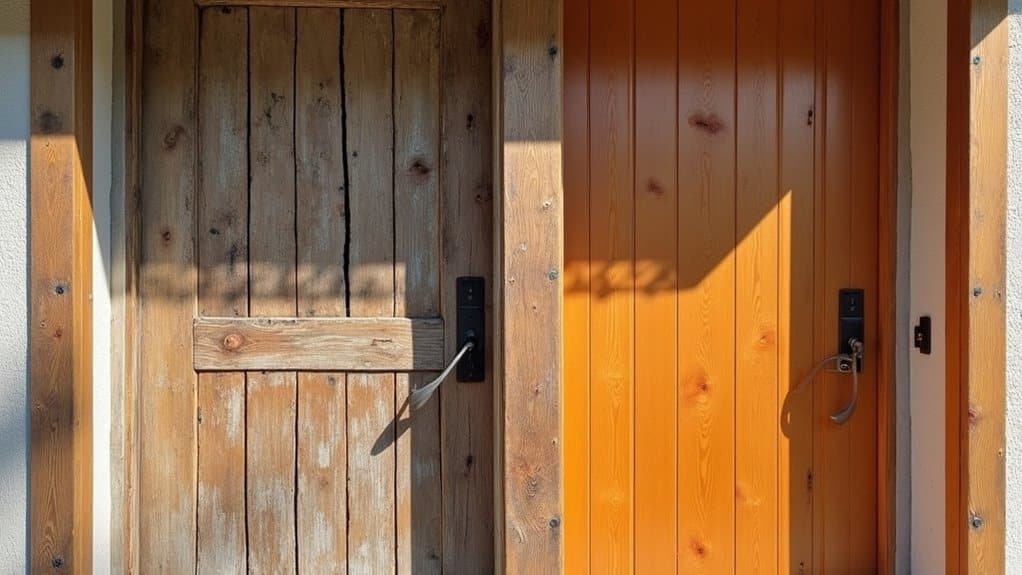
- Solid timber core models (e.g., Solidor) deliver 20, 25 years, extending to 35, 45 years with regular maintenance.
- GRP-skinned composites outlast uPVC doors (15, 20 years) and traditional timber (20, 25 years before rot).
- Budget foam-core units average only 8, 12 years, confirming that core material directly determines lifespan.
Component longevity matters too. Locks last 20+ years in premium models, while handles maintain 15 years. Your door’s colour finish, however, typically requires attention around the 10-year mark.
How Does Composite Wood Compare to Wood and uPVC Doors?
When choosing between composite, traditional wood, and uPVC doors, durability and weather resistance are where the differences become most apparent. Composite doors outperform both alternatives across key durability ratings, resisting warping, cracking, moisture damage, and UV deterioration without additional treatments. The strength of wood materials can vary significantly based on the species and treatment used. While traditional wood options may offer aesthetic value, they often lack the resilience of composite materials.
Traditional wood demands annual refinishing, routine paint or varnish applications, and remains vulnerable to forced entry and insect damage. uPVC offers reasonable weather resistance but lacks composite’s superior thermal efficiency and security-oriented solid core construction.
From installation considerations to long-term performance, composite doors deliver multipoint locking systems, high-density foam insulation, and a GRP external layer that resists denting and fading. You’re essentially choosing a door engineered to outperform both alternatives structurally, thermally, and aesthetically, requiring moderately less maintenance investment over its lifespan.
The Specs That Actually Matter When Buying a Composite Door
Buying a composite door means traversing a specification sheet that can quickly become overwhelming, but only a handful of metrics genuinely determine long-term performance. Focus on these three:
- Thermal efficiency, Target a U-value of 1.4 W/m²K or lower. High-density polyurethane foam cores directly drive energy efficiency by minimising heat loss.
- Security rating, Confirm PAS 24 certification and Document Q compliance. Steel reinforcement and internally beaded glazing aren’t optional extras; they’re structural necessities.
- Core construction, A 44mm solid timber or polypropylene honeycomb core affects structural rigidity, acoustic performance, and long-term durability simultaneously.
You’ll also want UV inhibitors confirmed in the GRP skin to prevent premature fading. These specs separate a performing door from a decorative one.
Frequently Asked Questions
Can Composite Wood Doors Be Fitted With Smart Lock Technology?
Yes, you can fit composite wood doors with smart lock technology using standard Euro cylinders. Models like the WME DL1, WME DL2, and P220 support multipoint locking systems with integrated safeguard features, including biometric scanning, fingerprint readers, and tamper alerts. You’ll also gain remote access capabilities through Wi-Fi-enabled app control. Since no major drilling’s required, installation preserves your existing locking mechanism, making the upgrade straightforward and highly compatible with most composite door configurations.
Are Composite Wood Doors Available in Custom Sizes for Non-Standard Frames?
Yes, you can absolutely get composite wood doors in custom dimensions for non-standard frames. Manufacturers like Masterpiece Doors and Great Northern Door craft specialized designs to your exact specifications. RELIABILT and Masonite specifically engineer solutions for non-standard frames, while Rustica’s craftsmen build from thousands of custom selections. You’ll find options ranging from custom exterior sizes like 9×7 to interior configurations, ensuring your non-standard opening receives a perfectly fitted, high-performance composite door.
Do Composite Wood Doors Add Significant Resale Value to a Property?
Yes, composite wood doors greatly boost your property’s resale value. They deliver strong curb appeal enhancement through their premium aesthetics and durability, directly contributing to increased home value. You’ll recover up to 80% of your investment upon selling, while their energy efficiency and low maintenance attract eco-conscious buyers. With the composite door market growing at 6.8% CAGR, you’re making a financially sound, future-proof upgrade that commands premium pricing in competitive real estate markets.
Can a Damaged Composite Wood Door Panel Be Repaired or Replaced?
Yes, you can repair a damaged composite wood door panel using various repair methods depending on the severity. For minor damage, you’ll fill scratches with matching acrylic paint or wood filler, sand smooth, and refinish. For structural cracks, you’ll insert a wood spline with epoxy adhesive for reinforcement. However, if damage is extensive, panel replacement becomes necessary. Always clean the surface first to guarantee better adhesion and professional results.
Are Composite Wood Doors Environmentally Friendly or Sustainably Sourced?
Yes, composite wood doors use eco friendly materials and sustainable production methods that make them a responsible choice. You’ll benefit from foam cores, recycled components, and wood-plastic composites that reduce deforestation and virgin resource consumption. Their 30+ year lifespan minimizes waste cycles, while superior thermal efficiency cuts your energy consumption. They also eliminate chemical treatments required by traditional wood, further reducing your cumulative environmental footprint throughout the door’s operational life.