


You’ll need to comply with seven critical window ventilation regulations governing your home’s safety and performance. Habitable rooms require operable ventilation equaling 4% of floor area with a 5-square-foot minimum. Mechanical systems must meet ASHRAE 62.2 standards, delivering specified airflow rates and undergoing annual testing. Emergency egress windows demand minimum dimensions of 5.7 square feet with sill heights not exceeding 44 inches. Energy efficiency standards mandate low-U-factor windows with proper thermal envelope integrity. Building permits require documentation proving code compliance. Understanding these interconnected requirements positions you to make informed decisions about your home’s ventilation infrastructure.
Minimum Ventilation Opening Requirements for Natural Air Flow

To comply with building codes, you’ll need to verify your habitable rooms have a minimum operable ventilation area of 4% of the room’s floor area, with an absolute minimum of 5 square feet. For rooms lacking direct outdoor access, you must provide openings equaling at least 8% of the adjoining room’s floor area. Toilet and utility rooms require a minimum operable area of 4%, but not less than 1.5 square feet.
These requirements affirm adequate air quality metrics and support condensation control strategies by facilitating continuous air exchange. Your ventilation openings must remain intentional, accessible, and user-controllable, capable of being closed or covered with gravity dampers. Position all air intakes at least 10 feet horizontally or 3 feet below contaminant sources to maintain indoor air quality and prevent moisture accumulation. Maintaining indoor relative humidity below 60% through proper ventilation design prevents mold growth and ensures long-term air quality in your home. Proper ventilation also protects occupant health by removing harmful air pollutants and reducing respiratory risks. Natural ventilation requirements of 5% of floor area can be achieved through operable windows, ceiling fans, and HVAC vents working together.
Mechanical Ventilation Systems When Natural Methods Fall Short
When your home’s natural ventilation, through windows and passive inlets, doesn’t meet code requirements, you’ll need to install mechanical ventilation systems that comply with ASHRAE 62.2 and your local building codes. You must verify that your system delivers the minimum airflow rate specified for your dwelling’s size and occupancy, typically 0.35 air changes per hour or 15 CFM per person, with field testing to confirm performance. Your chosen system type, exhaust-only, supply-only, or balanced, will determine how effectively you’ll achieve consistent indoor air quality while meeting energy efficiency standards. During the commissioning phase, your mechanical ventilation system must undergo ventilation system performance testing to ensure it operates according to design specifications. Modern homes have become increasingly airtight due to energy efficiency improvements, which means mechanical ventilation is mandatory to prevent the buildup of indoor contaminants and pollutants from common building materials and household products. Natural ventilation is particularly ineffective at reducing humidity in climates with high moisture levels, making mechanical systems essential for proper moisture control and indoor air quality.
When Natural Ventilation Fails
Many modern homes don’t rely on natural ventilation alone, and for good reason. When your home’s airtightness exceeds local code thresholds (≤5 ACH 50), natural airflow becomes insufficient. Regional climate factors and building orientation often prevent adequate passive ventilation, necessitating mechanical systems.
Your occupant health needs, particularly moisture and pollutant control, frequently exceed what natural methods can deliver, especially in urban environments. Building codes mandate mechanical ventilation when natural strategies fail to meet ASHRAE 62.2 standards. Mechanical ventilation with heat recovery systems can reduce heating costs by approximately 25% while maintaining fresh air circulation and removing stale, moisture-laden air from kitchens and bathrooms. MEV systems provide a more affordable alternative, with initial costs between £160 and £500, making them accessible for budget-conscious homeowners seeking moisture control. Balanced ventilation systems maintain neutral pressure while simultaneously introducing fresh air and exhausting stale air, preventing the moisture and pressure issues that can occur with exhaust or supply-only approaches.
| System Type | Function | Primary Benefit |
|---|---|---|
| Exhaust-only | Expels indoor air | Low cost |
| Supply-only | Introduces outdoor air | Simple installation |
| Balanced | Simultaneous in/out airflow | Neutral pressure |
| ERV/HRV | Heat/energy recovery | Energy efficiency |
| Local exhaust | Source removal | Contaminant control |
You’ll benefit from consistent, controllable airflow that reduces condensation, mold risk, and indoor pollutant concentrations while maintaining code compliance.
Airflow Requirements and Standards
Establishing compliant mechanical ventilation requires understanding the specific airflow ventilation rates and calculations that govern residential systems. You’ll calculate required ventilation rates using ASHRAE Standard 62.2, which factors floor area and bedroom count: Q_tot = 0.03 × A_floor + 7.5 × (N_br + 1), measured in CFM.
Your mechanical system must maintain measured outdoor air rates within 10% of required values across all operating conditions. Variable air volume systems demand control ventilation with dynamic controls rather than fixed dampers to achieve compliance. You’re responsible for ensuring your system includes proper commissioning to verify correct airflow and controls functionality. Installation must follow ACCA Manual D guidelines, positioning outdoor air intakes away from contamination sources and equipping them with pest-prevention screens. Enclosed spaces normally used by humans must be continuously ventilated during occupied hours to maintain indoor air quality standards. Air filters in your mechanical ventilation system shall have a designated efficiency equal to or greater than MERV 13 to ensure proper filtration of recirculated and outdoor air before it passes through thermal conditioning components. Ventilation rates of every mechanical ventilation system shall be tested after initial installation and at least annually to verify system performance.
Proper Window Placement and Design for Optimal Air Circulation
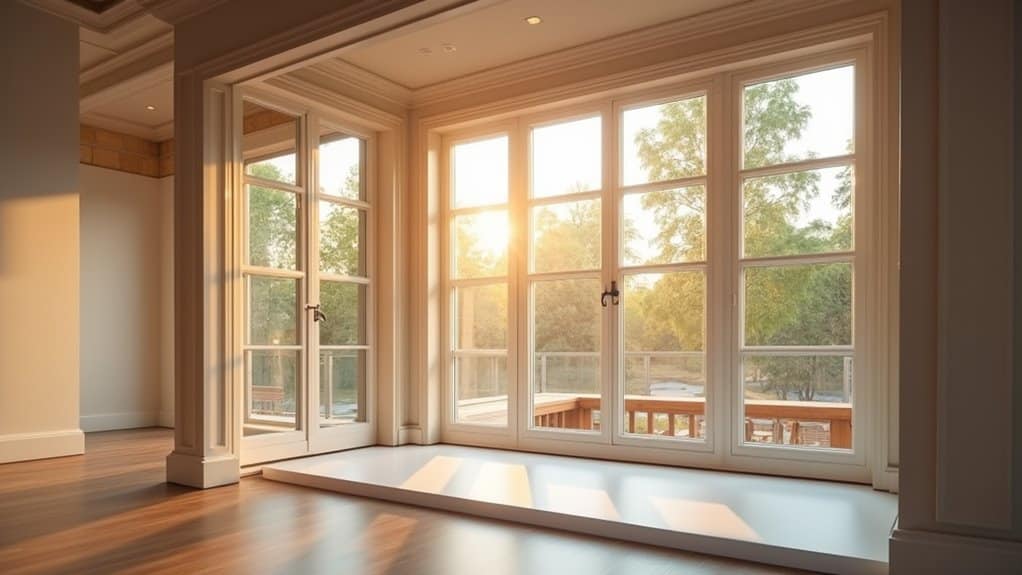
To optimize natural ventilation throughout your home, you’ll need to strategically position windows according to prevailing wind patterns and building orientation. Window orientation impacts your home’s ventilation efficiency significantly. Position inlet windows on windward walls to guarantee fresh air intake, then place outlet windows on leeward sides to facilitate cross-ventilation. Research using computational fluid dynamics simulations demonstrates that optimal window positions sometimes contradict conventional cross-ventilation strategies, requiring customized analysis for your specific building layout.
Site planning considerations require you to avoid obstructions like trees or neighboring structures that block airflow. Implement multi-level window placement, positioning lower windows for cool air entry and higher windows for warm air exhaust, to harness both stack and cross-ventilation principles. For optimal effectiveness, windows should be positioned at approximately 2 metres above floor level to ensure proper airflow dynamics. Integrating window trickle vents into your design provides constant, controlled fresh air even when windows remain closed.
Select operable window types such as casement or awning designs, which direct breezes more effectively than fixed or sliding options. Ensure your window area comprises at least 10% of floor area to meet ventilation standards and maintain ideal air circulation throughout your residence.
Emergency Egress Window Standards and Safety Specifications
You must comply with minimum size requirements, 5.7 square feet of opening area (5.0 sq. ft. at ground level), 20 inches minimum width, and 24 inches minimum height, to guarantee your egress window meets code standards. Your window’s placement and accessibility directly affect emergency evacuations, requiring sill heights no higher than 44 inches and unobstructed operability without tools or special knowledge. You should also consider integrating safety detection systems that alert occupants to window operability failures, verifying your emergency egress remains functional when needed most.
Minimum Size Requirements
Because emergency egress windows must facilitate rapid escape during fire or other critical situations, they’re governed by strict dimensional standards that you’ll need to meet during installation or renovation. Your accessibility requirements mandate specific measurements guaranteeing usability during emergencies.
You must comply with these minimum size specifications:
- Net clear opening area: Achieve at least 5.7 square feet for upper-level windows, or 5.0 square feet for ground floor and basement installations
- Dimensional minimums: Maintain a 20-inch width and 24-inch height with the window fully open, excluding frame obstructions
- Sill height restrictions: Position your window sill no higher than 44 inches above finished floor to ensure accessible egress without requiring ladders
These prescriptive requirements establish enforceable standards protecting occupant safety during emergency situations.
Placement and Accessibility
While minimum size requirements establish the dimensional foundation for emergency egress windows, their strategic placement throughout your home and accessibility features determine whether occupants can actually utilize them during critical situations. You must install egress windows in every bedroom and habitable basement space, ensuring direct outside access without obstruction. Windows must remain operable from inside without tools or keys, with sill heights not exceeding 44 inches for accessibility. You should maintain clear pathways to all egress windows and remove permanent obstructions immediately. Install signage visibility markers to identify emergency exits clearly. Implement occupant training programs ensuring all household members understand window operation procedures. Local codes may impose additional requirements, so you must verify compliance with your jurisdiction before installation. Simple thumbturn locks facilitate rapid emergency egress without impeding initial responder access.
Safety Detection Systems
Beyond guaranteeing your egress windows are properly positioned and accessible, you must also equip them with safety detection and fall prevention systems that protect occupants without compromising emergency escape capability.
Window sensor technologies and window child locks must comply with ASTM F 2090 standards. These devices incorporate emergency release mechanisms that allow full window operation during egress situations without requiring tools or special knowledge.
Your safety system must meet three critical requirements:
- Enable complete window opening during emergencies without obstruction or hindered access
- Utilize window sensor technologies that detect unauthorized opening attempts in child-occupied spaces
- Guarantee window child locks don’t impede initial responder rescue operations or occupant escape
Local building codes may mandate stricter safety device specifications, particularly for upper-story windows. Schedule routine inspections to verify all components function properly and remain fully operational under emergency conditions.
Energy Efficiency and Thermal Performance Standards
Three critical performance metrics, the U-factor, Solar Heat Gain Coefficient (SHGC), and thermal envelope integrity, form the foundation of modern window energy regulations. You must understand that U-factor measures non-solar heat transfer; lower values indicate superior efficiency. SHGC quantifies solar heat gain, critical for managing seasonal temperature swings.
Your windows directly influence mean radiant temperature impacts, affecting occupant comfort and energy consumption. Low-E coatings and inert gas fills substantially reduce U-factors, while thermal breaks within frames block heat transfer pathways. You’ll find that proper window selection and installation preserve thermal envelope integrity, reducing total home energy consumption by 10, 50% depending on climate and placement.
Compliance requires documentation, third-party testing, and NFRC certification labels. You must verify that your windows meet state and local energy codes before installation.
Building Permits and Code Compliance Documentation

Why do building permits matter for window installations? You’ll protect your property investment and guarantee regulatory compliance throughout your project.
The permit review process demands thorough compliance documentation submittal before any installation begins. You must submit completed application forms, detailed floor plans with dimensions, and technical window specifications. Structural calculations prepared by licensed professionals are necessary if your project involves substantial size increases or multi-story buildings.
Your documentation package requires three critical elements:
- Proof of compliance with local building codes and energy efficiency standards (Title 24 in California)
- Evidence that windows meet minimum natural light (8, 10% of floor area) and ventilation requirements (4% of floor area)
- Certification demonstrating egress windows satisfy emergency escape opening sizes and height/width specifications
Building departments review your submittal for conformance, conduct post-completion inspections, and grant final sign-off only upon satisfactory verification of all ventilation and code requirements.
Weather Sealing and Air Infiltration Control During Installation
You must prioritize weather sealing during window installation to prevent air infiltration, which accounts for substantial energy losses in residential structures. When selecting materials, apply material comparison criteria by evaluating silicone-based sealants for exterior applications and foam tape for irregular gaps. Understanding product lifespan expectations is critical: felt deteriorates within 1, 2 years, while silicone and vinyl can last several years with proper maintenance. Clean all surfaces thoroughly before application, then apply caulk at 45-degree angles and allow full manufacturer-recommended curing time. Compress weatherstripping slightly against the window frame to optimize air infiltration control without impeding operation. Measure and cut materials precisely to your window dimensions, avoiding wrinkles or overlaps. These installation procedures directly reduce energy loss by up to 30%, enhancing both comfort and cost efficiency.
Frequently Asked Questions
Can I Use Screens or Bars on Windows Without Reducing Their Ventilation Opening Area?
You can install approved insect screens without reducing your ventilation opening area; codes explicitly permit fly-proof netting. However, bar installation requirements are stricter. Non-removable security bars obstruct openings and reduce recognized vent area. You must guarantee bars remain removable or openable during emergencies and don’t impede required operability. Your screen placement and bar installation requirements vary by jurisdiction, so you’ll need to consult your local authority having jurisdiction for specific compliance guidelines.
What Happens if My Home Fails Ventilation Inspection After Window Installation?
If you’re facing a failed ventilation inspection, you’ll encounter serious consequences of failed inspections, including delayed property sales, denied insurance claims, and penalties for ventilation deficiencies from building authorities. You’ll need to remediate violations by installing or repairing mechanical systems, sealing ductwork leaks, and ensuring proper airflow rates per ASHRAE 62.2 standards. Expect costly repairs, a secondary inspection, and documented proof of compliance before obtaining your final completion certificate.
Are Interior Partition Walls Allowed to Block Cross-Ventilation Between Rooms?
No, you can’t allow interior partition walls to fully block cross-ventilation between rooms. Building codes require substantial openings, typically 50% of the wall area, to maintain ventilation airflow impact across spaces. Your partition wall placement must facilitate air movement through archways, wide doorways, or transoms. Walls aligned perpendicular to airflow pathways drastically reduce ventilation effectiveness by up to 39%. You’ll need strategically positioned, unobstructed openings to guarantee compliance and preserve natural cooling functionality throughout your home.
How Often Should Mechanical Ventilation Systems Be Inspected and Maintained Annually?
You should schedule thorough annual inspections of your mechanical ventilation system, supported by industry standards like ASHRAE 62.1 and Title 8 CCR §5143(a)(5). You’ll need to establish a professional maintenance schedule that includes quarterly or semi-annual filter replacement, sensor calibration, and performance testing. You must verify automatic controls, inspect ductwork and belts, and document all findings for five-year compliance records. You’re protecting system integrity and indoor air quality through consistent, methodical maintenance protocols.
Can Temporary Window Coverings Affect Natural Ventilation Compliance During Occupancy?
Yes, temporary window coverings can drastically impact your natural ventilation compliance. You’ll risk reducing airflow below the required 5% of floor area if you obstruct operable windows during occupancy. You must guarantee coverings remain removable and don’t block necessary ventilation openings. Consider your seasonal ventilation needs when selecting treatments. You should implement retractable or motorized solutions that allow you to sustain code-compliant air exchange rates while meeting your comfort requirements year-round.