
For coastal Florida homes, you need a hurricane-rated garage door backed by a Florida Product Approval number or Miami-Dade NOA. Your wind rating depends on location, HVHZ zones like Miami-Dade and the Keys demand 205+ mph ratings and 180 PSF minimum, while inland areas require less. Choose impact-resistant (Designation A) doors with reinforced tracks, heavy-gauge steel, and watertight seals. Proper installation with approved fasteners is critical. Keep going to protect your home’s largest opening.
Why Garage Doors Fail First in Hurricanes
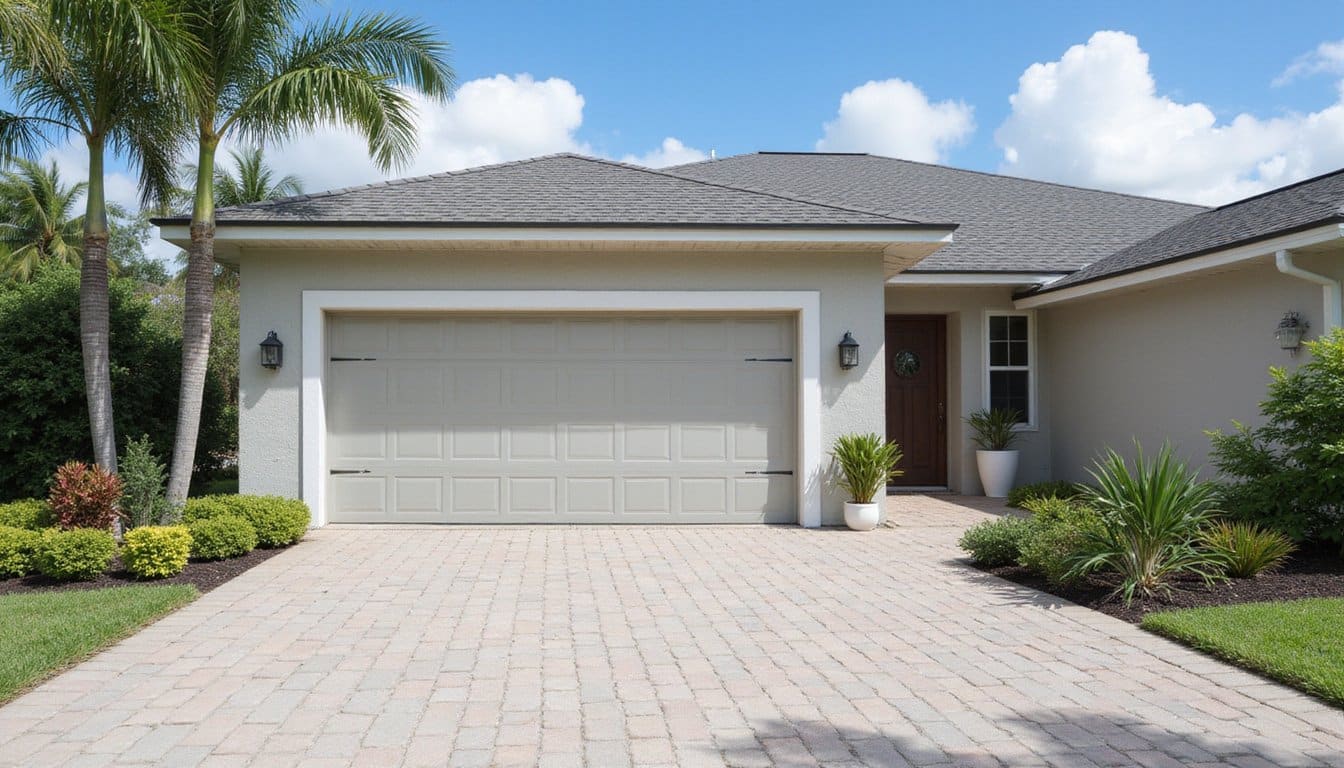
Because your garage door covers the largest opening in the house and is typically weaker than the surrounding walls and roof system, it’s often the first major component to fail in a hurricane. FEMA-linked guidance identifies garage door failure as a leading cause of structural damage during these storms. Once a standard door breaches, wind enters the garage and interior pressure rises rapidly, lifting the roof from below and forcing walls outward. A hurricane garage door resists this by using reinforced panels, heavy-duty tracks, and stronger hardware rated for design wind speeds and debris impact. Without a wind-rating label, your door’s storm performance is unknown and likely noncompliant with high-wind codes. IBHS research confirms a wind-rated door prevents this cascade of whole-home structural failure. These same high-wind-rated doors also protect against tornadoes and other severe winds.
What Wind Rating Does Your Florida Home Need?
How do you know which wind rating your home needs? It depends on your location, exposure category, and local building code, not a single statewide number. First, confirm whether you’re in the Miami-Dade/Florida Keys HVHZ, another coastal zone, or an inland area. Then match your hurricane proof garage door to your site design wind speed and exposure. Each certified door must include a Notice of Approval with a specific approved drawing accessible as a public record through the Miami-Dade County Building Department.
Your wind rating isn’t a statewide number, it’s determined by your location, exposure category, and local building code.
- Panhandle/northern coast: roughly 150 mph, with doors rated near 150 PSF.
- Palm Beach County: around 160 mph, with 160 PSF ratings.
- Intermediate high-wind zones: 170 mph, requiring 170 PSF doors.
- Miami-Dade and the Keys (HVHZ): 205, 230+ mph, mandating a 180 PSF minimum.
Exposure D applies within 600 feet of open water. Always read the manufacturer label and confirm against local code.
What Makes a Garage Door Truly Hurricane-Rated
Although a manufacturer’s label might call a garage door “hurricane-rated,” that claim means nothing without matching product approval documents to back it up. You need FL numbers and drawing numbers that identify the exact tested model, not a marketing name. Look for A and B designations: A typically marks an impact-resistant assembly, while B indicates a non-impact configuration with regular glass. A true hurricane garage door resists both specified wind pressures and 2×4 missile-impact testing.
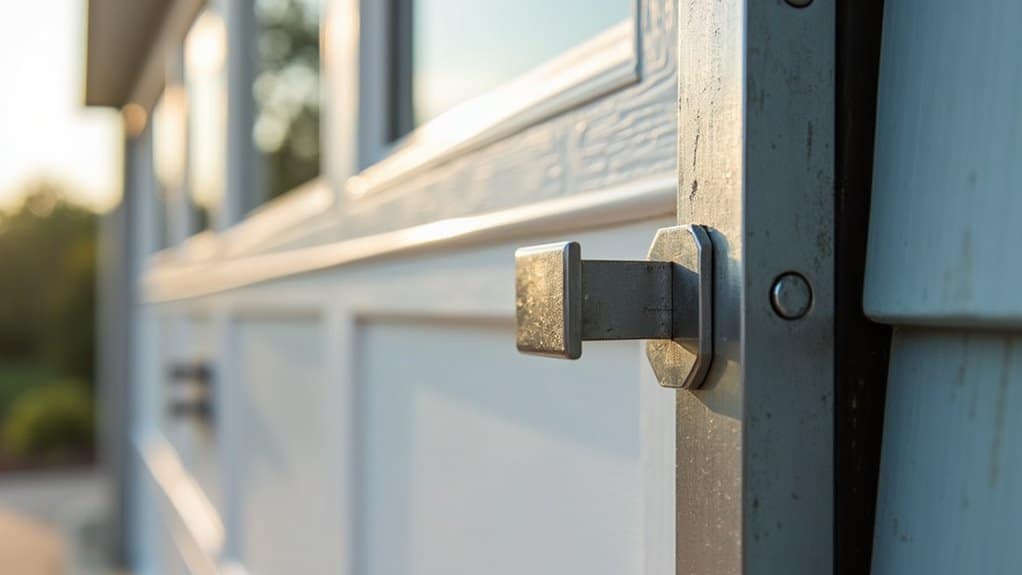
Verify reinforced hardware too, heavy-gauge steel tracks, hinges, rollers, locks, secure wall anchoring, and visible horizontal steel struts. Add weather seals and perimeter sealing to limit wind-driven rain. Since hurricane garage door cost reflects this engineering, confirm the approval paperwork covers the complete door system, not just a single panel. For coastal installations, also check that the hardware and steel are hot dipped galvanized to withstand corrosive salt air.
Inside a Hurricane-Rated Door’s Construction
Construction is where a hurricane-rated garage door earns its rating. Every component works together to transfer wind loads through the hardware into your home’s structure rather than concentrating stress on the panels. Hurricane-rated garage doors rely on engineered reinforcement and material selection to resist buckling, puncture, and detachment under storm pressure.
A hurricane-rated door spreads wind loads across its structure, so no single panel bears the storm alone.
- Reinforced frame and track: Heavy-duty tracks, reinforced hinges, double-end stiles, and extra struts stiffen each section and keep the assembly aligned.
- Panel materials: Steel, aluminum, or fiberglass construction, with high-strength galvanized steel resisting corrosion in coastal air.
- Steel gauge: Lower gauge numbers mean thicker, stronger steel and greater resistance to bending.
- Seals and hardware: Watertight seals and weatherstripping limit perimeter gaps and reduce water intrusion during storms.
How Impact Doors Block Wind, Water, and Debris
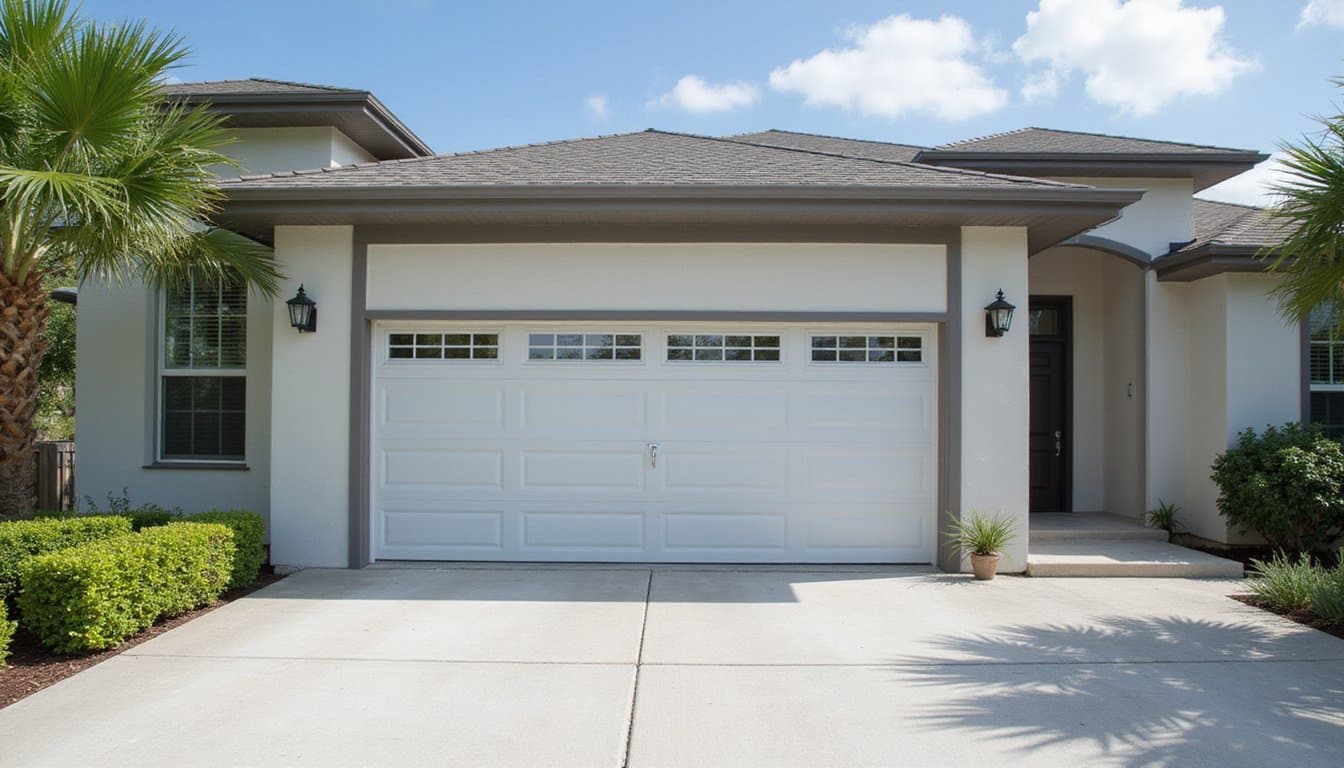
Once you’ve chosen a hurricane-rated garage door, you need to understand how it actually performs against the three threats a coastal storm throws at it: wind, debris, and water. Your impact-rated door resists high wind loads to stay anchored in the opening and prevent the internal pressurization that drives roof uplift, while its reinforced panels keep debris from breaching the building envelope. It’s also water-resistant, reducing wind-driven rain intrusion through seals and tracks, though it won’t stop floodwater or storm surge from rising water levels.
Blocking Wind and Debris
When a hurricane drives debris toward your home, an impact-rated garage door works as a physical buffer between flying projectiles and the opening, absorbing or redirecting impact energy that would otherwise breach a standard door. Engineered to withstand high winds and flying debris, an impact rated garage door reduces the chance of a wind-driven breach during severe storms.
- Debris resistance: Reinforced panels and struts withstand large missile impact under Florida coastal standards.
- Pressure ratings: Assemblies resist both positive and negative wind loads, often rated for 140 to 180+ mph zones.
- Opening integrity: The door stays in place longer, reducing catastrophic enlargement.
- Envelope protection: Limiting failure preserves the building envelope and prevents escalating interior damage.
You’re keeping wind from exploiting your home’s weakest point.
Sealing Out Water
Blocking debris keeps the structure intact, but water finds the gaps that wind misses. Even a hurricane-rated door won’t keep your garage dry if the perimeter seals fail. Inspect the bottom, side, and top edges before storm season, replacing any brittle, torn, or flattened weatherstrip. Pliable rubber or vinyl seals compress evenly and maintain continuous floor contact, while threshold seals add height at the slab line to block wind-driven runoff.
| Seal Type | Function | Failure Sign |
|---|---|---|
| Bottom seal | Closes door-to-slab gap | Flattened edge |
| Threshold seal | Raised flood barrier | Cracked profile |
| Side seal | Blocks lateral entry | Visible daylight |
| Top seal | Stops top-edge seepage | Torn strip |
Layered sealing completes your garage door opening protection, keeping interiors dry and code-compliant.
Signs Your Garage Door Needs Replacing Now
You don’t have to wait for a hurricane to learn your garage door has failed. Watch for visible damage and wear, including separated torsion spring coils, loose or grounded cables, rust along the springs, and a door that lifts unevenly or drops when balanced by hand. Just as critical is outdated code compliance, because a door that doesn’t meet current large missile impact and cyclic pressure standards leaves your home’s largest opening unprotected and can disqualify you from the opening protection insurance credit.
Visible Damage And Wear
Visible damage tells you when a garage door has crossed from serviceable to a liability, especially on a coastal home where wind loads punish any weakness. You can’t trust a panel that’s cracked, bent, or separating at the seams to hold design pressure when a storm hits. Inspect closely before assuming a hurricane-rated garage door still performs as documented.
Watch for these failure indicators:
- Cracks in panels, particularly spreading across sections or near hinges and stress points.
- Bent, warped, or twisted panels that prevent tight sealing and smooth travel.
- Separation at joints or seams, signaling sections no longer align under repeated wind loading.
- Sagging or bowing surfaces, reflecting weakened framing or panel fatigue.
Gaps that widen during movement confirm the structure’s flexing beyond acceptable limits.
Outdated Code Compliance
While visible damage signals physical failure, outdated code compliance reveals a different problem: a door that can’t legally or structurally meet today’s Florida Building Code. Check for a Florida Product Approval number or, in High-Velocity Hurricane Zones, a Miami-Dade NOA. Missing labeling, absent permits, or a wind-load rating that no longer matches your zone classification are clear replacement triggers.
| Compliance Marker | Warning Sign |
|---|---|
| Florida Product Approval / NOA | No visible approval labeling |
| Design Pressure Rating | Mismatch with current wind zone |
| Permit Documentation | No record at inspection or resale |
Non-impact doors in coastal zones rarely pass current standards, and retrofitted garage door hurricane bracing won’t help if approval paperwork and installation documentation don’t exist. Verify before you’re disqualified.
Why Installation Makes or Breaks Compliance
Even a fully certified hurricane-rated garage door can fail compliance if it’s installed incorrectly. The product rating only holds when the installed assembly matches the approved hardware, fastening pattern, and anchoring detailed in the Notice of Approval (NOA). When you plan a garage door replacement Florida code requires you to install the complete system exactly as tested.
- Verify hardware, confirm tracks, brackets, and struts match the approved assembly.
- Check fasteners, use the specified type, size, and spacing into the header and jambs.
- Confirm impact compliance, install glazed doors or covers per TAS 202 approval.
- Document the label, record the DP rating and certification numbers for verification.
Loose tracks, wrong fasteners, or weak anchoring undermine the rating and disqualify your opening protection.
Get Outdoor Protection Built for Florida Weather
From hurricane garage doors to lanai enclosures, smart outdoor upgrades protect your investment and extend the life of your home. At Innovative Storm Defense serving Boynton Beach, FL, our experienced team delivers dependable Storm Protection Services built for Florida’s toughest weather. Call (561) 517-9399 today and protect what matters most.
Frequently Asked Questions
How Much Does a Hurricane-Rated Garage Door Cost to Install?
You’ll typically pay $1,500 to $3,500 installed for a single-car hurricane-rated door, and $2,500 to $6,000 or more for a two-car unit. In HVHZ zones like Miami-Dade and Broward, expect $4,500 to $7,500 for singles and $7,000 to $12,000 for doubles. Labor adds $250 to $800, and permits run $50 to $500 depending on your municipality. Factor in removal, framing, and disposal charges where they apply.
Can I Retrofit My Existing Garage Door Instead of Replacing It?
Sometimes, yes, but only if your existing door is structurally sound and local code allows reinforcement as an acceptable path. You can install manufacturer-approved bracing kits or post systems that anchor into the floor and header. However, if your door’s older, underbuilt, or lacks adequate track and framing strength, retrofitting won’t meet required wind-load or impact standards. In those cases, full replacement gives you a clearer path to documented compliance and stronger storm performance.
Will a Hurricane-Rated Garage Door Qualify Me for Insurance Credits?
A hurricane-rated garage door can qualify you for Florida’s opening-protection credit, but only when it’s impact rated and properly documented. You’ll need Florida Building Code compliance, a Miami-Dade NOA, or Statewide Product Approval, plus certified installation. The credit depends on all your openings cumulatively, so windows, skylights, and side doors must also be protected. You’ll need a wind mitigation inspection to verify everything before your insurer applies the windstorm discount.
What Insulation R-Value Do Hurricane-Rated Garage Doors Typically Offer?
You’ll typically find hurricane-rated garage doors offering R-values between R-6 and R-18, though some insulated models in Southeast Florida range from R-6.3 up to R-20.4. Product-specific hurricane-rated doors often advertise R-13.45 to R-17.66, and a steel-and-polyurethane build can reach about R-16.22. If you want stronger thermal performance, choose polyurethane-insulated models over polystyrene, polyurethane delivers roughly twice the insulating power. Remember, hurricane-rated status depends on wind-load or impact testing, not insulation alone.
How Long Does a Hurricane-Rated Garage Door Installation Take?
You’ll typically need same-day to two-day installation for a hurricane-rated garage door. A basic single door runs about 3 to 4 hours, while a double door takes 4 to 6 hours. Custom or heavy reinforced doors can require 6 to 8+ hours when bracing or framing changes apply. Plan extra time if you’ve got damaged frames, reframing, delivery scheduling, or permitting and inspection steps tied to code-compliance verification.