
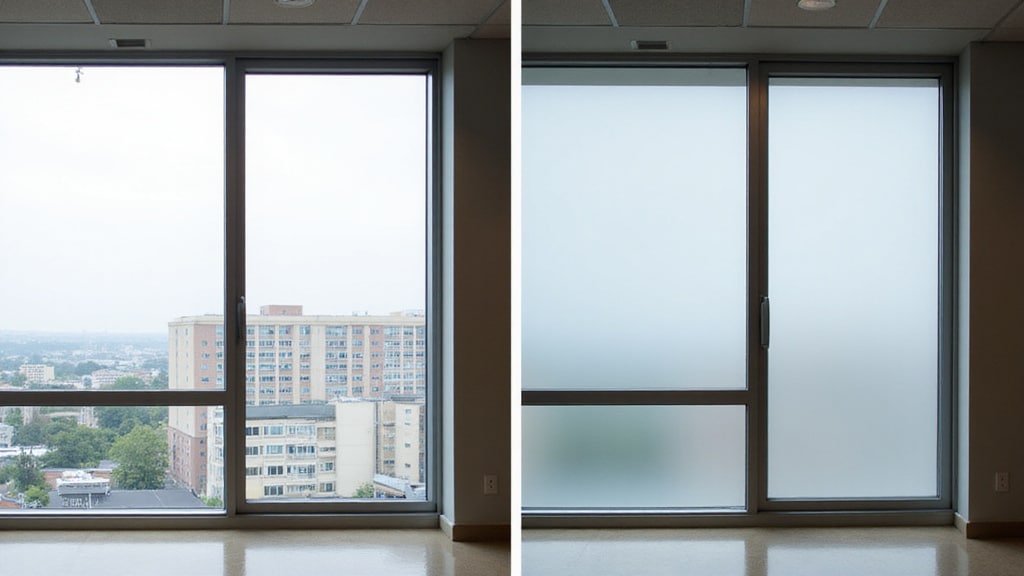
Your home’s safety and aesthetic appeal can be bolstered by selecting door glass designs that blend tempered safety features, smart technology integration, and modern architectural styles aligned with 2025 standards. Frameless and black-framed options offer minimalist elegance or industrial appeal, while floor-to-ceiling installations optimize natural light and space. Smart glass technology provides instantaneous privacy control and AI-powered threat detection with up to 92% crime reduction effectiveness. Mixed materials with custom shapes deliver personalized visual impact. Explore how these innovations work together to transform your entryways.
Frameless Glass Doors: Modern Elegance Meets Open Living
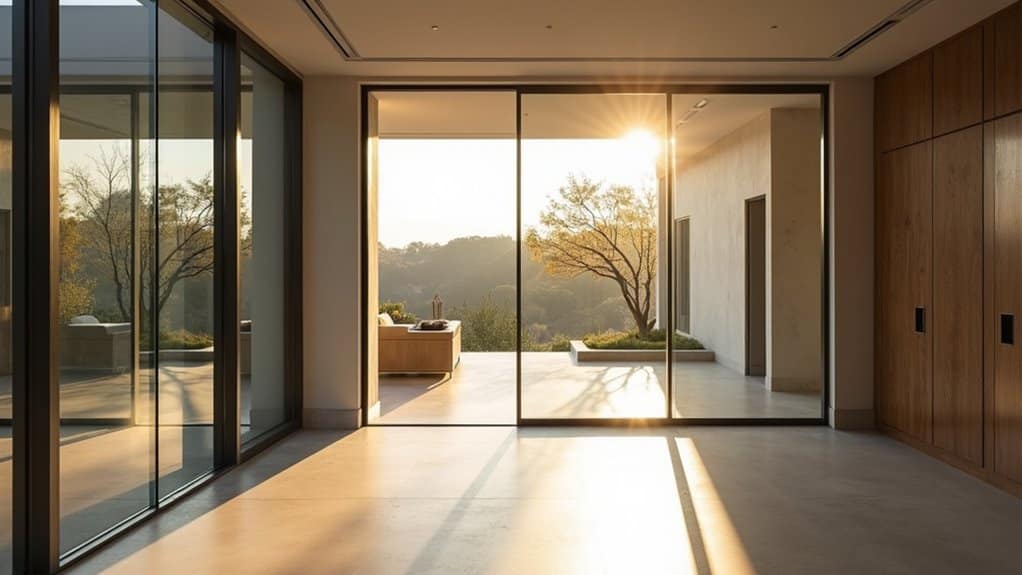
Frameless glass doors deliver a minimalist design that eliminates visual barriers, creating an illusion of spaciousness while maximizing natural light throughout your interior. You’ll appreciate how clean lines showcase architectural statement features without obstruction.
These doors utilize thick tempered safety glass that fragments into blunt pieces upon breakage, minimizing injury risk. Non-slip coatings and frosted finishes bolster grip and surface visibility. The accessible threshold design, eliminating raised tracks, reduces tripping hazards and supports universal accessibility standards. Ace Decor’s frameless bathtub shower doors feature premium tempered glass with water-repellent coating that maintains clarity and durability for long-term performance.
Modern hardware like stainless hinges and lever handles guarantees durability and secure closure. You benefit from straightforward maintenance since the frameless structure prevents dirt accumulation in joints. Water-repellent coatings maintain clarity with minimal effort. The seamless sightlines created by frameless designs allow both natural and artificial light to flow freely throughout the bathroom, brightening the entire space. Available in swinging, sliding, or fixed panel configurations, these doors can be tailored to match your specific aesthetic preferences and privacy needs. Integration options include swing, sliding, or pivot mechanisms, allowing you to customize installations for your specific layout and aesthetic preferences.
Black-Framed Glass Doors: Industrial Style With Contemporary Appeal
Black-framed glass doors represent a contemporary evolution of 20th-century industrial architecture, delivering bold visual contrast and structural integrity through steel or aluminum frames that optimize glass visibility while anchoring your interior design. You’ll benefit from heightened security through sturdy metal construction and multi-glazing options like laminated or double-glazed systems that increase impact resistance and soundproofing. Powder-coated finishes provide weather resistance and color stability with minimal maintenance demands. These doors support interior space flow in open-plan layouts while maintaining visual cohesion across your home. Black frames instantly draw attention and boost curb appeal with high-contrast impact on both interior and exterior spaces. Advanced glazing technologies, including Low-E coatings and thermal breaks, reduce heat conduction and energy loss. Modern black-framed systems often incorporate soft-close technology to prevent slams and ensure smooth, controlled door operation. Frosted or textured glass variants balance privacy with natural light transmission. Their increasingly popular adoption in urban and industrial-style homes demonstrates the versatility of black-framed glass doors across diverse architectural preferences. Discreet locking hardware integrates seamlessly without compromising aesthetic appeal or regulatory compliance for fire safety and egress requirements.
Floor-to-Ceiling Glass Installations: Maximizing Light and Space
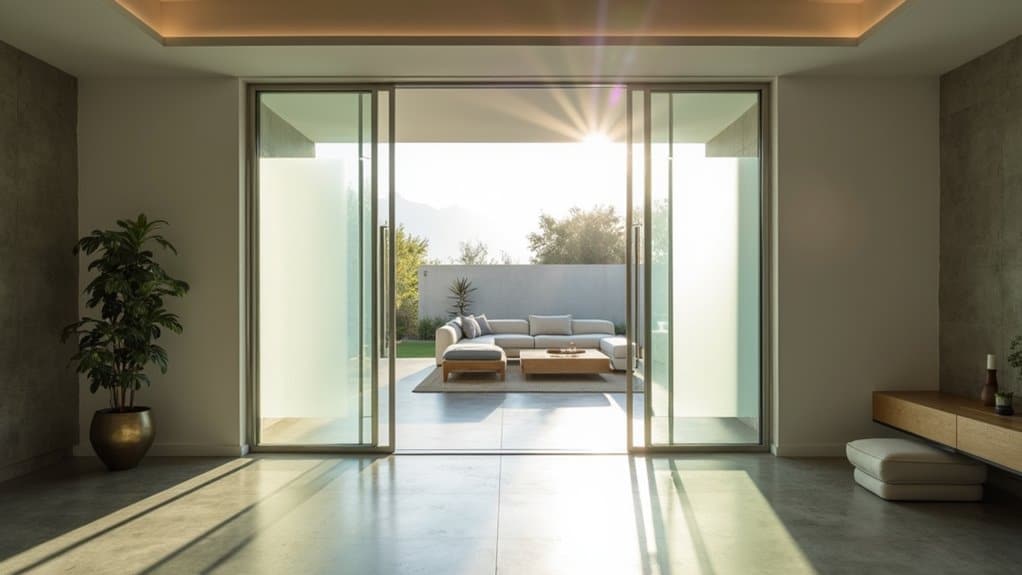
When you’re designing spaces that demand both visual openness and functional performance, floor-to-ceiling glass installations deliver transformative results through strategic light optimization and spatial perception amplification.
| Feature | Benefit | Application |
|---|---|---|
| High-Performance Glazing | Minimizes heat loss; reduces energy costs | Climate control optimization |
| Tempered Safety Glass | Increased impact resistance; structural integrity | Load-bearing installations |
| Smart Tinting Technology | UV protection; glare management | Privacy without light reduction |
You’ll achieve seamless indoor-outdoor integration by eliminating solid barriers, creating multidimensional spatial perceptions that expand functional areas. Professional installation reinforces structural support for oversized panels, guaranteeing long-term durability. Triple-pane low-E coatings optimize insulation while soundproofing properties support urban environments. Window wall systems and stacking glass configurations provide multiple design flexibility for adapting to various architectural requirements. These installations rank among top ROI home improvements, consistently elevating resale value. You’ll maximize daylight exposure, align circadian rhythm, and establish panoramic focal points organizing interior layouts around outdoor scenery. Incorporating smart glass technology with switchable privacy features allows occupants to control transparency and glare while maintaining energy efficiency. The hallmark feature of contemporary architectural style transforms ordinary rooms into large, airy areas filled with natural light that significantly reduces the need for artificial lighting while creating a warm, inviting atmosphere.
Smart Glass Technology: Security and Convenience Combined
You’ll transform your entryway’s functionality by leveraging smart glass technology, which gives you instantaneous privacy control through switchable transparency while simultaneously integrating with your home security infrastructure for real-time monitoring and automated threat detection. Your system activates glass break detectors, motion sensors, and connected alarms in coordinated response to suspicious activity, eliminating manual intervention during critical security events. Smart glass doors also optimize your energy consumption by dynamically regulating heat and light transmission based on weather conditions and occupancy patterns, reducing HVAC demands and lowering operational costs throughout the year. These energy-efficient smart glass doors can be programmed to adjust transparency based on sunlight levels, contributing to a more sustainable approach to home climate control. Installation of smart glass doors requires careful consideration of electrical current placement to ensure proper functionality and seamless integration with your home automation systems. As eco-conscious property buyers increasingly seek value-added features that combine security with sustainability, smart glass doors position your property as an attractive investment that addresses both safety and environmental concerns.
Privacy Control On Demand
Modern smart glass technologies like PDLC (Polymer Dispersed Liquid Crystal) and SPD (Suspended Particle Device) fundamentally transform how you manage privacy in residential and commercial spaces. You activate these systems via switches, voice commands, remotes, or mobile apps, integrating seamlessly with your smart home ecosystem for instantaneous privacy control.
| Application | Activation Method | Privacy Benefit |
|---|---|---|
| Entryways | Mobile App | Deters intruders |
| Bathrooms | Voice Command | On-demand concealment |
| Home Offices | Scheduled Automation | Customizable opacity schedules |
| Partitions | Smart Speaker Integration | Flexible workspace privacy |
Smart glass privacy modes eliminate curtains and blinds while maintaining minimalist aesthetics. Reverse PDLC film operates passively, consuming no power during standard operation, supporting energy-efficient privacy solutions. These active smart glass technologies use electrical charge to dynamically control the transmission of light, enabling seamless transitions between transparent and opaque states. Beyond privacy management, smart glass also provides reduction in glare that enhances visual comfort throughout your home. The ability to switch from transparent to opaque at the touch of a button represents a highly sought-after feature in modern residential design. You customize transparency levels per room and time, creating programmable security protocols that bolster both safety and convenience.
Automated Security and Monitoring
Smart glass door systems now incorporate AI-powered threat detection that analyzes behavioral patterns in real-time, drastically reducing your reliance on manual surveillance and minimizing false alarms. Advanced algorithms process visual data to identify forced entry attempts and unauthorized access with up to 92% crime reduction effectiveness.
You’ll receive instant notifications through smartphone apps, enabling immediate visual verification via integrated camera feeds. Remote system diagnostics allow you to monitor your home’s security status from anywhere, while on-site security monitoring remains continuously active. Cloud-based platforms guarantee automatic software updates protect against emerging threats.
Your smart glass integrates seamlessly with professional monitoring services, triggering coordinated responses, automatic lock engagement, alert dispatch, and lighting activation. Electronic access controls provide customizable permissions for household members, while tamper-resistant designs and reinforced materials amplify physical security.
Energy Efficiency Through Intelligence
Beyond the surveillance capabilities and access controls that safeguard your property, intelligent glass door systems actively manage your home’s thermal and luminous environment, cutting energy consumption by up to 40% while maintaining the security layers you’ve established. Glass door options for security are increasingly becoming essential for homeowners who prioritize both safety and energy efficiency.
Your smart glass adapts dynamically to environmental conditions through building energy optimization protocols. Adaptive tinting reduces artificial lighting dependency by maximizing natural daylight utilization, while thermally responsive glazing minimizes heating and cooling demands year-round.
- Smart climate control automatically adjusts glass transparency based on temperature fluctuations, lowering A/C usage in summer and enabling passive solar heating in winter
- Remote operation through apps or voice commands customizes schedules aligned with occupancy patterns
- Integration with occupancy sensors synchronizes energy management across multiple systems simultaneously
This convergence of security and efficiency reduces utility expenses while optimizing operational performance, delivering measurable cost savings on electric bills throughout 2025.
Mixed Materials and Custom Shapes: Blending Organic and Modern Design
The most compelling door designs of 2025 strategically combine contrasting materials, steel with wood, copper with glass, or reclaimed planks with painted panels, to achieve visual impact while maintaining structural integrity and design flexibility across residential styles. You’ll find textured metallic finishes like matte black and graphite boost curb appeal while masking wear. Designers integrate organic sculptural motifs through fluted glass panels and custom geometric shapes that heighten visual depth without compromising security.
| Material Pairing | Primary Benefit |
|---|---|
| Steel + Wood | Contrast & durability |
| Copper + Glass | Corrosion resistance |
| Reclaimed + Painted | Sustainability focus |
| Mixed metals | Elevated aesthetics |
Custom laser-etched patterns and asymmetrical insets provide personalization while maintaining privacy. Large glass inserts framed in mixed materials create dramatic entries that amplify natural light. These hybrid configurations deliver improved insulation and reduced maintenance compared to traditional designs.
Tempered Glass and Impact-Resistant Options: Safety Without Compromise

While standard glass doors offer basic visibility and light transmission, tempered glass transforms your entry into a fortified barrier that doesn’t sacrifice aesthetics or functionality. You’re investing in safety reliability through engineered heat treatment that strengthens glass four to five times beyond standard options. The safety benefits of glass doors extend beyond mere aesthetics; they provide a significant barrier against potential intruders. Glass door options for security can enhance both your home’s appearance and its protective features.
When compromised, tempered glass shatters into harmless, pebble-like fragments, eliminating dangerous sharp edges that traditional glass produces. This fragmentation design meets building codes while protecting occupants from laceration hazards.
Consider these critical advantages:
- Impact resistance reduces forced-entry success rates greatly
- Thermal durability prevents cracking from temperature fluctuations
- Maintenance-free durability extends lifespan without deterioration
Pair tempered glass with reinforced aluminum frames and multi-point locking systems for extensive security. Impact-resistant options like PGT WinGuard boost protection further, while customizable tints and frosted finishes preserve your desired aesthetic without compromising safety performance.
Energy-Efficient Glass Doors: Performance and Sustainability
As you evaluate door options for climate control and long-term cost savings, energy-efficient glass doors deliver measurable thermal performance through engineered pane technology and frame construction. Double-pane Low-E glass achieves U-Factor ratings of 0.25-0.35, while triple-pane systems reach 0.15-0.25. Fiberglass doors with polyurethane cores represent peak efficiency at U-Factor 0.09 with R-values exceeding 20.
Custom glass coatings and inert gas fills optimize thermal resistance. For your climate zone, select doors matching specific performance requirements. Southern regions demand low Solar Heat Gain Coefficient (SHGC) ratings ≤0.25 using tinted glass for passive cooling strategies. Mixed climates benefit from moderate U-Factor ratings ≤0.30 with SHGC around 0.30-0.35.
| Climate Zone | U-Factor Target | SHGC Priority | Glass Type |
|---|---|---|---|
| Warm/Southern | ≤0.25 | ≤0.25 | Spectrally selective |
| Mixed (4-5) | ≤0.30 | 0.30-0.35 | Double-pane Low-E |
| Cold | ≤0.20 | 0.40+ | Triple-pane Low-E |
| High-Performance | 0.09-0.15 | Variable | Fiberglass composite |
ENERGY STAR certification authenticates independently verified performance standards. Strategic door orientation and shading elevate efficiency further.
Advanced Locking Systems and Security Features: Protecting Your Home
Your door’s thermal efficiency means little if you can’t guarantee it against unauthorized entry, which is why advanced locking systems have become just as critical to modern home protection.
Today’s smart locks integrate biometric authentication, multi-factor verification, and encrypted digital communication to eliminate vulnerabilities. Remote access control lets you manage permissions instantly via smartphone, while real-time activity logging enables proactive theft deterrence through continuous monitoring.
Smart locks combine biometric authentication, multi-factor verification, and encrypted communication to eliminate vulnerabilities and enable remote access control via smartphone.
Consider these protective features:
- Tamper-resistant mechanisms with immediate alerts detect unauthorized access attempts before breaches occur
- Camera-equipped locks with night vision provide documented evidence for investigations and insurance claims
- Customizable user permissions grant temporary codes to guests while maintaining permanent security oversight
High-strength materials and seamless smart home integration confirm your glass doors receive protection matching their aesthetic investment, safeguarding both property and peace of mind.
Frequently Asked Questions
What Is the Average Cost of Installing Frameless Versus Black-Framed Glass Doors?
You’ll find frameless glass doors cost $1,200 on average for installation, while black-framed options run $400, $1,100. Your cost comparison reveals frameless doors demand 20, 70% higher investment due to installation complexity, they require thicker glass and specialized hardware. Black-framed doors offer better value with simpler installation procedures and lower labor costs ($150, $550). Consider your budget constraints; frameless provides modern aesthetics, but black-framed delivers cost-effective style with easier maintenance.
How Often Does Smart Glass Technology Require Maintenance or Battery Replacement?
You’ll maintain smart glass doors with monthly cleaning and professional inspections every 2, 3 years. Most systems don’t require batteries since they’re hardwired to your electrical system. However, if you’re using battery-powered controllers, you’ll need replacements every 6, 12 months with frequent use. Watch for sensor malfunction signs, irregular switching or control failures, which compromise your energy efficiency and safety. Always consult manufacturer specifications for your specific maintenance intervals and battery replacement schedules.
Can Glass Doors Be Retrofitted Into Existing Door Frames Without Major Renovations?
Yes, you can retrofit glass doors into existing frames without major renovations if your frame’s in good condition. You’ll need to assess existing frame compatibility carefully, ensure it’s structurally sound and properly dimensioned for your new glass slab. Professional installation requirements are critical; you’ll want certified technicians measuring precisely and verifying the frame can support tempered glass weight. They’ll remove the old door slab and install the new one into your current frame and threshold, minimizing disruption.
What Is the Lifespan of Tempered and Impact-Resistant Glass Before Replacement?
You’ll find that high-quality tempered and impact-resistant glass typically lasts 20, 30 years, though cheaper options last only 10, 15 years. Your glass durability factors, including environmental stress, installation quality, and seal integrity, significantly impact longevity. You’ll optimize this lifespan through consistent glass maintenance requirements: scheduled inspections every few years, regular cleaning, anti-corrosion treatments, and prompt seal repairs. You should plan replacement when you notice extensive cracking, persistent fogging, or operational dysfunction.
Are Curved and Custom-Shaped Glass Doors More Difficult to Clean Than Standard Designs?
Yes, you’ll face greater cleaning difficulties with curved and custom-shaped glass doors. Their non-flat surfaces trap soap scum and water spots in crevices, requiring specialized tools that standard squeegees can’t efficiently reach. You’ll need to invest more time and effort maintaining these designs. Furthermore, textured finishes compound your maintenance requirements by providing extra surface area for dirt accumulation. Regular after-shower squeegeeing helps minimize buildup and preserves safety visibility.