
Both impact-rated French and sliding patio doors can protect your Florida home, so neither’s automatically “better.” What matters is matching certified design pressure ratings to your wind-borne debris zone. If you’re in Miami-Dade or Broward’s HVHZ, verify a Miami-Dade NOA or Florida Product Approval. Sliding doors offer fewer moving parts and lower maintenance, while French doors need reinforced hinges. Your ideal choice depends on several factors worth exploring before you decide.
How Florida Storm Codes Shape Your Door Choice
Because Florida’s storm codes hinge on where your home sits, your door choice starts with identifying your zone before you ever compare French doors to sliders. If you’re in a Wind-Borne Debris Region, where basic wind speeds hit 130 mph or you’re within a mile of coastal mean high water, your doors must be impact-resistant or protected by an approved shutter system. In Miami-Dade and Broward’s HVHZ, expect stricter opening-protection standards. Whether you choose impact rated French doors or sliders, both must survive the large missile test (a 9-pound 2×4), pass 9,000 cycles of pressure testing, and meet your site’s design pressure and wind-driven rain requirements. Verify compliance through a Miami-Dade NOA or Florida Product Approval number, not generic “hurricane-rated” marketing claims. These rigorous standards exist because door failures can trigger catastrophic internal pressure changes that compromise your entire building envelope during a storm.
Which Holds Up Better in a Hurricane: Sliding or French?
When you’re comparing storm performance, start with the tested impact rating, because both French and sliding doors can pass Florida’s large-missile and pressure-cycling requirements when they’re properly engineered and installed. From there, look at structural weak points: French doors carry more seams, hinges, and a center meeting stile that often needs extra reinforcement, while sliders rely on their track and roller system to stay aligned under wind load. To strengthen storm resistance, both door types can be built with reinforced frames and impact-resistant glass packages that meet Florida’s stringent building codes. Neither style wins automatically, so you’ll weigh the certified rating, frame integrity, and installation quality against your specific coastal exposure.
Impact Ratings and Certification
Although both door styles can earn the same hurricane certifications, the better performer in a Florida storm comes down to the certified product, not the silhouette. Whether you’re specifying an impact rated sliding door or a French set, you’re really comparing tested assemblies evaluated for three benchmarks: impact resistance, wind resistance, and water infiltration performance. Check the door edge or hinge area for a sticker confirming design pressure and impact rating. Because sliding doors have fewer moving parts, they reduce the risk of failure during high winds. Pre-2004 glass-insert doors usually aren’t rated without explicit certification.
- Look for a label showing design pressure (DP) and impact rating near the hinge or jamb.
- Confirm all three benchmarks, not just impact resistance.
- Verify both glass and framing are certified together.
- Prioritize water-performance ratings, since sliders show high water vulnerability.
Structural Weak Points
If you want to know which style holds up better in a Florida hurricane, you’ve got to look past the silhouette and study where each assembly actually fails. French doors concentrate stress at the center meeting stile, center pins, hinges, and latch connections. Hurricane research found double doors especially prone to failure, metal doors pulling out at the center pins, wooden leafs shattering at the same point. Sliding doors avoid that center-pin mode entirely, using one panel on a track, but they fail at the track, rollers, interlock, and frame corners, where panels get forced out of alignment. Either way, an impact rated patio door lives or dies on its connectors: a 130 mph wind imposes 580 pounds, demanding roughly 100 pounds per hinge and 290 per lock.
Comparing Energy Efficiency for Sliding vs. French Doors
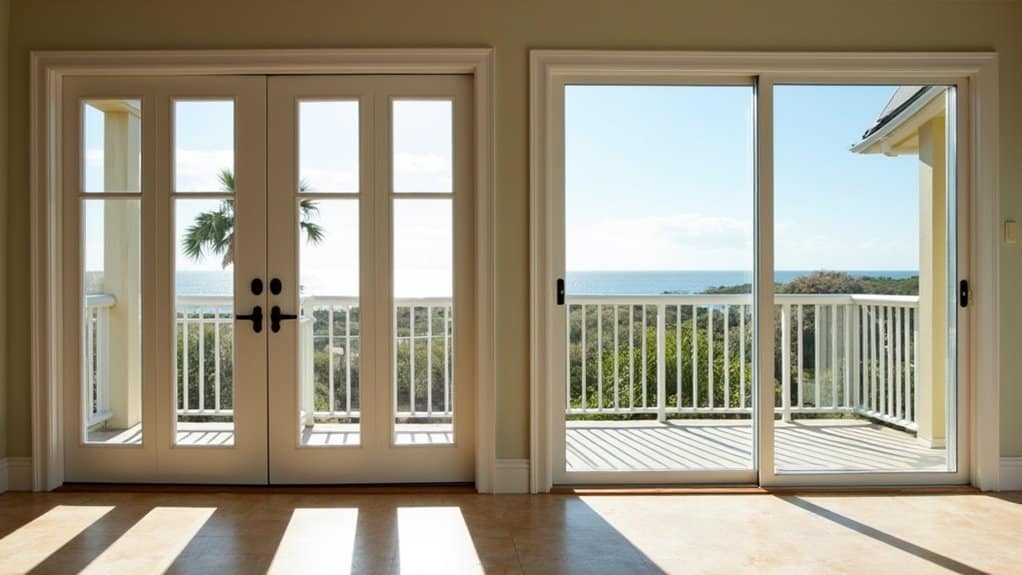
Because energy efficiency depends far more on glazing, frame material, and installation quality than on whether a door swings or slides, you can’t assume one style automatically outperforms the other in Florida’s climate. A hurricane rated sliding door often gains an edge through tighter seal consistency and fewer swing-related alignment issues, but a properly sealed French door can match it when built for airtight closure.
What actually drives energy efficiency:
- Double- or triple-pane laminated glass with low-E coatings to reduce solar heat gain
- Argon gas fills between panes for added thermal insulation
- Frame material quality affecting conductivity and long-term seal compression
- Code-compliant installation preventing air infiltration around jambs and tracks
For Florida, choose the best-glazed, best-sealed product, sliding patio doors or French, regardless of operation.
Which Door Stays Secure and Lasts Longer?
When you’re weighing protection and longevity for a Florida coastal install, focus on three factors: impact glass break-in resistance, required storm certifications, and frame material durability. You’ll want laminated impact glass and Miami-Dade HVHZ-approved certification on either door style, since that’s the code marker proving resistance to wind-driven debris and water infiltration. Whether you choose French doors or a slider, the frame material, reinforced aluminum or steel, determines how well your door resists corrosion and pressure loads over years of salt-air exposure.
Impact Glass Break-In Resistance
Although both impact French doors and sliding patio doors share the same core defense, laminated glass bonded with a PVB interlayer, they don’t deliver identical break-in resistance once you factor in frames, locks, and seam count. The glass itself buys you time: a struck panel cracks but stays attached, slowing forced entry rather than guaranteeing it. Your real impact glass break-in resistance depends on what surrounds that glass.
- A multi-point locking hurricane door engages the top, middle, and bottom, distributing prying force across the frame.
- Reinforced steel or aluminum frames resist bending and separation under storm pressure.
- Sliding doors add anti-lift devices, foot bolts, and track locks against panel removal.
- French doors need reinforced strike plates, hinges, and meeting stiles to match.
Required Storm Certifications
Once you’re shopping for impact doors in Florida’s wind-borne debris regions, the certification label matters more than the style on the showroom floor. Both French doors and hurricane patio doors need the same core framework: Florida Product Approval (FPA) or Miami-Dade Notice of Acceptance (NOA). Under the 2023 Florida Building Code, all glazed openings must meet ASTM E1996, ASTM E1886, and TAS 201-203. That means surviving a large-missile test, a 9-pound 2×4 fired at 50 feet per second, followed by 9,000 cycles of positive and negative pressure, plus water and air leakage testing. If you’re in an HVHZ zone across southeast Florida, you’ll need stricter approval. Don’t assume either style is storm-ready without the right label and design pressure rating for your site.
Frame Material Durability
Durability comes down to three frame materials, aluminum, fiberglass, and steel, and how well each holds up against Florida’s salt air, humidity, and wind-driven debris. The frame you pick determines whether your door stays safe and rigid through decades of coastal exposure.
- Aluminum: Strong strength-to-weight ratio, ideal for wide openings; reinforced frames in hurricane french doors add structural durability when paired with stainless hinges and corrosion-resistant anchors.
- Fiberglass: Resists moisture better than wood, delivers solid impact performance, and avoids metal corrosion concerns, great for low-maintenance, long service life.
- Steel: Premium rigidity and protection, but demands protective coatings and corrosion-resistant hardware to survive salt air.
- Sliding tracks: Frame stiffness, track quality, and reinforced jambs prevent water infiltration and lock-area weak points.
Match frame, hardware, and installation precisely.
Maintenance Demands for Sliding vs. French Doors
Because both door styles face the same wind-driven sand, salt spray, and humidity along Florida’s coast, you’ll find their maintenance demands diverge in predictable ways. Sliding doors concentrate upkeep on track cleaning, roller inspection, and glass washing, while French doors add hinge alignment, latch checks, and more weatherstripping surfaces at the center seam.
| Task | Sliding Doors | French Doors |
|---|---|---|
| Tracks/Hinges | Clean tracks, check rollers | Inspect hinges, alignment |
| Seals | Periodic checks | Frequent replacement |
| Material | Vinyl/aluminum, low upkeep | Wood needs refinishing |
You’ll spend less time servicing sliders overall, since they expose fewer movable parts to coastal wear. If you choose wood French doors, plan for protective coating renewal to resist UV and moisture degradation.
How to Pick the Right Impact Door for Your Home
Where do you start when picking an impact door for your Florida coastal home? Begin with code compliance, then match performance to your site exposure. Verify Florida Product Approval or Miami-Dade NOA for the exact model, confirming the notice of acceptance number reads “NOA XX-XXXX.XX.” Then check the design pressure against your wind zone, prioritizing windward-facing and large glazed openings. Don’t overlook impact glass and construction details, since these determine real-world storm performance. Hurricane rated front doors provide an additional layer of safety against severe storms. Many homeowners in coastal areas prioritize these doors due to their enhanced durability and resistance to wind and rain.
Start with code compliance, then match performance to your site exposure, because real-world storm protection depends on getting both right.
- Confirm DP/PG ratings of 60, 70 PSF for coastal properties
- Verify laminated impact glass with a visible 0.090-inch PVB interlayer
- Require multi-point locking with 3, 5 points along header, sill, and jambs
- Ascertain sidelights and transoms are also impact-rated
Choose fiberglass, steel, or aluminum to suit your budget and durability needs.
Secure Your Home With a Hurricane-Rated Door
Your front door is the first line of defense against storm damage, so choosing one built for Florida weather makes all the difference. At Innovative Storm Defense serving Boynton Beach, FL, our experienced team provides trusted Storm Doors with premium materials and lasting craftsmanship. Call (561) 517-9399 today and protect your home for years to come.
Frequently Asked Questions
How Much Do Impact-Rated French Doors and Sliding Patio Doors Cost Installed?
You’ll typically pay $2,000 to $6,500 installed for impact-rated French doors, with standard double doors running $2,000 to $4,500 and sidelite configurations reaching $6,500. Sliding patio doors cost $1,500 to $8,000-plus installed, where standard 6-foot units start around $1,500 to $3,000 and multi-panel systems climb past $8,000. Your final price depends on door width, panel count, glass configuration, frame material, and your specific opening’s site conditions across South Florida.
How Many Panel Configurations Are Available for Impact Sliding Patio Doors?
You’ll find impact sliding patio doors in 2-, 3-, and 4-panel configurations. A 2-panel layout pairs one fixed and one operable panel for standard openings. A 3-panel setup stacks moveable panels over a fixed section for wider spans. A 4-panel design, often part of multi-slide systems with up to 4-track configurations, handles your largest openings. You can also choose bypass, bi-parting, or pocketing systems depending on your wall width and layout.
Can Sliding Doors Pocket Into the Wall to Disappear Completely?
Yes, you can get pocket sliding doors that slide into a wall cavity and disappear completely when open. You’ll need a wall deep enough to house the full panel, with framing free of switches, plumbing, or insulation conflicts. For your Florida home, make sure you choose a product-specific impact-rated, code-compliant system tested for your wind-load zone, the pocket mechanism alone won’t deliver storm protection. Retrofits work but add framing complexity.
Which Door Style Works Best for Pool Deck Access?
Sliding patio doors usually work best for your pool deck access. They don’t need swing clearance, so you’ll save space for furniture and foot traffic near the deck. You’ll also get uninterrupted sightlines to the pool and smooth operation for frequent movement. Choose impact-rated sliders with laminated glass, heavy-duty rollers, and reinforced jambs that meet HVHZ/Miami-Dade compliance. Multi-panel configurations handle wider spans, and Low-E coatings cut your South Florida cooling demand.
How Long Does Professional Installation of Impact Doors Typically Take?
You’ll typically see each impact door installed in a couple of hours, though tricky access or upper-floor work can push that to four. Most Florida home projects wrap in 1, 3 days, depending on how many openings you’re replacing. But don’t forget the lead time: custom impact units usually run 6, 12 weeks in production, especially during hurricane season. Permits and inspections can also stretch your overall timeline beyond actual labor hours.